
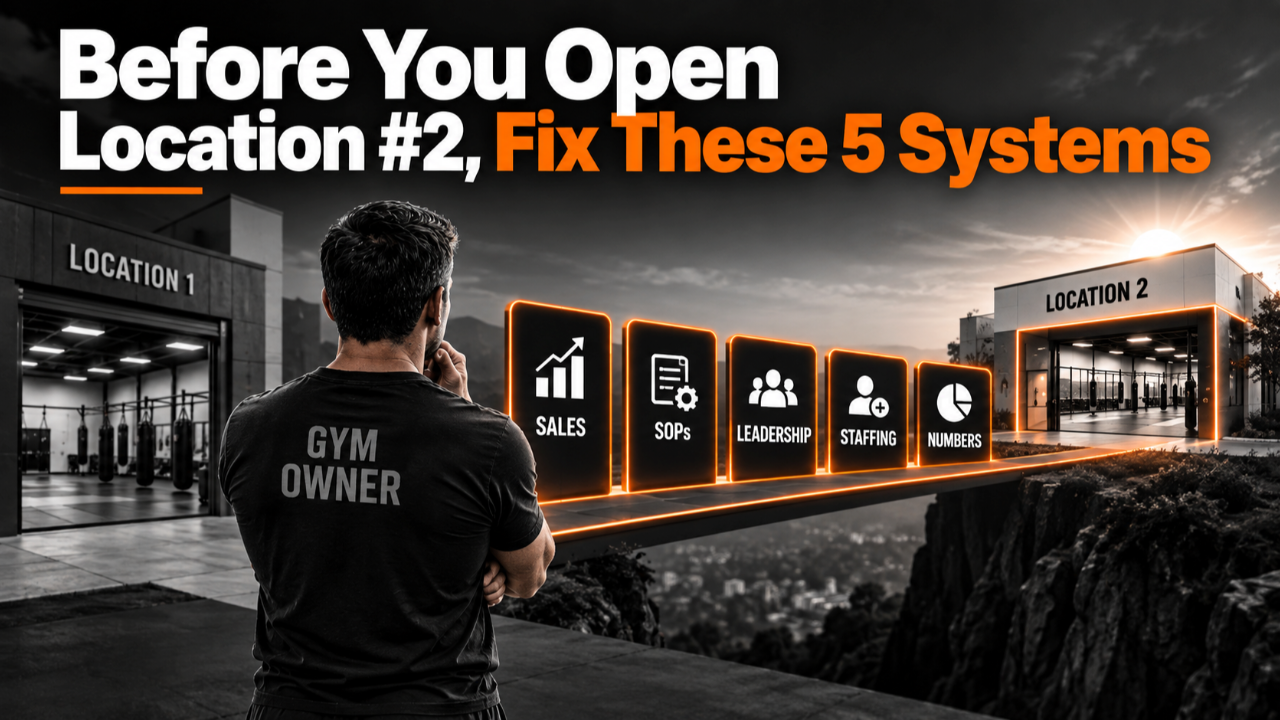
Before You Open Location #2, Fix These 5 Systems
Oct 12, 2026A second location is exciting.
Another building. Another team. Another market. More members. More revenue.
But location #2 does not give you a second version of your best days.
It gives you a second version of everything.
If your sales process is inconsistent, you now have two inconsistent sales processes.
If staff need you to make every decision, you now have two teams calling you.
If your SOPs live mostly in your head, you now have twice as many people trying to figure out how things are supposed to work.
That is why the question before opening another martial arts gym should not simply be:
Can we afford the second location?
It should also be: Can we duplicate the first location without duplicating its problems?
Before you start negotiating leases or ordering mats, make sure these five systems are ready to scale.
- Fix the Sales System
If the owner is still the best — or only — person who can consistently turn a prospect into a member, location #2 will expose that immediately.
You cannot personally handle every lead, trial, and membership conversation at two locations forever. Your sales process needs to work through a team. That means there should be a clear path from:
Lead → Contact → Appointment → Show → Sale → Follow-Up
And everyone involved needs to know what happens next.
Who responds to new leads?
How quickly?
What happens when they do not answer?
Who confirms appointments?
Who handles the trial?
Who presents the membership?
Who follows up if the prospect leaves without joining?
If those answers change depending on who happens to be working, you do not yet have a repeatable system.
The test:
Pull the last 30 days of sales activity. Compare results when you handled the prospect versus when your team handled the prospect. If conversion drops dramatically whenever the owner is removed, that is a system you should strengthen before expansion.
Location #2 needs a sales process, not a heroic owner.
- Fix the Operating SOPs
Your first location probably has dozens of processes that work because everybody already knows what to do.
That familiarity disappears when you start building a new team. Location #2 will need clear standards for things like:
- opening and closing,
- lead handling,
- trial preparation,
- new-member onboarding,
- billing questions,
- freezes and cancellations,
- member communication,
- class coverage,
- incidents,
- cleaning,
- front-desk responsibilities,
- and escalation procedures.
But having documents is not enough. The SOP needs to reflect what actually works in the first gym.
The test:
Choose five recurring processes. Give the SOPs to someone who did not create them. Can that person complete the process correctly without asking the owner to fill in the missing pieces?
If not, the SOP is not finished.
The goal is not to create a giant operations manual. It is to make the most important parts of the member and employee experience repeatable.
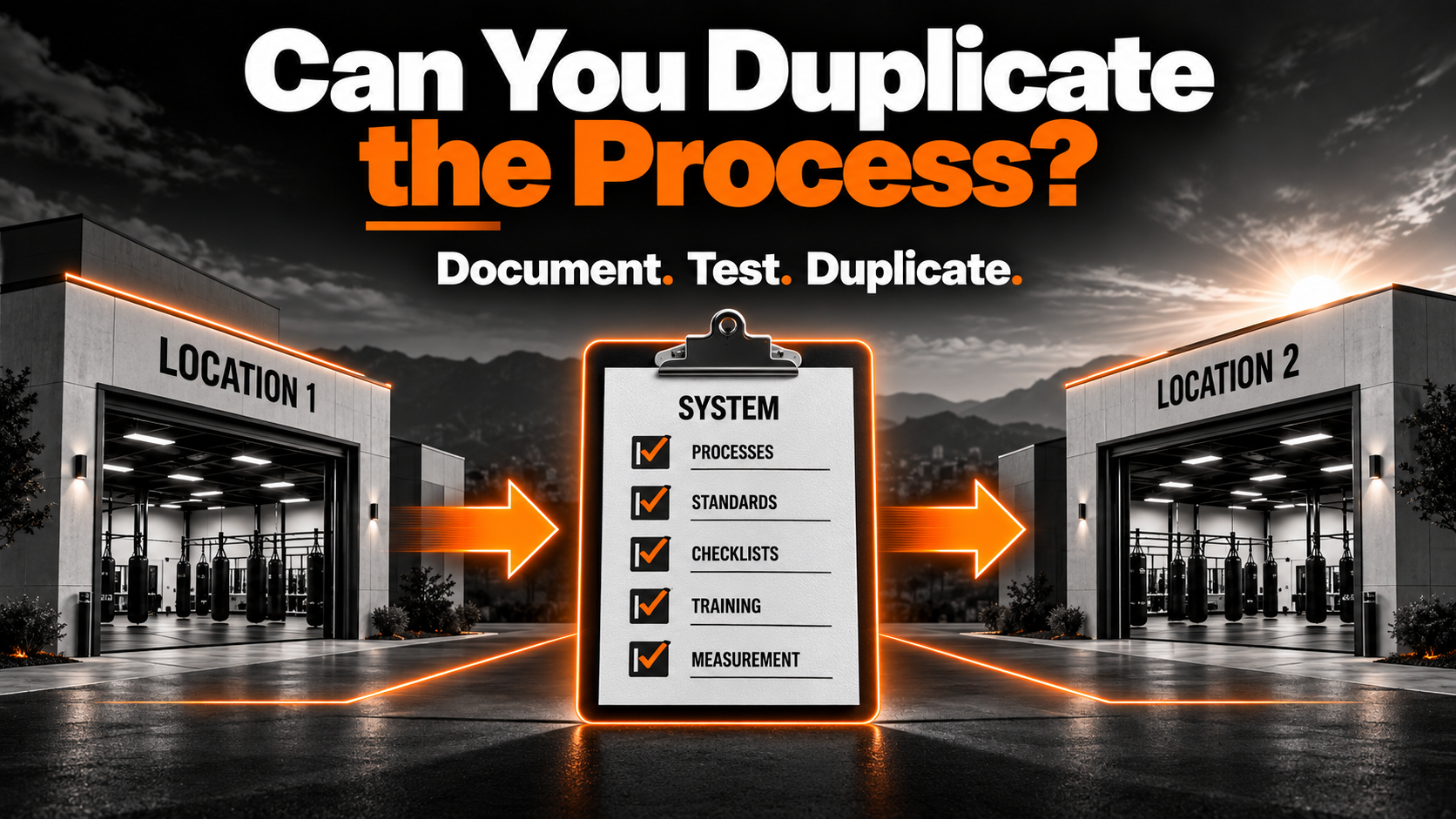
- Fix the Leadership System
A second location needs more than another group of employees. It needs someone capable of protecting the standard when you are somewhere else.
That is a different job.
- A good instructor may not automatically be a good manager.
- A strong salesperson may not know how to hold a team accountable.
- A loyal employee may not be ready to make difficult decisions.
Before opening location #2, you need to understand who is responsible for leadership at each location.
Someone needs to know:
- whether leads are being handled,
- whether staff are following processes,
- whether member issues are being resolved,
- whether classes are properly staffed,
- whether numbers are slipping,
- and when something genuinely needs owner involvement.
The test:
Ask yourself one question: If I spent the next 30 days focused almost entirely on opening location #2, who would run location #1?
If the answer is still “me,” expansion is going to be painful. Your second location should not create your first management system.
Build the management layer before you need it.
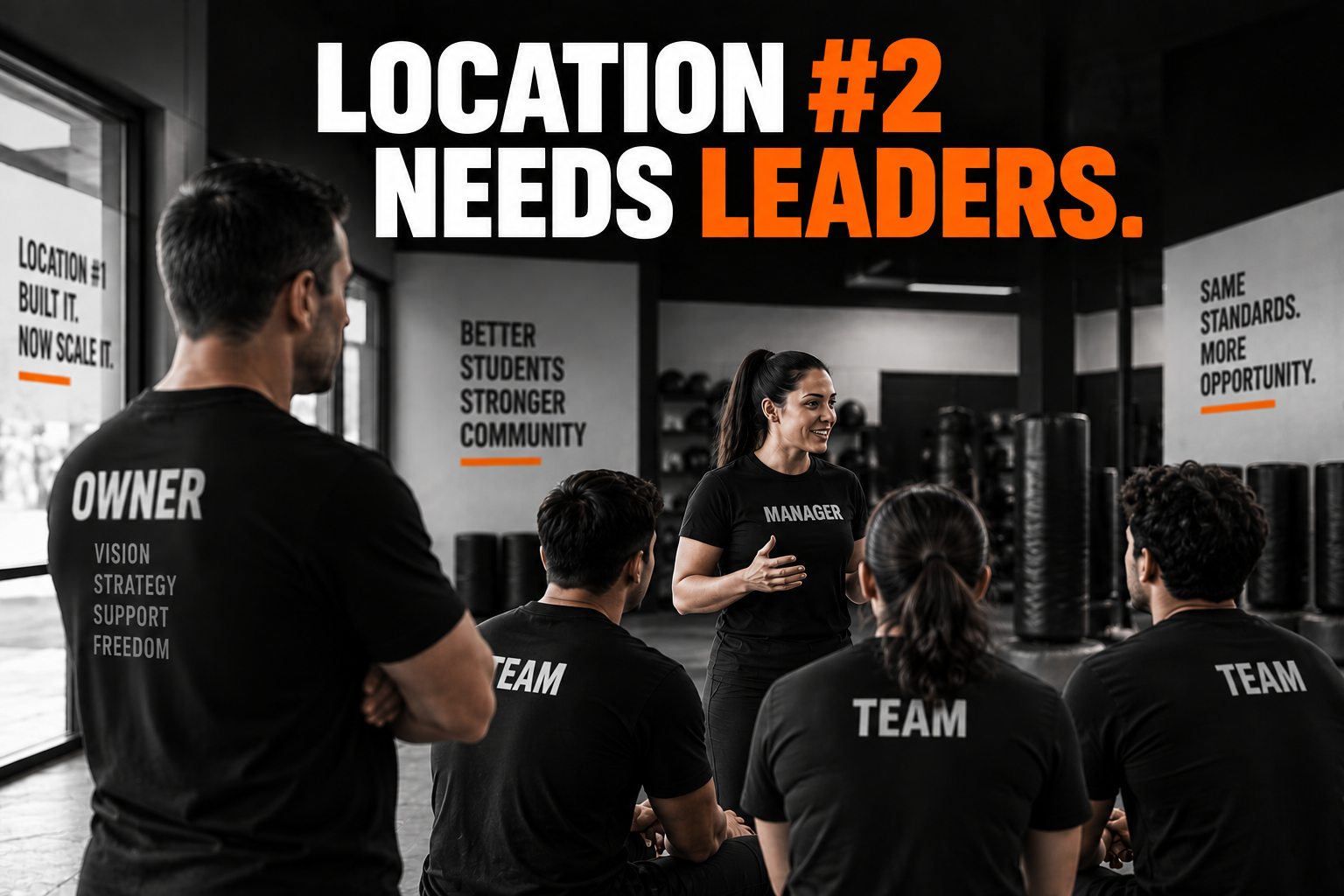
- Fix the Staffing and Training System
Opening another location means you need more people.
That sounds obvious.
What owners often underestimate is how much harder it becomes when hiring, onboarding, and training are still informal. If new staff learn mostly by watching whoever happens to be working that day, consistency will be difficult to reproduce.
You need a process for turning a new hire into someone who can perform the role independently. That may include:
- Role expectations: What exactly do they own?
- Training sequence: What do they learn first, second, and third?
- SOP access: Where do they find the process?
- Practice: Can they rehearse sales, member issues, and common situations before doing them live?
- Verification: How do you know they can actually perform the role?
The test:
Imagine you hired a new front-desk employee for location #2 tomorrow.
Could you hand the training responsibility to someone other than yourself and feel confident that the employee would learn the same standard?
If not, your staffing system is still owner-dependent.
That matters because scale requires the business to create capable people faster than the owner can personally train them.
- Fix the Numbers and Reporting System
With one location, you can sometimes get away with managing by feel.
You walk through the gym.
You know the members.
You hear the sales conversations.
You notice when classes look quiet.
You know when staff seem overwhelmed.
At two locations, physical presence stops being a reliable management tool.
You need numbers.
At minimum, you should be able to see performance in areas such as:
- leads,
- contact rate,
- appointments,
- show rate,
- close rate,
- new memberships,
- cancellations,
- active members,
- revenue,
- payroll,
- marketing spend,
- and cash flow.
And those numbers need to be visible by location. Otherwise one successful location can hide problems in the other.
The test:
Ask: If I were not physically inside either gym today, could I tell which location needed my attention?
If the answer depends on someone calling you and saying, “Things feel slow,” your reporting system needs work.
A multi-location owner should be able to see problems before they become emergencies.
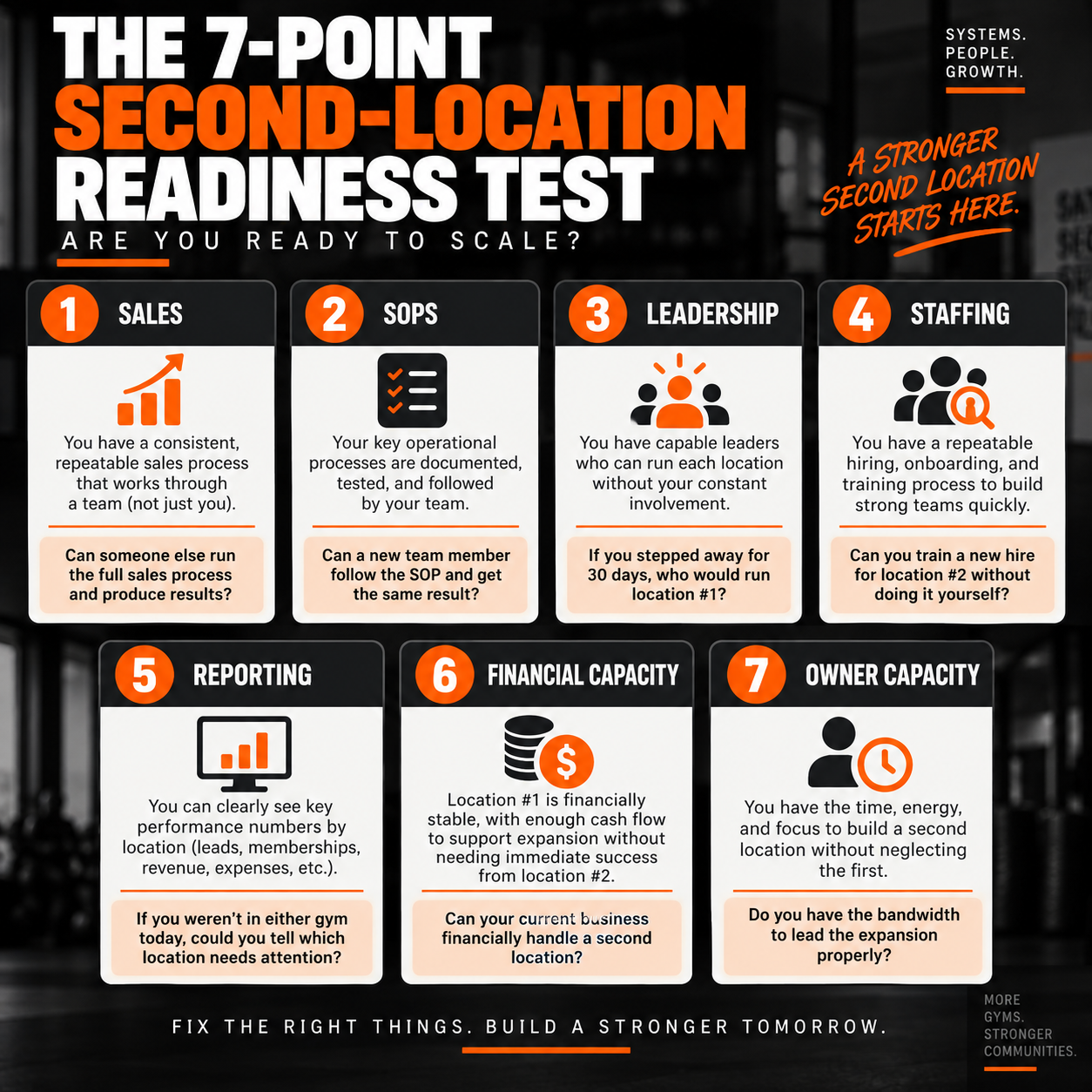
The 10-Minute Second-Location Readiness Audit
Rate each statement:
0 = No
1 = Partially
2 = Yes, consistently
- Sales: Someone other than me can run the full sales process and produce acceptable results.
- SOPs: Our most important operational processes are documented, tested, and actually followed.
- Leadership: A capable leader can run location #1 without my constant involvement.
- Staffing: We have a repeatable way to recruit, onboard, train, and evaluate new employees.
- Reporting: I can clearly see sales, membership, and financial performance without physically being in the gym.
- Financial Capacity: Location #1 has enough stability and cash flow that location #2 does not need to succeed immediately.
- Owner Capacity: I have enough time and attention available to build the second location without neglecting the first.
Score:
12–14: You may have a strong operational base for expansion.
8–11: You may be close, but identify the weak systems before committing.
0–7: The second location is likely to multiply owner pressure before it creates scale.
The score is not a permission slip. The value is finding your lowest-scoring category. That is where your expansion plan should start.
Do This Today: Run the “Duplicate It Tomorrow” Test
Choose one critical part of your gym:
- Sales.
- Member onboarding.
- Opening/closing.
- Staff training.
- Reporting.
Then ask: If location #2 opened tomorrow, could I reproduce this process there without personally running it?
If not, write down what is missing.
Maybe the process is undocumented.
Maybe the owner is still the only person who knows how to do it.
Maybe the numbers are not tracked.
Maybe the team knows the task but not the standard.
That gap is more important than choosing the paint color for location #2.
Fix the system first.
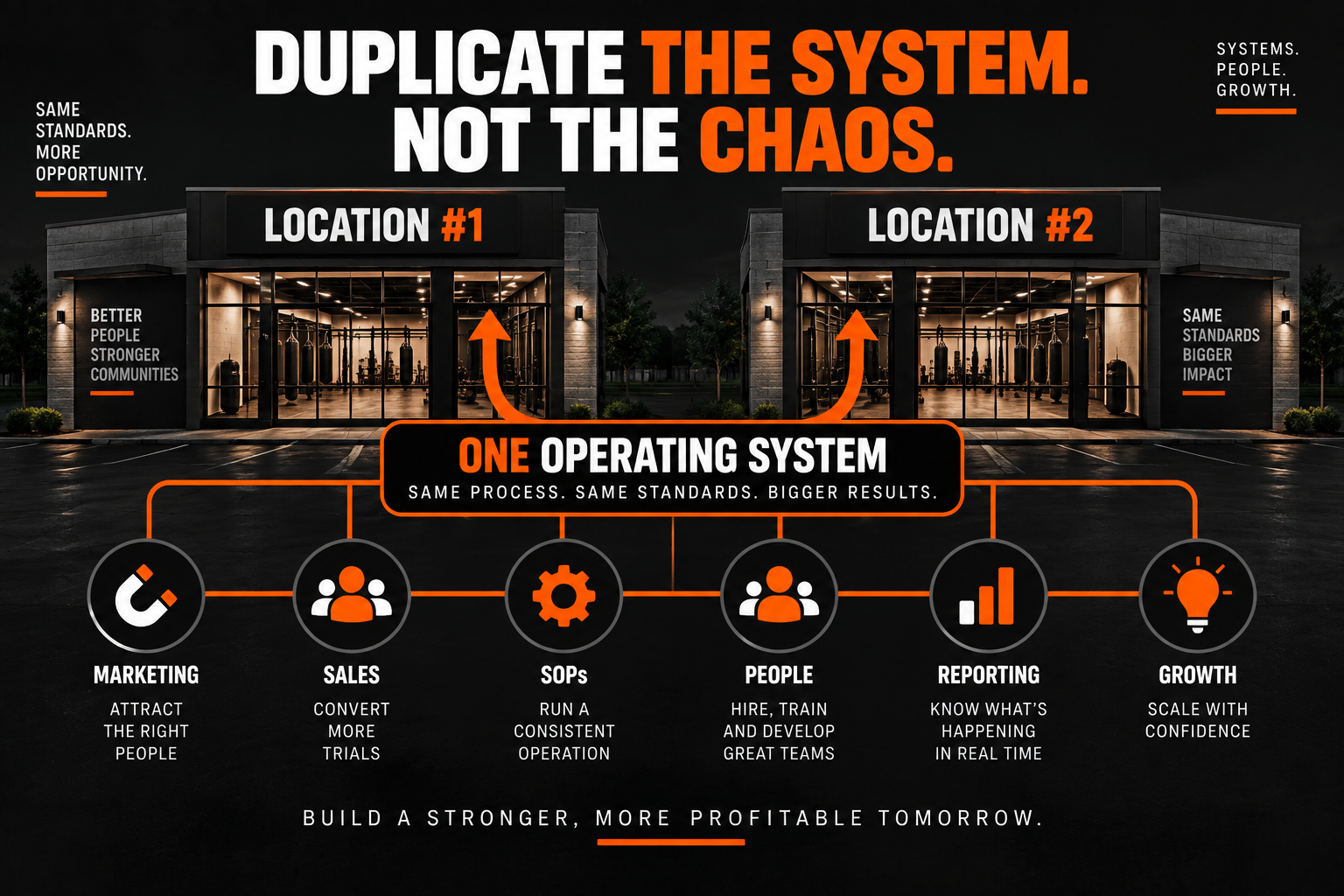
A Second Location Needs a Company, Not Just Another Gym
The first location is often built through hustle.
The owner teaches, sells, manages, fixes problems, trains employees, follows up with leads, and makes sure everything gets done. That works because one motivated person can cover a surprising amount of operational weakness.
Two locations change the game.
Now the business needs: systems that transfer, leaders who decide, staff who execute, and numbers that reveal what is happening.
That is the difference between opening another gym and building a multi-location martial arts company. The goal is not to create two buildings that need you. The goal is to build an operation that can reproduce results without reproducing owner dependency.
FAQ: Opening a Second Martial Arts Gym
What should I fix before opening a second martial arts gym?
Prioritize repeatable sales, documented operations, leadership, staff training, and clear reporting. Those systems allow the second location to reproduce the first gym's standards without requiring the owner to personally run both.
How do I know if my first martial arts gym is ready to scale?
A strong indicator is that the first location can continue producing consistent sales, member experience, and operations when the owner is not physically present every day.
Do I need a manager before opening location #2?
In most cases, you need capable leadership at one or both locations. Someone must be able to monitor execution, manage staff, solve routine problems, and protect standards without everything escalating directly to the owner.
What is the biggest risk of opening a second martial arts gym?
One major risk is duplicating weaknesses from the first location. Poor sales processes, unclear SOPs, weak leadership, inconsistent staff training, and limited financial visibility become harder to manage when they exist in multiple locations.
Build the System Before You Duplicate It
The question is not whether you can find another building.
It is whether the business inside the first building is ready to be reproduced.
Before location #2:
- Fix the sales system.
- Document the operation.
- Develop the leaders.
- Build the training process.
- Know the numbers.
Then expansion becomes much less dependent on hope. You are no longer trying to recreate success from memory. You are duplicating a business model you understand.
Thinking about opening location #2? It’s one of the major conversations happening at Combat Business Live, October 23–24 in Cresson, Texas.
VIP guests begin Friday with executive hot seats, the DriveXotic experience, and dinner.
On Saturday, Chase Halme will share an inside look at what it has been like working with his dad while opening a second location, including the realities of growing the business without destroying the family relationship.
The event will also feature sessions on using AI to reduce payroll costs, dominating social media to grow beyond $100,000 in monthly revenue, building and positioning a gym for a seven-figure sale, and purchasing the building your gym operates from.
Then, on October 30, attendees will reconnect for a live implementation webinar to turn what they learned into clear next steps.
Because opening another location is not just about finding another building.
It’s about building a business and a working relationship—that can handle the growth.
→ See Event Details & Reserve Your Seat
