

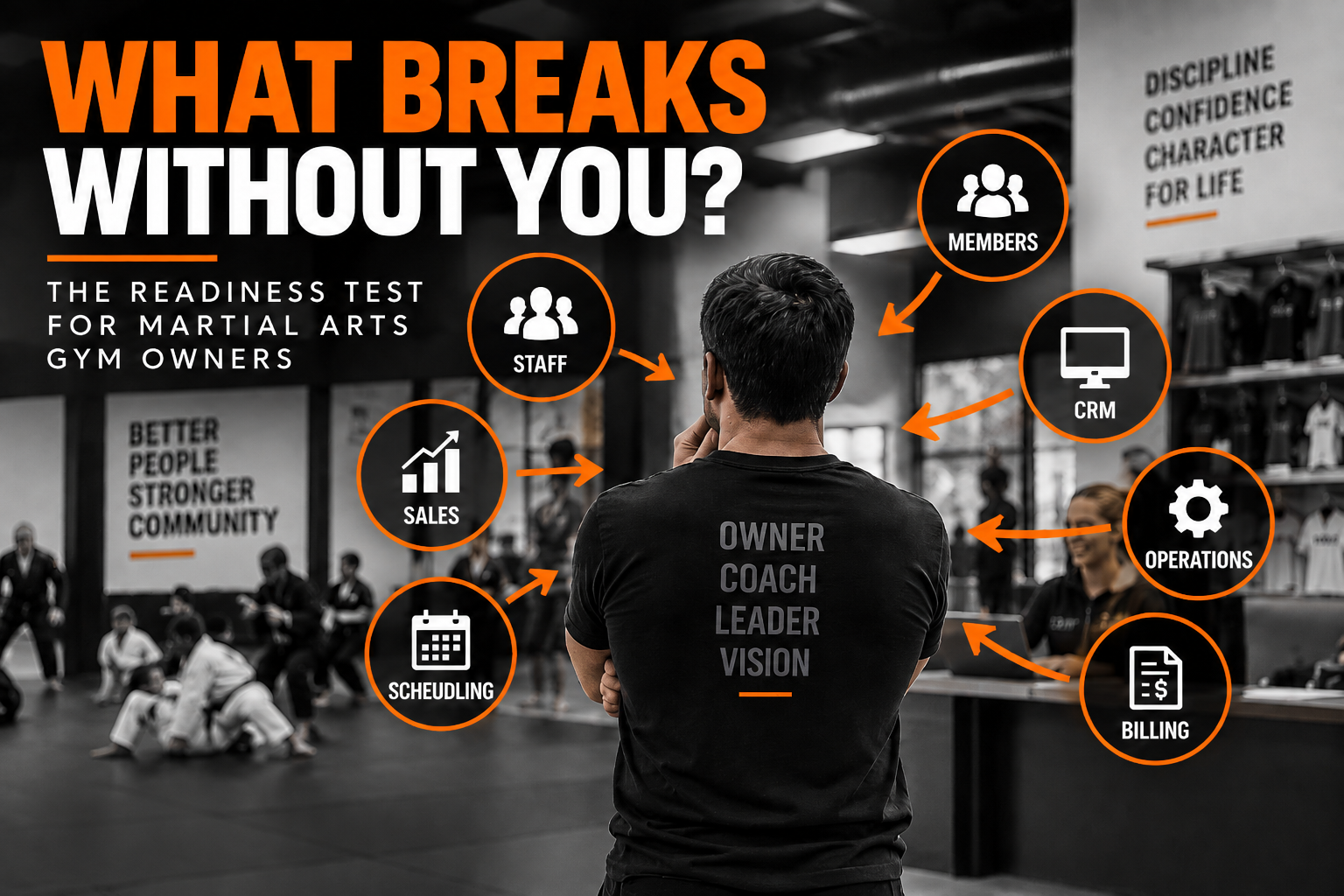
What Breaks Without You? The Readiness Test for Martial Arts Gym Owners
Sep 28, 2026Most martial arts gym owners know when their business is busy.
They know when classes are full, leads are coming in, staff schedules are packed, and revenue is moving in the right direction. But there is another question that tells you much more about the health of the business:
What stops working when you stop working?
Take yourself out of the gym for a few days.
Do leads still get followed up with?
Do trials get booked?
Do prospects get asked to join?
Can staff solve normal member problems without calling you?
Does the schedule stay covered?
Do billing questions get handled?
Or does everything slowly start waiting for the owner to come back?
That is the difference between owning a growing martial arts gym and building a business that is actually becoming more scalable.
You do not need to disappear from your company. But if the company cannot operate without your constant intervention, growth will eventually become limited by one thing:
your capacity
Here is how to find out where that dependency still exists.
1. Test Your Sales System
Start with the part of the business closest to revenue. Imagine you do not touch a new lead for the next five business days. What happens?
Does someone immediately own the inquiry?
Does the prospect get contacted?
Is the conversation recorded in the CRM?
Does follow-up continue if the prospect does not respond?
Does someone confidently book the intro?
And once the prospect walks through the door, does someone actually own the membership conversation?
A gym can have advertising, a CRM, automated texts, and a front-desk team and still have a sales process that quietly depends on the owner. The giveaway is usually this:
“If it’s an important lead, I handle it.”
That may produce results today. It does not create a business that can grow beyond you.
Look for this:
Your sales system should have a clear owner at every stage:
Lead → Contact → Appointment → Show → Sale → Follow-Up
If any stage depends on you personally noticing that something was missed, that is a system gap.

- Test Your Team’s Decision-Making
Most owners do not realize how many small decisions they make every day until they try to step away.
- A member wants to freeze.
- A parent has a concern.
- A coach needs coverage.
- Someone requests a refund.
- A front-desk employee is unsure how to handle an account.
- The team messages the owner.
Individually, none of those questions seems like a big deal. Collectively, they can consume an entire day. And if staff have learned that the safest response is always: “Let me ask the owner”, then the owner has accidentally become the decision-making system.
Your team does not need unlimited authority. They need to understand what they can decide, what requires manager approval, and what genuinely needs owner-level judgment.
Look for this:
Take the last week of questions your team asked you. Sort them into three categories:
- Staff should handle this.
- The manager should handle this.
- The owner actually needs to handle this.
You may be surprised how much of your workload belongs in the first two categories.
- Test Your SOPs Against Reality
Having SOPs is not the same as having systems. A Google Drive folder full of documents means very little if nobody uses them. The real test is whether your team can follow a process without needing the person who wrote it standing beside them.
Pick one recurring activity:
- new-member onboarding,
- lead follow-up,
- opening the gym,
- closing the gym,
- membership freezes,
- cancellations,
- staff call-outs,
- billing issues.
Then ask an employee to execute the process using the SOP.
Where do they get stuck?
What information is missing?
What happens differently in real life than it does in the document?
That is the useful part. SOPs should not describe the business you wish you had. They should help your team consistently run the business you actually have.
Look for this:
If the employee still has to ask: “But what do I do if...?”
that exception probably needs to be added to the system.
4. Test Your Management Layer
Employees complete tasks. Leaders protect standards.
That difference becomes more important as the gym grows.
If you have coaches, salespeople, and front-desk staff but the owner is still the only person checking whether things are actually happening, you have staffing — but not necessarily management.
Someone besides the owner needs to know:
- whether leads are being followed up,
- whether staff are completing responsibilities,
- whether member issues are being resolved,
- whether numbers are moving in the wrong direction,
- and when something genuinely needs escalation.
Otherwise the business can look systemized while the owner remains the invisible glue holding everything together.
Look for this:
Ask yourself: Who notices when something starts slipping before I do?
If the answer is nobody, that is a leadership gap.
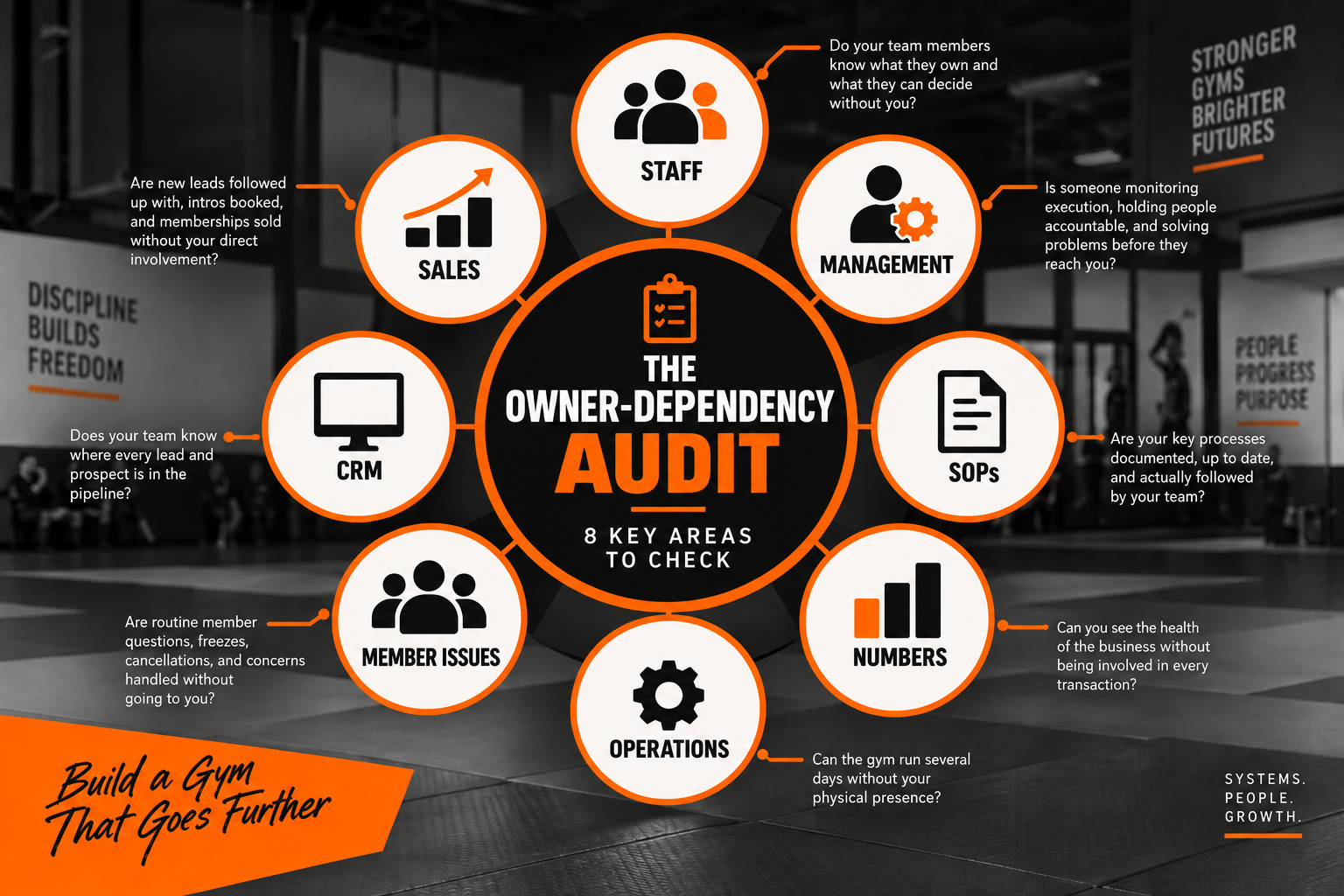
The 10-Minute Owner-Dependency Audit
You can run this today. Rate each statement from 0 to 2:
0 = Not true
1 = Sometimes true
2 = Consistently true
- Sales: New leads receive timely follow-up without me personally checking.
- CRM: My team knows exactly where every active prospect is in the sales process.
- Member Issues: Routine customer-service situations are handled without automatically escalating to me.
- SOPs: Our important processes are documented and actually followed.
- Staff: Employees know what they own and what they are allowed to decide.
- Management: Someone besides me monitors execution and holds people accountable.
- Numbers: I can see the health of the business without personally being involved in every transaction.
- Operations: The gym can run several days without my physical presence.
Score:
13–16: Your business is becoming less owner-dependent. Look for the remaining weak points rather than rebuilding everything.
8–12: You have systems, but several still depend heavily on owner involvement.
0–7: Growth will probably keep adding work to your plate until the operating system catches up.
The score itself is not the point. The useful question is:
Which category scored lowest?
That is probably where your next system needs to be built.
Do This Today: Find One Thing You Should Stop Owning
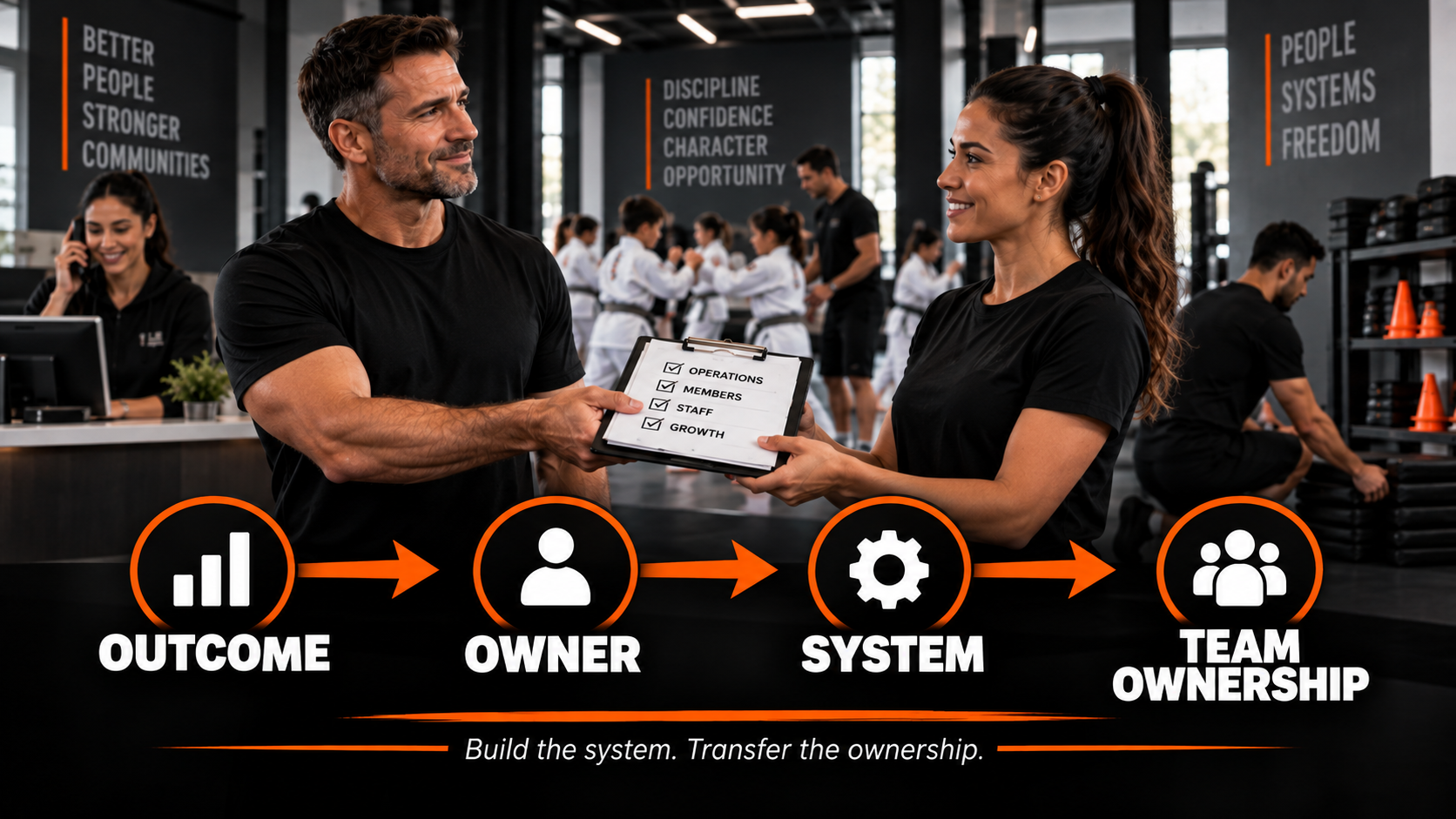
Do not try to systemize the entire business this afternoon. Pick one recurring responsibility that should no longer require you. Maybe it is:
- checking whether leads were contacted,
- approving every membership freeze,
- finding class coverage,
- onboarding new staff,
- answering the same front-desk question,
- reviewing every sales conversation.
Then do three things:
- Define the outcome. What should happen when this is handled correctly?
- Assign ownership. Who should be responsible?
- Build the rule. What process, SOP, checklist, or decision guideline would allow them to handle it without you?
That is how owner dependency actually gets reduced.
One responsibility at a time.
The Goal Is Not to Make Yourself Unnecessary
This is where some owners get uncomfortable. They hear:
“Build a business that runs without you.”
and think that means removing themselves from the gym.
It does not.
The owner may still coach.
They may still lead staff.
They may still sell.
They may still love being on the mat.
The difference is choice.
You should be doing those things because they are the highest-value use of your time or because you genuinely want to do them.
Not because everything collapses if you stop.
A scalable martial arts business gives the owner room to move toward higher-value work:
leadership, strategy, financial planning, growth, partnerships, culture, or even another location.
That capacity has to come from somewhere. Usually, it comes from better systems and stronger people.
FAQ: Making a Martial Arts Gym Less Owner-Dependent
How do I make my martial arts gym run without me?
Start by identifying the recurring decisions and tasks that automatically return to you. Assign ownership, document the expected outcome, create clear processes, and define when staff should escalate an issue.
Which martial arts gym systems should I build first?
Start with systems tied directly to revenue, customer experience, and owner workload. Lead follow-up, sales, onboarding, billing, staffing, daily operations, and member communication are usually strong priorities.
How do I know if my gym is too dependent on me?
A strong warning sign is that normal operations slow down when you are unavailable. If staff routinely wait for your approval, sales require your involvement, or recurring problems cannot be solved without you, the business is still highly owner-dependent.
Do I need a manager before I can scale my martial arts gym?
Not necessarily at every stage, but growing gyms eventually need leadership beyond the owner. Someone needs to monitor standards, execution, staff performance, and routine problems without everything flowing directly back to you.
Growth Should Create Capacity, Not Just More Work
Your gym does not become scalable because membership increases. It becomes scalable when the systems and people underneath the growth become stronger too.
That is why one of the most useful questions a martial arts gym owner can ask is not:
“How do we grow faster?”
It is:
“What would break if I stepped away?”
Find that answer.
Fix it.
Then grow.
We will be going much deeper into this at the upcoming Combat Business Live! including SOPs, massive delegation, sales systems, CRM, AI, and what it actually takes to build a martial arts business that can scale beyond the owner.
VIP guests begin Friday with executive hot seats, the DriveXotic three-car experience, and VIP dinner.
Saturday is the main event, featuring expert speakers and practical strategies you can bring back to your business.
Then, on October 30, we’ll reconnect for a live implementation webinar designed to help you turn what you learned into clear next steps.
Don’t just leave inspired. Leave ready to implement
