

Are You Actually Ready for a Second Location? 7 Signs Your First Gym Can Scale
Sep 14, 2026Opening a second martial arts gym can look like the obvious next move.
Your first location is busy. Membership is growing. Classes are full. People keep asking whether you'll ever open on the other side of town.
So naturally, the thought starts creeping in: Maybe it’s time for location #2.
Maybe.
But a second location is not just a bigger version of what you already have.
It introduces another lease, another team, another sales process, another schedule, another member base, another manager, another set of operational problems, and another place where something can go wrong.
If the first gym still depends heavily on the owner, opening a second one rarely creates freedom. It creates two businesses that depend on the owner.
That’s why the right question isn’t: Can we afford another location?
It’s: Can the first location keep performing when I am no longer physically there every day?
That is the real test.
Here are seven signs your martial arts business may actually be ready to scale.
Sign #1: Your First Location Can Operate Without You Being the Daily Problem-Solve

This is the most important one.
If every staff issue, member complaint, schedule problem, billing question, sales decision, and class-coverage emergency still finds its way back to you, the business is not yet ready to be duplicated.
You may have employees. You may even have managers. But if you are still the person everyone turns to when something gets complicated, you are still carrying a large part of the operating system inside your head.
That becomes dangerous when you open location #2.
Now you have two teams asking questions.
Two schedules changing.
Two sets of customers needing help.
Two buildings generating problems.
And you are still one person.
Here’s the test: If you disappeared from the first location for five business days, what would happen?
Would the gym continue operating at roughly the same standard?
Would sales still happen?
Would leads still get followed up?
Would classes still run?
Would billing issues get handled?
Would member problems get resolved?
Would the manager make reasonable decisions without calling you every few hours?
If the answer is no, that doesn’t mean you can never open a second location. It means the first location is showing you exactly what needs to be built first.
Sign #2: You Know Why Location #1 Is Successful
A gym can be successful without the owner fully understanding why.
Maybe you have a strong reputation.
Maybe the location is excellent.
Maybe your personality carries the culture.
Maybe one incredible salesperson is responsible for most enrollments.
Maybe a particular kids program drives the majority of revenue.
Maybe referrals are doing more of the work than your marketing.
That is all fine until you assume the same success will automatically transfer to another building.
The problem is that you cannot deliberately reproduce something you have never identified.
Here’s the play: Break location #1 down into the parts that actually drive performance. Look at:
- lead sources,
- sales conversion,
- program mix,
- average member value,
- retention,
- class capacity,
- staff performance,
- payroll,
- marketing cost,
- local demographics,
- referral volume,
- and operating margins.
Then ask: Which of these results come from a repeatable business system, and which depend on circumstances unique to this location?
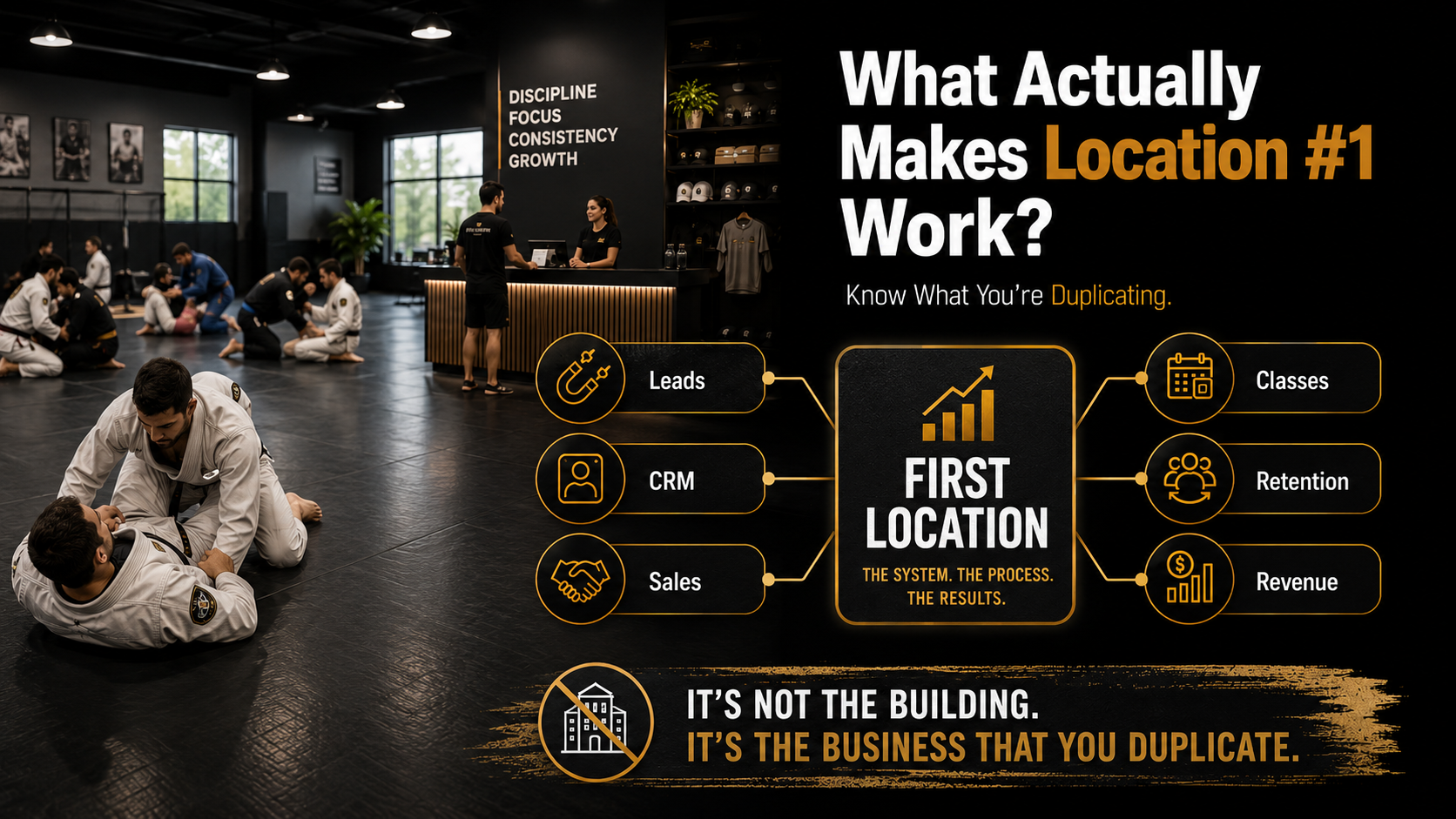
That distinction matters. You don’t want to duplicate the building. You want to duplicate the business model that makes the building work.
Sign #3: Your Sales Process Can Work Without You
This is where many owners discover they are less scalable than they thought. The owner is often the strongest salesperson in the gym.
They know the programs.
They believe in the product.
They have authority.
They understand objections.
They can read prospects quickly.
And because they are emotionally invested in the business, they tend to push the conversation forward better than anyone else. That works beautifully at one location. It becomes a bottleneck at two. You cannot personally take every sales appointment at two gyms indefinitely.
Here’s the test: Can someone else consistently take a lead through the entire process?
From:
inquiry → contact → appointment → show → membership
And can they do it at a level that produces acceptable conversion without you jumping in?
If not, you don’t necessarily have a sales system yet. You may simply have a talented owner who knows how to sell. Before opening location #2, the sales process needs to become teachable, measurable, and repeatable.
Sign #4: Your SOPs Reflect Reality, Not Theory
A folder full of SOPs does not automatically make a business systemized. The real question is whether the team actually uses them.
There is a big difference between: “We have a document for that” and “This is how the team actually handles it every time.”
Your SOPs should cover the recurring processes that protect revenue, member experience, and operational consistency. That may include:
- opening and closing,
- lead follow-up,
- trial scheduling,
- enrollment,
- new-member onboarding,
- billing issues,
- freezes and cancellations,
- class coverage,
- incident reporting,
- cleaning standards,
- member communication,
- and escalation procedures.
If those processes change every time a different employee handles them, duplicating the operation becomes very difficult.
Here’s the play: Don’t ask whether you have SOPs. Ask: If I hired a new team for location #2, could these systems help them reproduce the standard of location #1?
If the answer is no, keep building.
Sign #5: You Have Leadership Depth, Not Just Employees
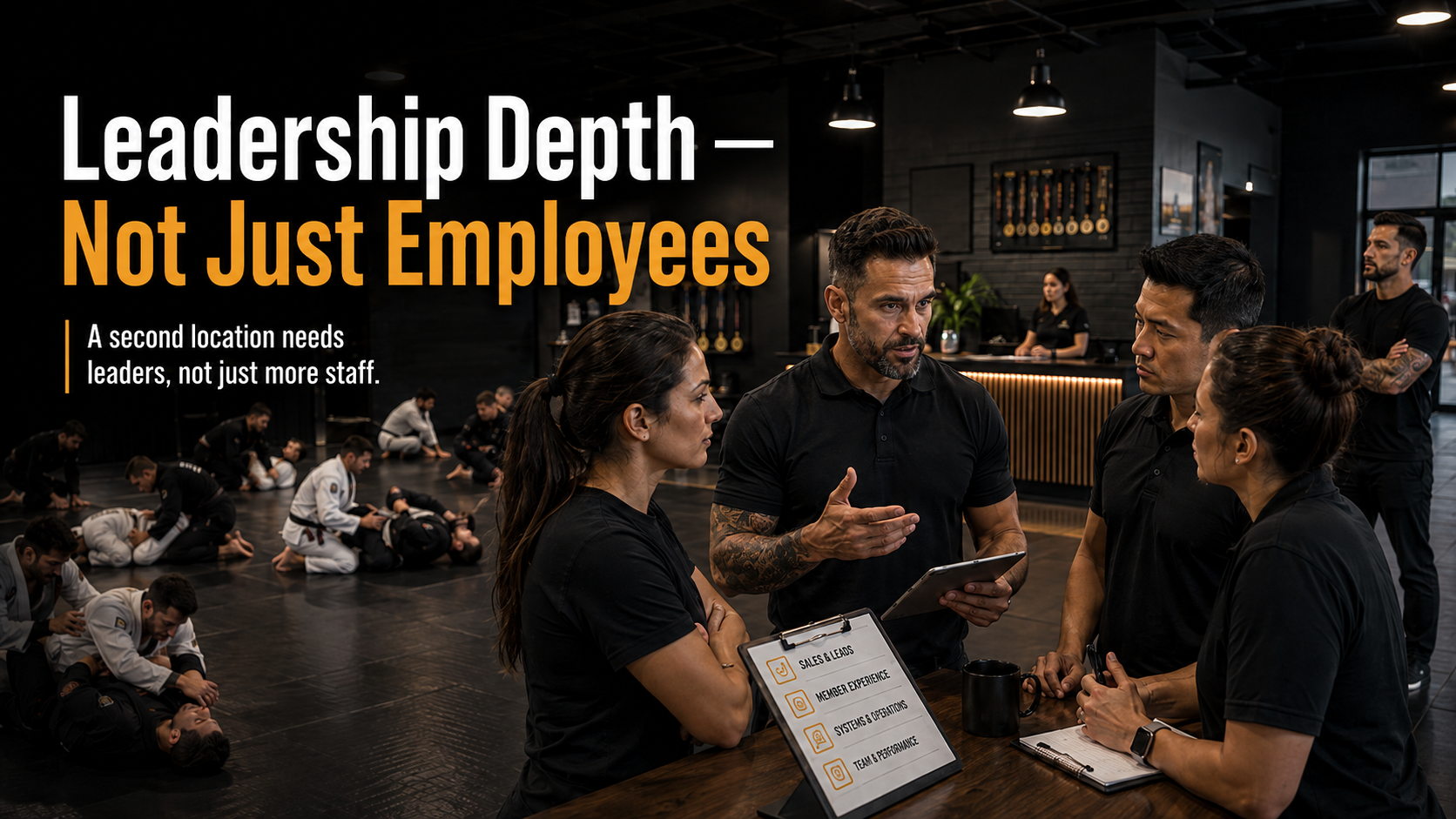
A second location needs more than coaches and front-desk staff. It needs leadership.
Someone has to protect standards when the owner isn’t there.
Someone has to hold staff accountable.
Someone has to notice when lead follow-up is slipping.
Someone has to deal with minor member issues before they become major ones.
Someone has to manage the schedule, enforce systems, communicate expectations, and make decisions.
If the only person capable of doing that is the owner, the second location will constantly pull you back into operations.
Here’s the test: Who could run location #1 if you spent most of your time opening location #2? Not “who could cover classes.” Who could actually run the business?
If you cannot immediately name that person, leadership development may be a bigger priority than real estate.
Sign #6: Location #1 Has Enough Financial Strength to Survive the Expansion
A second location usually consumes cash before it produces it.
There can be deposits, buildout costs, equipment, signage, technology, legal expenses, marketing, payroll, insurance, and months of operating expenses before the new location reaches healthy membership.
That means the first location cannot merely be “doing okay.”
It needs enough financial stability that the expansion does not put the entire company at risk. The wrong time to open location #2 is when you need location #2 to immediately rescue the economics of location #1.
Here’s the play: Before signing anything, understand:
- current operating profit,
- cash reserves,
- debt obligations,
- owner compensation,
- projected startup costs,
- expected break-even membership,
- monthly fixed costs,
- realistic sales ramp,
- and how long the business can carry the new location if growth is slower than expected.
Optimism is not a financial plan. If the new gym takes six months longer than expected to stabilize, you need to know what happens next.
Sign #7: You Have a Reason to Open Location #2 Beyond “We’re Busy”

A busy gym does not automatically need another location. Sometimes the better move is to improve the economics of the first one.
Add classes.
Raise capacity.
Improve pricing.
Increase retention.
Strengthen premium programs.
Improve scheduling.
Expand the facility.
Add private lessons.
Improve conversion.
A second location may absolutely be the right move, but it should solve a specific strategic problem.
- Maybe there is demand in a neighboring market your current location cannot serve.
- Maybe class capacity is genuinely maxed out.
- Maybe the brand has enough awareness to support another location.
- Maybe your systems and leadership are strong enough that geographic expansion is the most logical next step.
That is different from opening location #2 because growth feels exciting.
Here’s the question: What business problem does the second location solve?
If you cannot answer that clearly, you may be expanding before you have a reason to.
Ready to Scale vs. Ready to Get Busier
Here’s the distinction.
|
❌ Not Ready Yet |
✅ More Scale-Ready |
|
Owner still solves most daily problems |
Team handles routine operations |
|
Success depends heavily on the owner |
Core systems produce consistent results |
|
Sales happen because the owner closes |
Team can run a measurable sales process |
|
SOPs exist but are rarely followed |
SOPs guide daily execution |
|
Staff are good, but leadership is thin |
Managers can operate independently |
|
Location #1 has tight cash flow |
Expansion can be funded without destabilizing the business |
|
Second location is mostly an exciting idea |
Expansion solves a clear strategic need |
|
Owner assumes location #2 will work the same way |
Business understands what must be replicated |
Before You Sign a Second Lease, Run This 7-Question Test
Score each one honestly. Give yourself one point for every statement that is true.
- The first location can operate for a full week without me being physically present.
- I know the key numbers that make location #1 profitable.
- Someone other than me can consistently handle sales.
- Our most important operating processes are documented and actually followed.
- I have at least one leader capable of running a location.
- We have enough financial strength to absorb a slower-than-expected launch.
- We have a clear strategic reason for opening in the new market.
If you scored:
6–7: You may have the foundation for expansion. Now the work becomes market selection, financial modeling, leadership planning, and execution.
4–5: You may be close, but the gaps matter. Fix the weak points before multiplying them.
0–3: A second location will probably create more operational pressure than scale. Build the first location into a stronger business before duplicating it.
This isn’t a scientific formula. It is a forcing mechanism. Expansion decisions get expensive quickly, so you want to expose weaknesses while they are still cheap to fix.
What Actually Needs to Be Duplicated?
When gym owners think about location #2, they often think about the visible pieces.
Another mat space.
Another sign.
Another website page.
Another front desk.
Another schedule.
But those are not the hardest things to duplicate.
The real work is duplicating the systems underneath them.
You need a repeatable:
Lead Generation System
- Can you reliably generate demand in a second market?
- A strong first-location reputation does not guarantee immediate awareness somewhere else.
Sales System
- Can another person convert leads without relying on the owner?
Staffing System
- Can you recruit, train, schedule, manage, and retain good people?
Operating System
- Can both locations deliver roughly the same customer experience?
Management System
- Who owns accountability at each location?
Reporting System
- Can the owner quickly see what is working and what is slipping without physically standing inside both gyms?
This is where scaling becomes less about “opening another gym” and more about building a company capable of operating multiple gyms.
That is a completely different challenge.
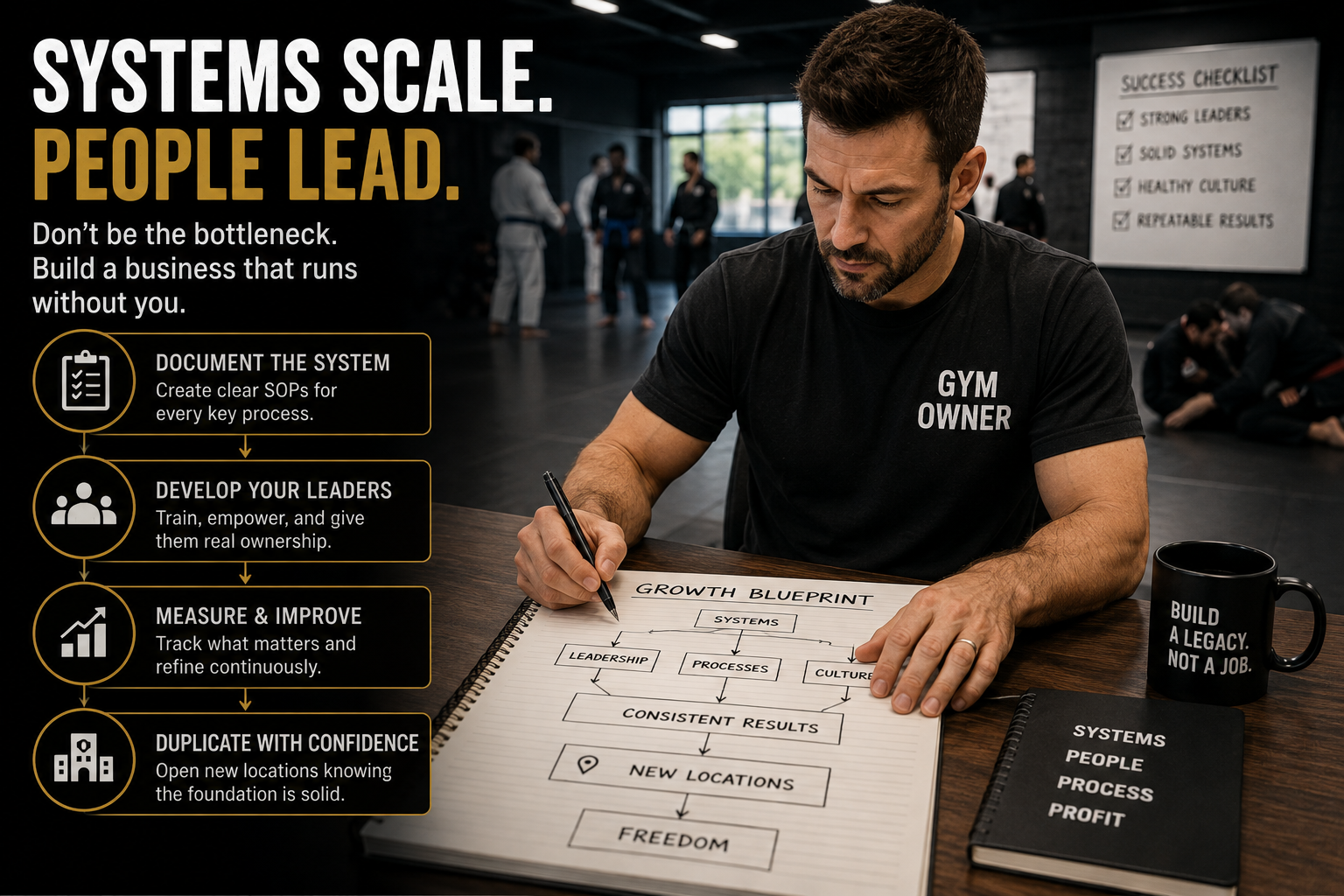
Location #2 Should Be a Copy of the System — Not a Copy of the Owner
Your first gym may have been built on hustle.
You taught.
You sold.
You cleaned.
You followed up.
You hired.
You fixed everything.
That is often how the first location gets off the ground. But that model does not duplicate well.
If location #1 works because you personally hold everything together, the business has not yet become scalable.
The real milestone is when the operation starts producing strong results through people, systems, standards, and accountability.
Then the owner can move from being the person who runs the gym to the person who builds the company.
That is the transition second-location owners need to make.
FAQ: Opening a Second Martial Arts Gym Location
When should I open a second martial arts gym?
Consider expansion when your first location is operationally stable, financially healthy, and able to perform without your constant involvement. You should also understand the systems driving your current results and have a clear reason for expanding into another market.
How profitable should my first martial arts gym be before opening another location?
There is no universal profit number because rent, payroll, startup costs, and business models vary. The important question is whether location #1 produces enough reliable cash flow and reserves to support the expansion without putting the original business at risk if location #2 takes longer than expected to reach break-even.
Should my second martial arts gym use the same programs as my first?
Usually, your strongest and most repeatable programs provide the best starting point, but the local market still matters. The goal is not to blindly copy every detail of location #1. It is to reproduce the systems and programs that drive results while adapting appropriately to the new market.
Do I need a manager before opening a second martial arts gym?
In most cases, strong leadership is critical. Someone needs to be capable of running day-to-day operations at one location while the owner focuses attention elsewhere. If the owner remains the only effective manager, opening a second site usually increases owner dependency rather than reducing it.
How do I know whether my martial arts gym systems are scalable?
Ask whether a trained employee or manager can consistently execute the process without relying on information stored only in the owner's head. A scalable system has clear ownership, documented expectations, measurable results, and a defined escalation path.
What is the biggest mistake martial arts gym owners make when opening a second location?
One of the biggest mistakes is assuming that success at location #1 will automatically reproduce itself. A second location magnifies weak sales, management, staffing, financial, and operational systems. The first business should become intentionally repeatable before you attempt to duplicate it.
Is opening a second martial arts gym the best way to grow revenue?
Not always. Sometimes improving pricing, sales conversion, retention, class capacity, premium services, or operational efficiency at the first location can create better returns with less risk. Expansion should be a strategic choice, not the default definition of growth.
Don’t Duplicate Chaos
A second location can be a powerful growth move.
It can create more revenue, greater brand reach, stronger enterprise value, and opportunities for your team. But it also removes the illusion that the owner can personally hold everything together.
With one gym, weak systems can sometimes be hidden by effort.
With two, they become obvious.
That’s why the best time to build a scalable operating system is before you need it.
And it’s one of the conversations we’ll be digging into at the upcoming Combat Business Tribe Event.
Paul and Chase will break down what it really takes to move into a second location, while the rest of the event tackles the systems that make expansion possible in the first place — sales, CRM, SOPs, delegation, leadership, and AI-powered leverage.
Because the goal isn’t simply to own more locations.
The goal is to build a business capable of running more locations well.
Don’t just open another gym. Build something you can actually scale.
