

Is Your Gym Growing or Are You Just Getting Busier?
Aug 31, 2026More members.
More classes.
More leads.
More staff.
More revenue.
That sounds like growth.
Until you realize it also means more texts to answer, more fires to put out, more staff questions, more sales calls, more schedule changes, more problems landing directly on your desk.
Your gym got bigger. But your job got bigger too. That is not the kind of growth most martial arts gym owners signed up for. Because there comes a point where adding more members to an owner-dependent business doesn't create freedom.
It creates pressure.
And if every increase in revenue also creates an increase in the amount of work that only you can do, you haven't built a scalable business yet.
You've built a busier one. Here's how to tell the difference.
Sign #1: Every Decision Still Comes Through You
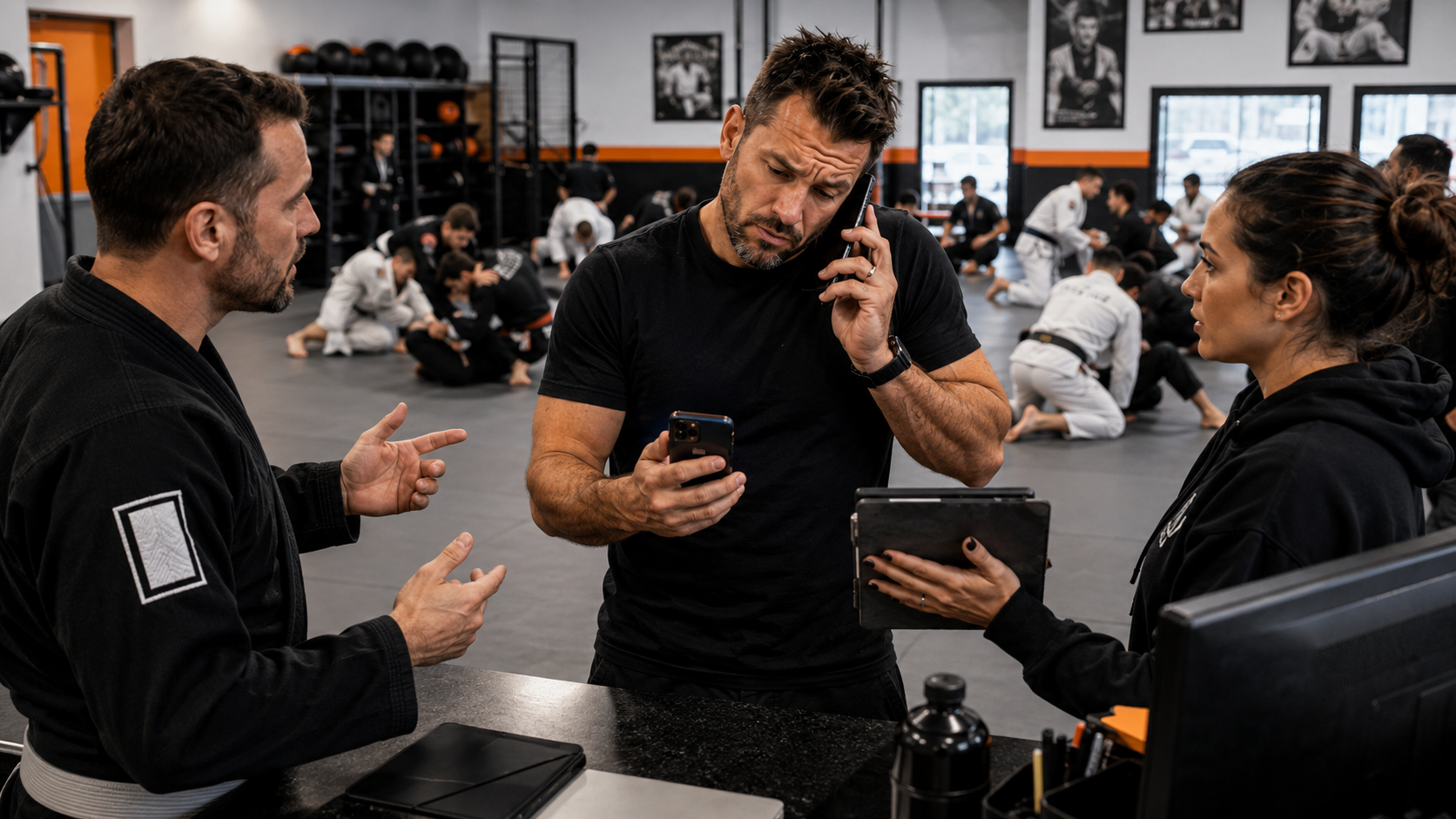
A staff member needs to comp a membership. They ask you.
A parent complains. They ask you.
Someone wants to freeze an account. They ask you.
A coach needs coverage. They ask you.
A lead wants a special deal. They ask you.
You may call this being involved. Eventually, it becomes a bottleneck. If your team cannot handle normal situations without waiting for you to make the call, the problem usually isn't that your team is incapable. It's that you've never clearly documented what they are empowered to decide.
Here's the play: Start with the questions your team asks you repeatedly.
If you have answered the same question five times, it probably belongs in a process, policy, checklist or decision framework.
The goal isn't to remove yourself from every decision. It's to stop spending your time making the same decisions over and over again.
Sign #2: Your Team Knows Their Job, But Not Your Standard
This is where a lot of delegation falls apart. You tell someone:
"Follow up with the leads."
"Handle the new student onboarding."
"Call the members who haven't been in."
"Make sure the gym gets opened correctly."
Technically, you delegated. But you didn't create a system. What does "follow up" actually mean? How quickly? How many times? By text, phone or email? What gets recorded? When does the lead get marked dead? When should the employee escalate something to you?
If those answers exist only in your head, your employee has two choices:
- Guess.
- Ask you.
Neither one scales.
Here's the play: Stop documenting jobs. Start documenting outcomes.
Instead of:
Follow up with new leads.
Build:
New lead enters CRM → first contact within X minutes → follow-up sequence begins → staff completes personal outreach → outcome gets recorded → exceptions get escalated.
Delegation works when the person knows what success looks like without needing you standing beside them.
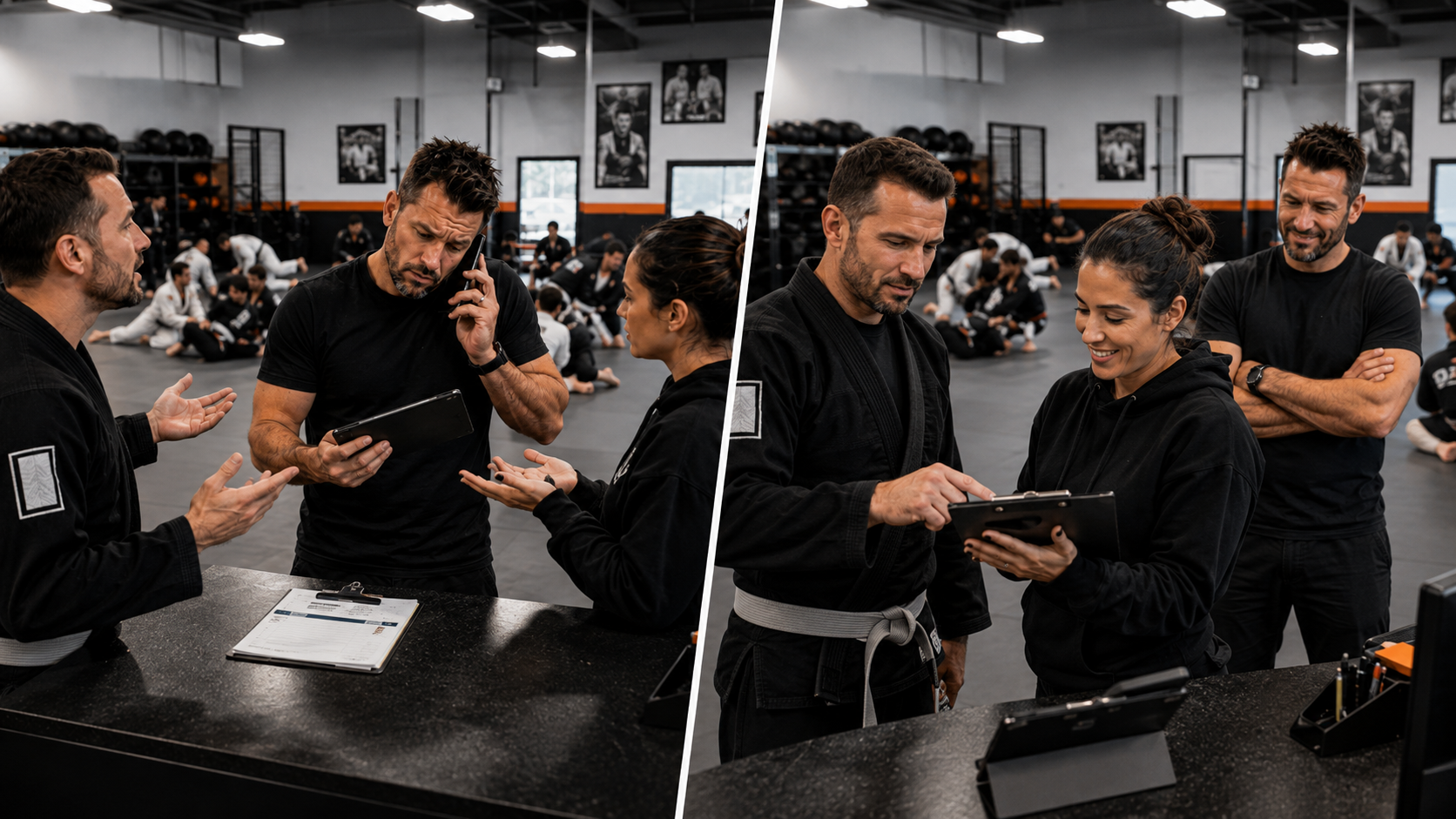
Sign #3: Growth Creates More Chaos Instead of More Capacity
This is the stress test.
Imagine your gym adds 30 new members over the next 90 days. Would that feel exciting? Or would part of you immediately think:
Who's going to handle all of that?
That's the warning sign. Real growth should eventually create more capacity. Owner-dependent growth creates more complexity.
30 additional members means more billing.
More onboarding.
More attendance tracking.
More questions.
More retention conversations.
More staff requirements.
More communication.
If every new member creates another manual task for the owner, growth eventually hits a ceiling. Not because demand disappears. Because the owner runs out of bandwidth. You cannot outwork that problem forever.
Here's the play: Before asking, "How do we get more members?" ask:
"What breaks if we get 30 more members?"
Fix that first. Because the cracks you tolerate at 75 members become expensive problems at 150.
Sign #4: You Delegate Tasks — Then Take Them Back
Gym owners do this constantly.
You hand something off. It doesn't get done exactly the way you would have done it. So you fix it yourself. Then next time, you skip the delegation entirely because doing it yourself feels faster. And technically, it is faster.
Today.
But six months from now, you're still doing it.
That's the trap.
Massive delegation doesn't mean dumping responsibility on employees and hoping for the best. It means creating enough clarity that someone else can repeatedly produce an acceptable result.
Will they do every task exactly like you?
Probably not.
That's not the standard. The standard is:
Can this function operate correctly without requiring the owner every single time?
If yes, you've created leverage.
If not, you're still the system.
Sign #5: Your Business Has Employees, But You're Still the Backup Plan for Everything
A gym can have five, ten or twenty employees and still be completely owner-dependent. That's because headcount doesn't create leverage.
Systems do.
If someone calls out and you teach the class...
If the salesperson misses a follow-up and you jump in...
If a billing issue gets complicated and it lands with you...
If the front desk doesn't know what to say and you're the person they call...
Then you're not just the owner. You're the emergency backup department. And the bigger the business gets, the more emergencies there are.
A strong operation has layers.
The staff knows what they own.
A manager knows what they own.
There is a clear escalation path. And the owner only enters when the problem genuinely requires owner-level judgment. That's very different from:
"Just ask me if you aren't sure."
That sentence feels helpful. It also quietly trains the entire company to depend on you.
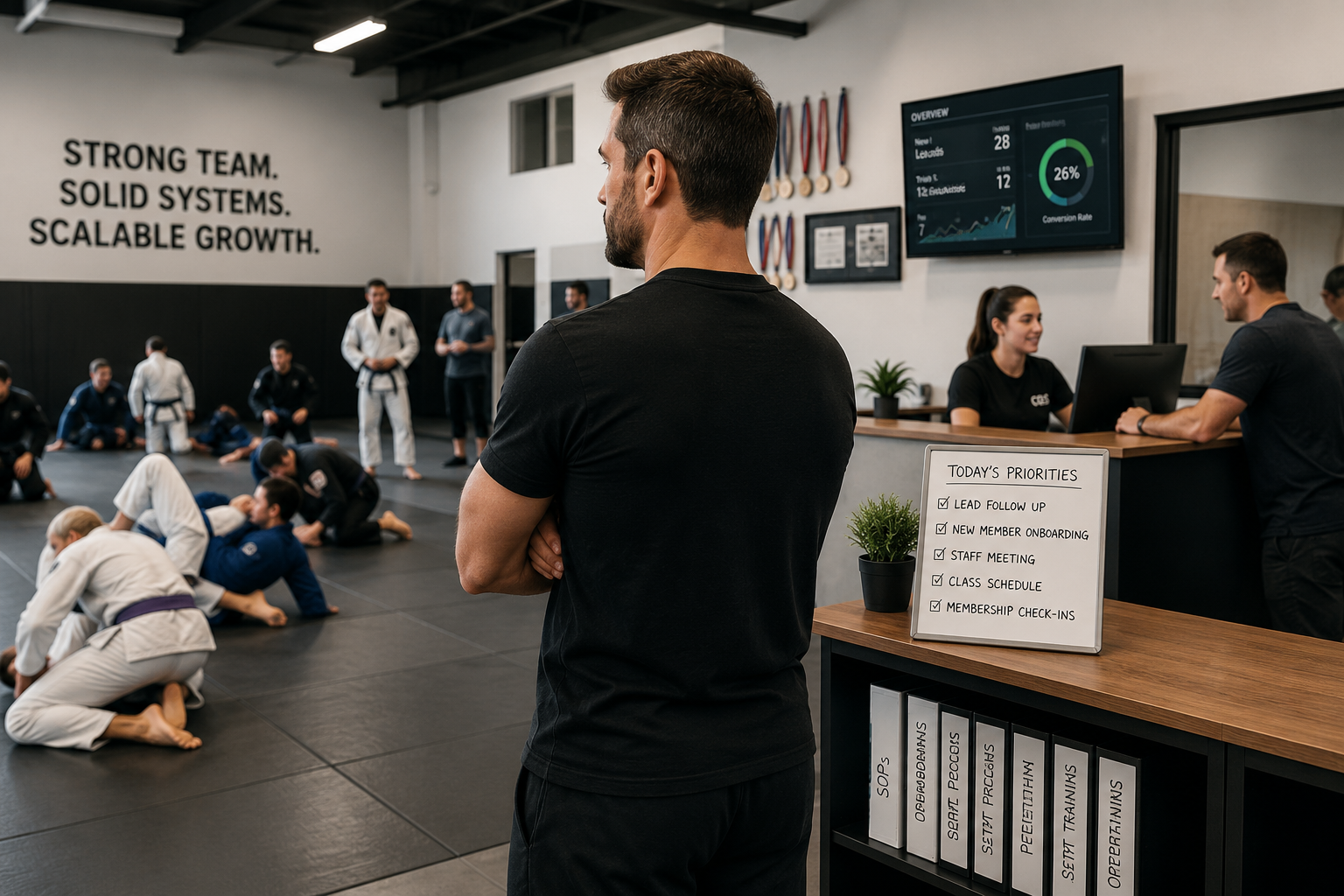
Busy Gym vs. Scalable Gym
Here's the difference.
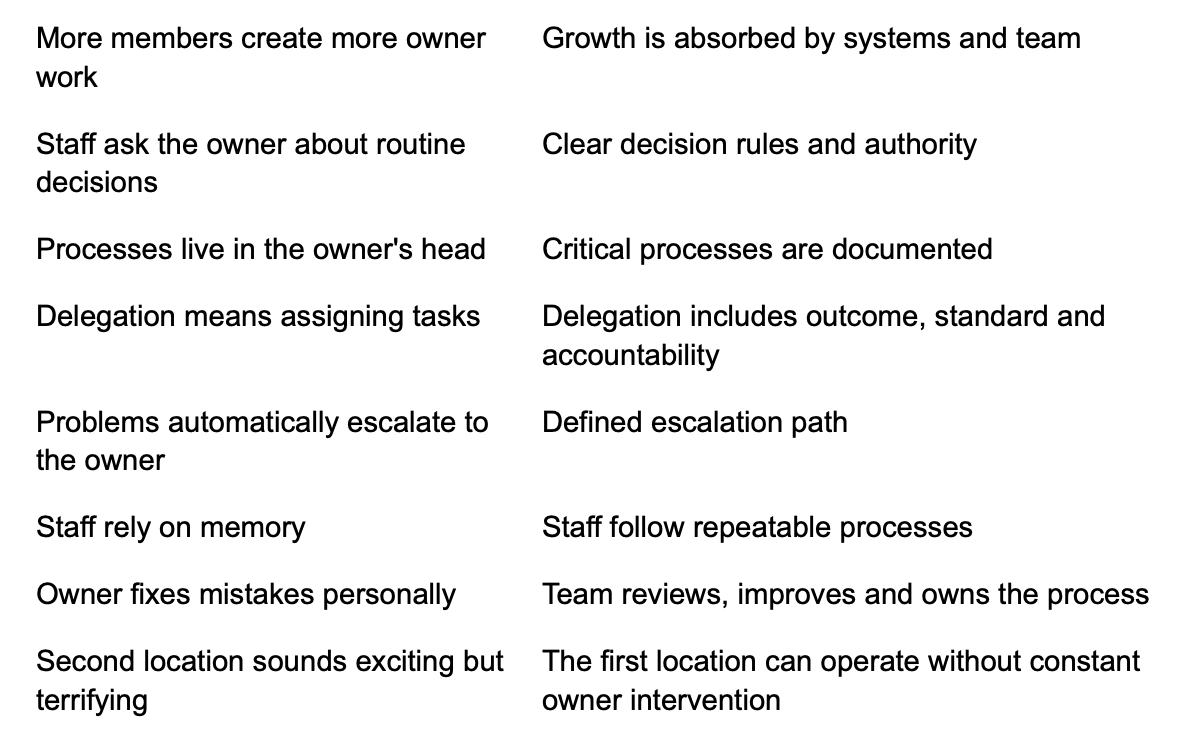
That last one matters.
Because opening a second location doesn't fix operational problems. It duplicates them. If location #1 cannot run cleanly without you, location #2 doesn't give you a bigger business. It gives you two places that need you.
The 5 Things to Systemize Before You Chase More Growth
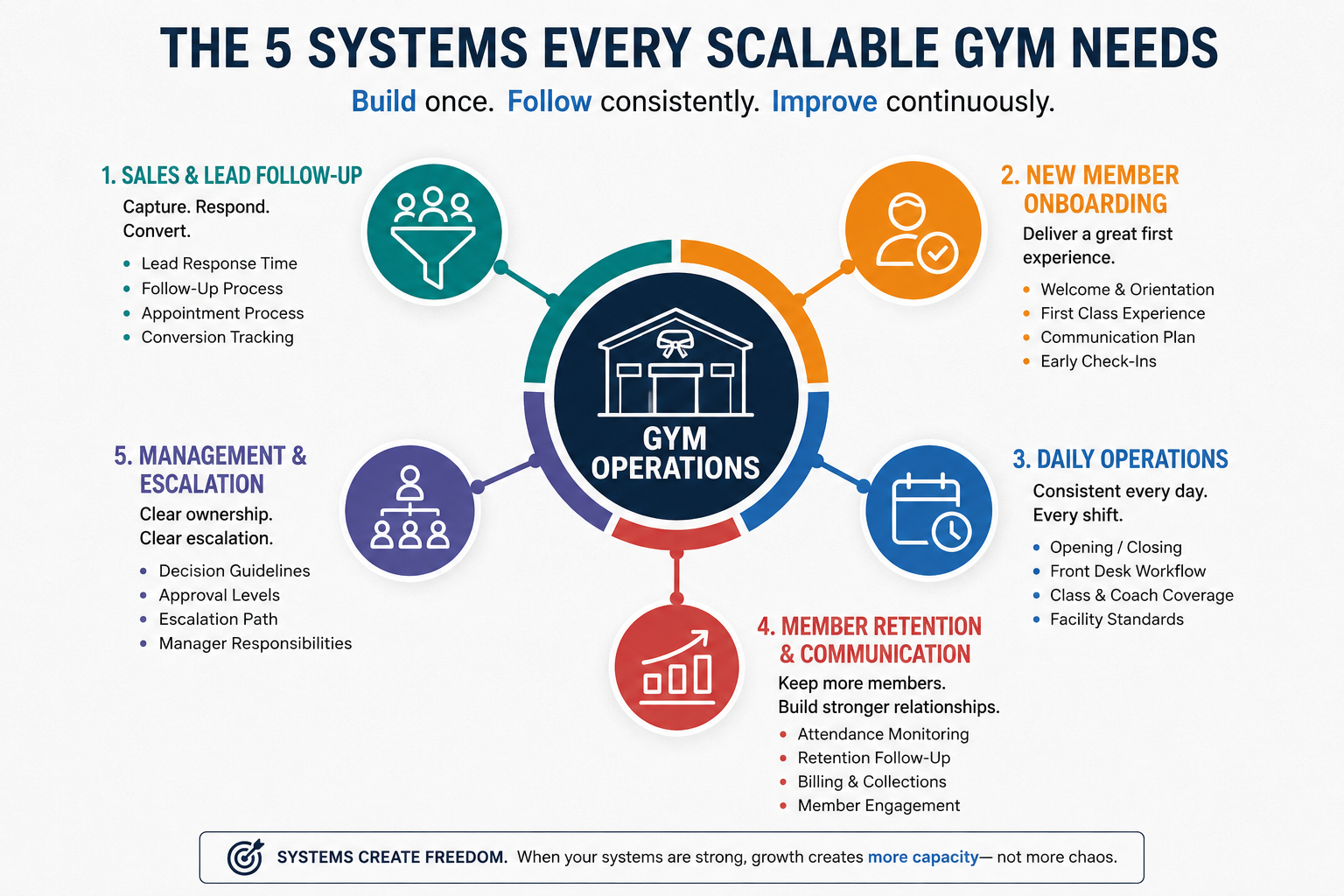
You do not need a 300-page operations manual. Start with the parts of the business that repeatedly consume your attention.
1. Sales
What happens from the moment someone becomes a lead until they become a member? Document the steps. Who owns each stage? What follow-up is required? What numbers are tracked?
2. New Member Onboarding
Once someone joins, what happens next?
- Welcome communication.
- First-class expectations.
- Billing.
- Uniform or gear.
- Introductions.
- Attendance.
- Early check-ins.
Build the experience so a new member receives the same standard regardless of whether the owner is there.
3. Daily Operations
- Opening.
- Closing.
- Cleaning.
- Class coverage.
- Front desk.
- Member questions.
- Incidents.
Stop making your staff reinvent the day every morning.
4. Member Retention and Communication
Who notices when someone disappears? Who handles membership freezes? Who follows up with cancellations? Who handles billing problems?
These processes protect revenue long after the marketing campaign did its job.
5. Management and Escalation
Your team needs to know:
- What can I decide myself?
- What requires manager approval?
- What actually needs the owner?
Without this, everything eventually finds its way back to you.
The Test Every Gym Owner Should Run
Ask yourself this: If my gym grew 30% over the next six months, which parts of the business would break first?
Write down your answers. Don't make them philosophical. Be specific.
Sales?
Staff?
Scheduling?
Lead follow-up?
Member onboarding?
Billing?
Communication?
Retention?
Management?
Those answers are your operational priorities. Because the next stage of your business probably doesn't require you to work harder. It requires the business to become less dependent on how hard you work.
FAQ: Scaling, SOPs and Delegation for Martial Arts Gym Owners
What systems should a martial arts gym owner build first?
Start with the processes that directly affect revenue, member experience and the owner's time. Sales, lead follow-up, member onboarding, billing, retention, daily operations and staff escalation are usually the highest priorities. Don't try to document everything at once. Start with the processes your team asks you about most frequently.
When should a martial arts gym start creating SOPs?
Before you think you need them.
If a task happens repeatedly, is performed by multiple people, affects revenue or member experience, or regularly requires the owner to explain how it should be done, it is a good candidate for an SOP.
Why does delegation fail in martial arts gyms?
Most delegation fails because the owner transfers the task without transferring the standard. The employee knows what they were asked to do but not exactly what success looks like, when it should happen, how it should be tracked or when an issue should be escalated.
How do I make my martial arts gym less dependent on me?
Start by identifying the decisions and tasks that repeatedly come back to you. Document the desired outcome, assign clear ownership, create a repeatable process and define when the team should escalate an exception. The objective isn't to disappear from the business. It's to remove yourself from work that doesn't require owner-level involvement.
Should I open a second martial arts gym location if my first location still depends on me?
Be careful. A second location magnifies both strengths and weaknesses. If sales, staff management, operations and member experience still depend heavily on the owner at location #1, adding another location often multiplies the pressure rather than creating scale. Build the operating system before duplicating the operation.
What is the difference between a growing gym and a scalable gym?
A growing gym is getting bigger. A scalable gym can get bigger without requiring the owner's workload to increase at the same rate. Growth is about volume. Scale is about creating systems, people and processes capable of handling that volume.
More Members Aren't the Goal. A Better Business Is.
There is nothing wrong with hustle. Hustle probably built your first hundred members. But what gets a gym started is not always what gets it to the next level. Eventually the question changes. It stops being: "How much more can I do?"
And becomes:
"How do I build this so everything doesn't require me?"
That's what systems, SOPs and real delegation are supposed to solve. And it's one of the core conversations we're bringing to the upcoming Combat Business Live
Paul Halme will be joined by gym owners and operators to break down SOPs, massive delegation, sales, CRM, scaling to a second location and practical AI, followed by a second day built around implementation.
Because knowing what to fix isn't enough. You need to actually build it. Don't just leave inspired. Leave with it built.
