

The Growth Math Every Martial Arts Gym Owner Should Know
Oct 05, 2026Most gym owners have goals.
- More members.
- More revenue.
- Better retention.
- A stronger quarter.
But “we want to grow” is not a plan. Neither is: “Let’s get more leads.”
If you want predictable growth, you need to know what has to happen between the revenue number you want and the leads entering your pipeline.
Because revenue is the result.
Before the result, there are memberships.
Before memberships, there are shows.
Before shows, there are appointments.
Before appointments, there are leads.
That means you can work backward. Instead of asking: “How many leads should we get?”
start with:
“What result are we trying to produce, and what does our current conversion math say we need to get there?”
That is the growth math every martial arts gym owner should know.
1. Start With the Result, Not the Lead Goal
Suppose you want 25 new members next month. That is a much more useful starting point than saying: “Let’s get 150 leads.”
Why?
Because 150 leads means absolutely nothing without context. One gym might turn 150 leads into 30 members. Another might turn them into 8. The difference is what happens throughout the sales process.
Your basic growth funnel looks like this:
Lead → Contact → Appointment → Show → Sale
Every stage has a conversion rate. Once you know those rates, you can estimate how much activity is required to produce your membership goal. That makes growth easier to diagnose because you stop treating the top of the funnel like the only number that matters.
2. Work Backward From the Number You Want
Let’s use a simple example.
Your goal: 25 new memberships
Your current close rate from attended intros is: 50%
So to get 25 new members, you need: 25 ÷ 50% = 50 shows
Now assume your show rate is 70%. To get 50 people through the door:
50 ÷ 70% = about 72 appointments
Now assume 60% of the leads you successfully contact book an appointment. You need:
72 ÷ 60% = 120 contacted prospects
And if your team successfully contacts 80% of incoming leads:
120 ÷ 80% = 150 leads
So your actual target becomes:
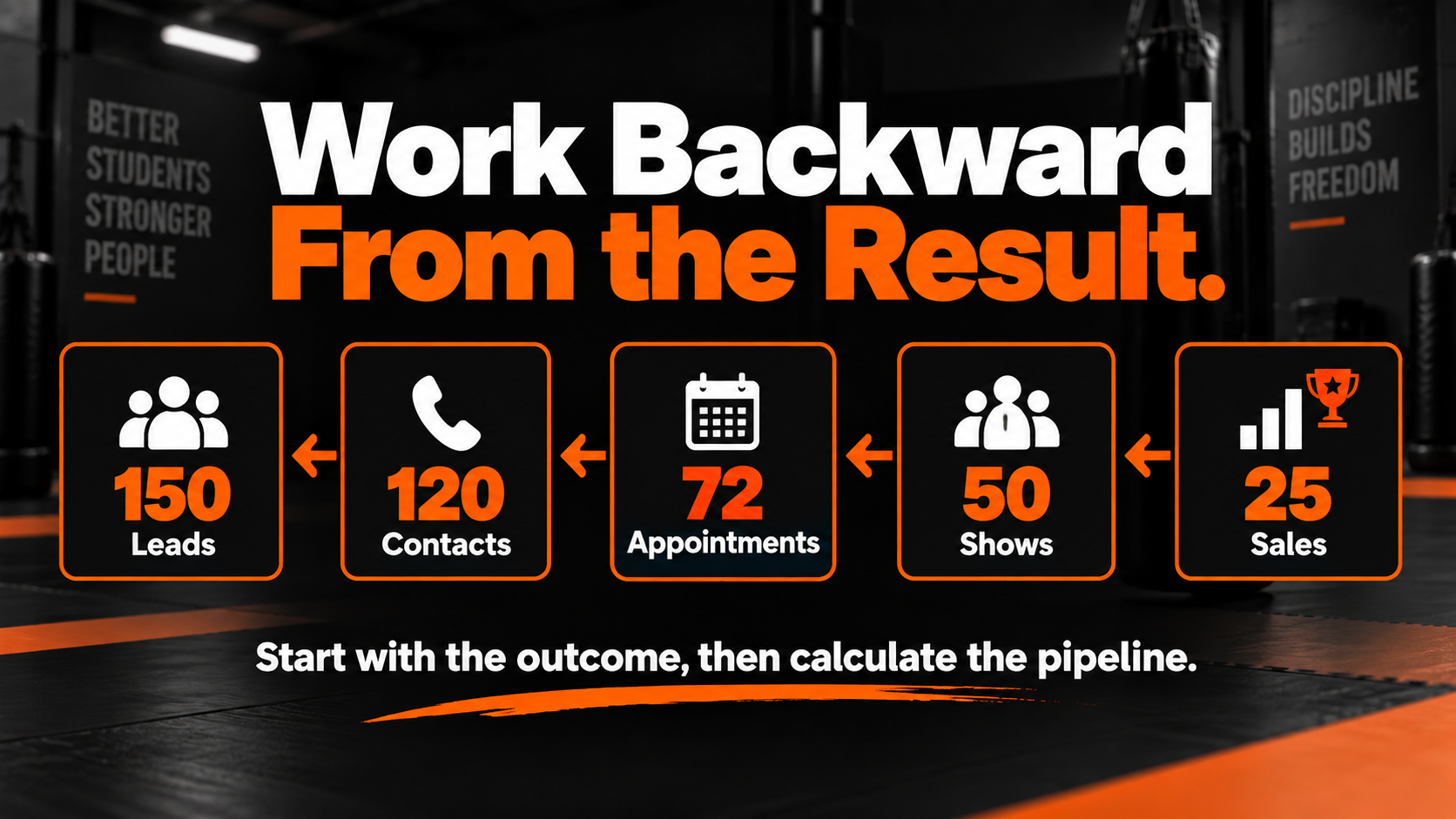
150 leads → 120 contacts → 72 appointments → 50 shows → 25 sales
Now you have a plan. More importantly, you have several places to improve the plan.
The Math Changes When the System Gets Better
Let’s say you still want 25 memberships.
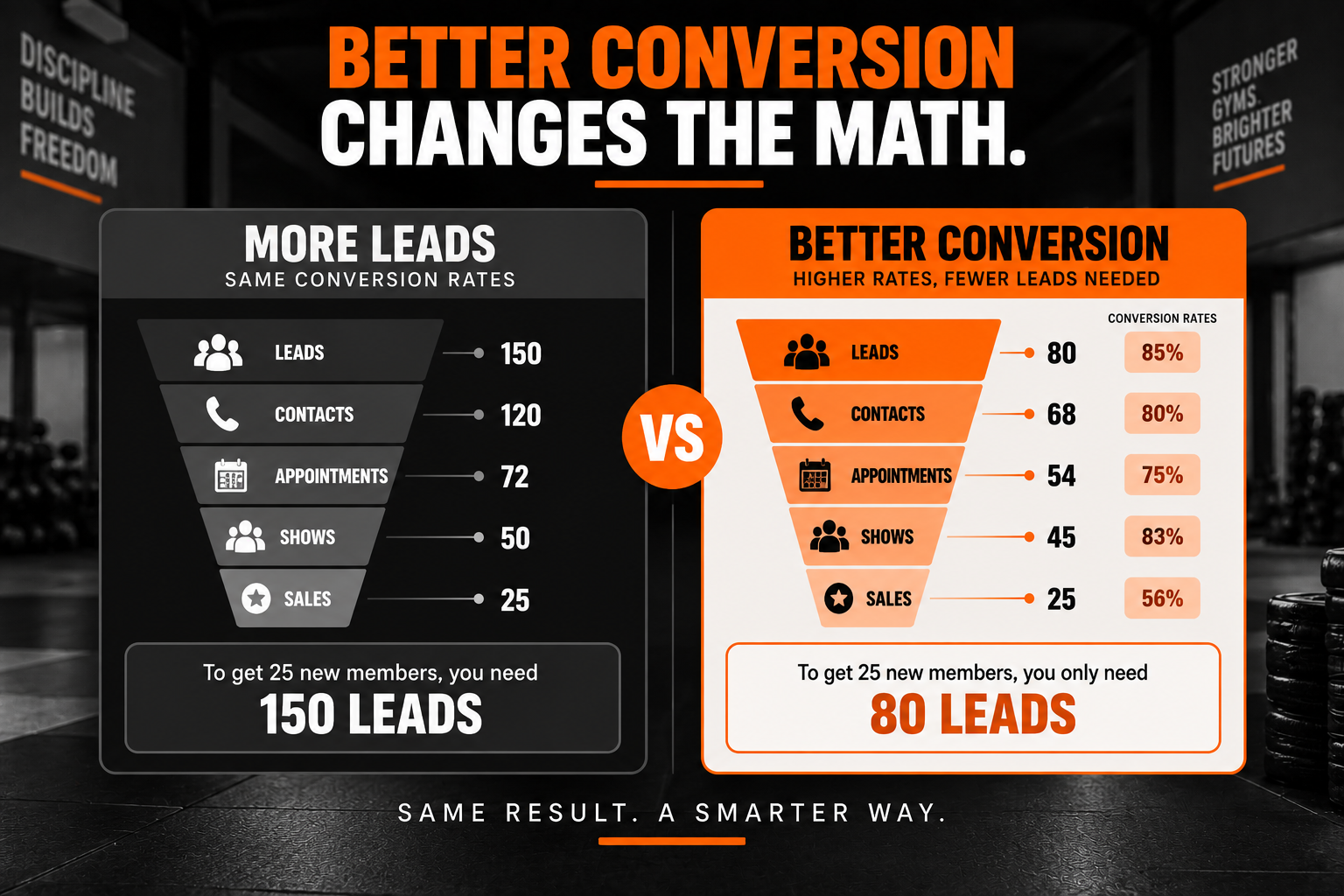
But instead of increasing your ad spend, your team improves the show rate from 70% to 80%. Now you only need: 50 shows ÷ 80% = about 63 appointments
You just reduced the appointment requirement from 72 to 63 without generating a single extra lead. Or maybe your close rate increases from 50% to 60%.
Now: 25 sales ÷ 60% = about 42 shows
That changes the entire funnel. This is why stronger sales systems matter. A small improvement in one conversion point can reduce the amount of demand you need at the top.
 3. Find the Number That Is Actually Holding Growth Back
Once you track the funnel, you stop arguing from gut feeling.
Instead of: “The leads are bad”, you can look at the numbers.
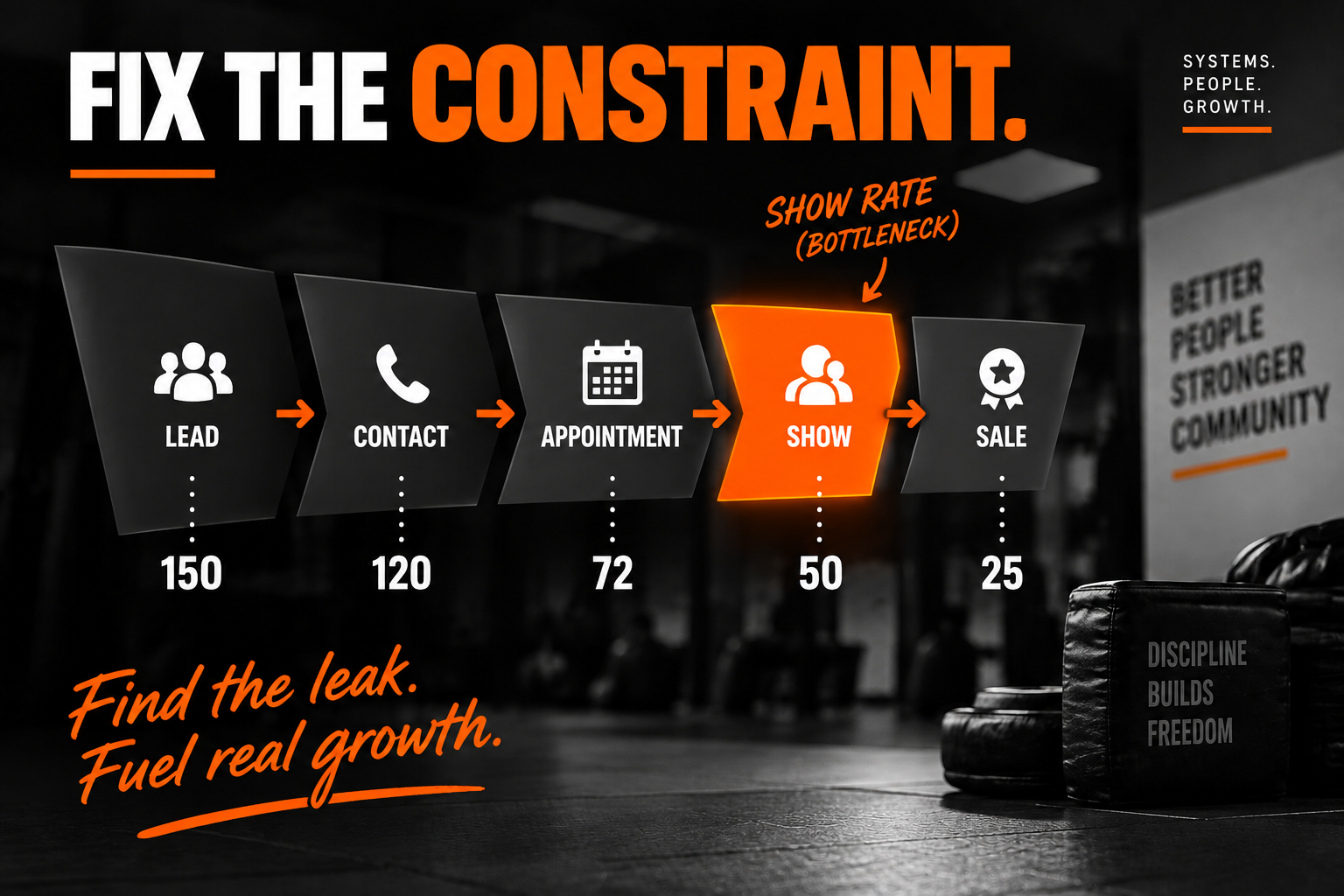
- Maybe lead volume is healthy, but only 55% of prospects are being contacted. That is a response problem.
- Maybe contact is strong, but very few prospects book. That could be a sales-conversation problem.
- Maybe appointments are high, but only half show up. That is a confirmation and pre-visit problem.
- Maybe plenty of prospects attend, but very few join. That is a closing, offer, or trial-experience problem.
Different leaks require different fixes. Throwing more leads into every one of those situations is expensive.
Your core numbers should be:
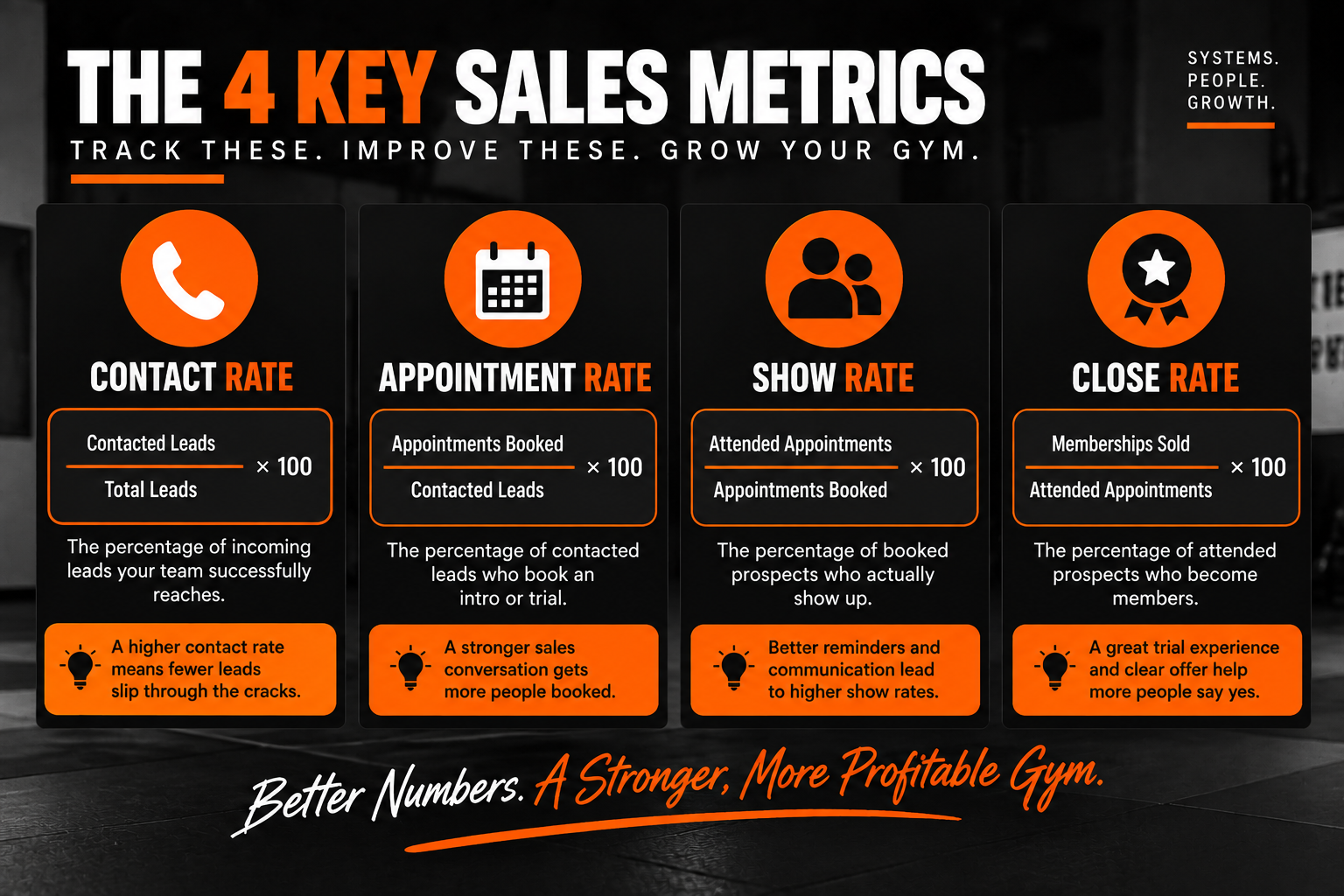
- Contact Rate: Contacted leads ÷ Total leads
- Appointment Rate: Appointments booked ÷ Contacted leads
- Show Rate: Attended appointments ÷ Appointments booked
- Close Rate: Memberships sold ÷ Shows
Those four numbers tell you much more than total lead count alone.
4. Revenue Goals Need Member Math Too
Membership goals are useful. Revenue goals go one step further.
Suppose your target is an additional $5,000 in monthly recurring revenue. If the average new membership contributes $200 per month: $5,000 ÷ $200 = 25 new members
Now you can take those 25 memberships and work backward through the same funnel. That connects your financial target to the actual activity required to produce it.
This is where many growth plans fall apart.
The owner has a revenue goal.
Marketing has a lead goal.
Sales has an appointment goal.
But nobody has connected the three. They should all be part of the same equation.
Revenue goal → Membership goal → Shows → Appointments → Leads
That is what turns a target into an operating plan.
Your 10-Minute Growth Math Audit
Pull the last 30 days of CRM or sales data.
Write down:
- Total leads: ______
- Leads successfully contacted: ______
- Appointments booked: ______
- Appointments that showed: ______
- Memberships sold: ______
Now calculate:
- Contact Rate: Contacts ÷ Leads × 100
- Appointment Rate: Appointments ÷ Contacts × 100
- Show Rate: Shows ÷ Appointments × 100
- Close Rate: Sales ÷ Shows × 100
Then ask one question: Where is the biggest drop-off? Do not automatically try to fix everything.
Start there.
Do This Today: Reverse-Engineer Your Next Growth Goal
Choose the number you want to hit next month.
Example: 20 new members.
Now use your actual current conversion rates.
- If your close rate is 40%: 20 ÷ 40% = 50 shows
- If your show rate is 75%: 50 ÷ 75% = 67 appointments
- If your appointment rate is 55%: 67 ÷ 55% = 122 contacted leads
- If your contact rate is 80%: 122 ÷ 80% = about 153 leads
That gives you a working target.
Then run a second scenario.
What happens if you improve just one conversion rate by 10 percentage points? That comparison tells you whether your next dollar or hour should go toward:
- lead generation,
- faster follow-up,
- sales training,
- appointment confirmation,
- trial experience,
- or closing.
That is a much smarter growth conversation than: “We just need more leads.”
Growth Math Turns Guessing Into Decisions
You are never going to predict every month perfectly. People cancel, prospects ghost, staff changes, seasonality matters, marketing fluctuates…
But that does not mean the business has to operate blindly.
The point of growth math is not to predict the future down to the exact membership.
It is to give you a model. A model tells you what should be happening. Then the real numbers tell you where reality is different.
That is where management starts.
FAQ: Martial Arts Gym Growth and Sales Metrics
How many leads does a martial arts gym need?
There is no universal lead number. The correct target depends on your contact, appointment, show, and close rates. Start with your membership goal and work backward using your actual conversion data.
What sales numbers should a martial arts gym track?
At minimum, track leads, contacts, appointments, shows, and memberships sold. Those numbers allow you to calculate the key conversion rates in your sales funnel.
What is the most important martial arts gym sales metric?
There is not one metric that matters in every gym. The most useful metric is often the stage with the largest or most unusual drop-off because that is where improvement can produce the greatest impact.
Should I increase my martial arts gym ad budget if sales are down?
Not automatically. Check your conversion rates first. If enough leads are entering the business but contact, appointment, show, or close rates are weak, fixing the sales process may create more memberships before additional ad spend is needed.
Better Numbers Create Better Growth Decisions
Growth gets expensive when every problem is treated as a marketing problem.
Sometimes you need more leads.
Sometimes you need better follow-up.
Sometimes you need more people to show up.
Sometimes your team needs to get better at selling.
The numbers tell you which one. So before you set the next big goal, work backward.
Start with the result.
Build the math.
Find the constraint.
Then fix the part of the system that is actually keeping you from the number you want.
This same principle applies to every stage of building a more valuable martial arts business: identify the number you want to change, understand what drives it, and focus on the right lever.
That’s what the speakers at Combat Business Live, October 23–24 in Cresson, Texas, will help gym owners do.
Paul Halme will show how AI can help reduce payroll costs and accelerate growth. Kacey White will break down how to use social media to grow a gym beyond $100,000 in monthly revenue. Chris Conolley will share how to build, scale, and position a gym for a seven-figure sale.
Attendees will also hear from Chase Halme about opening a second location with family, plus an owner panel on purchasing the building your gym operates from.
VIP guests begin Friday with executive hot seats, the DriveXotic experience, and dinner. Saturday features the speaker sessions and owner panel, followed by a live implementation webinar on October 30.
Because knowing your numbers is useful.
Knowing which number to change and how to change it—is where growth happens.
→ See Event Details & Reserve Your Seat
