

How Martial Arts Gym Owners Can Use AI to Save Time and Grow Faster
Sep 21, 2026AI has become almost impossible to ignore.
Martial arts gym owners are using ChatGPT, Claude and other AI tools to write social media posts, draft emails, brainstorm offers, summarize meetings, create training materials, and answer questions faster.
That’s useful.
But if the only thing AI is doing for your gym is writing captions, you’re barely scratching the surface.
The bigger opportunity is not: “How can AI create more content for me?”
It’s:
“What work am I doing over and over again that AI could help make faster, easier, or more consistent?”
Because most martial arts gym owners don’t have an idea problem.
They have a capacity problem.
There are leads to follow up with, staff to manage, classes to oversee, reports to review, members to communicate with, systems to document, marketing to create, and dozens of decisions competing for attention every day.
AI can’t replace good leadership. It can’t fix a bad business model. And it definitely can’t make every decision for you. But used correctly, it can give your team leverage.
Here are five areas where that leverage can make a real difference.
- Use AI to Make Lead Follow-Up Faster and More Consistent
A new lead comes in.
Maybe they’re looking for kids’ martial arts.
Maybe they’re an adult interested in Brazilian Jiu-Jitsu.
Maybe they asked about pricing, but the real concern is whether beginners are welcome.
The challenge isn’t simply sending a reply.
The challenge is responding quickly while still sounding like a human being who understands what the prospect is asking.
That becomes harder when the front desk is busy, classes are changing over, phones are ringing, and several leads arrive at once.
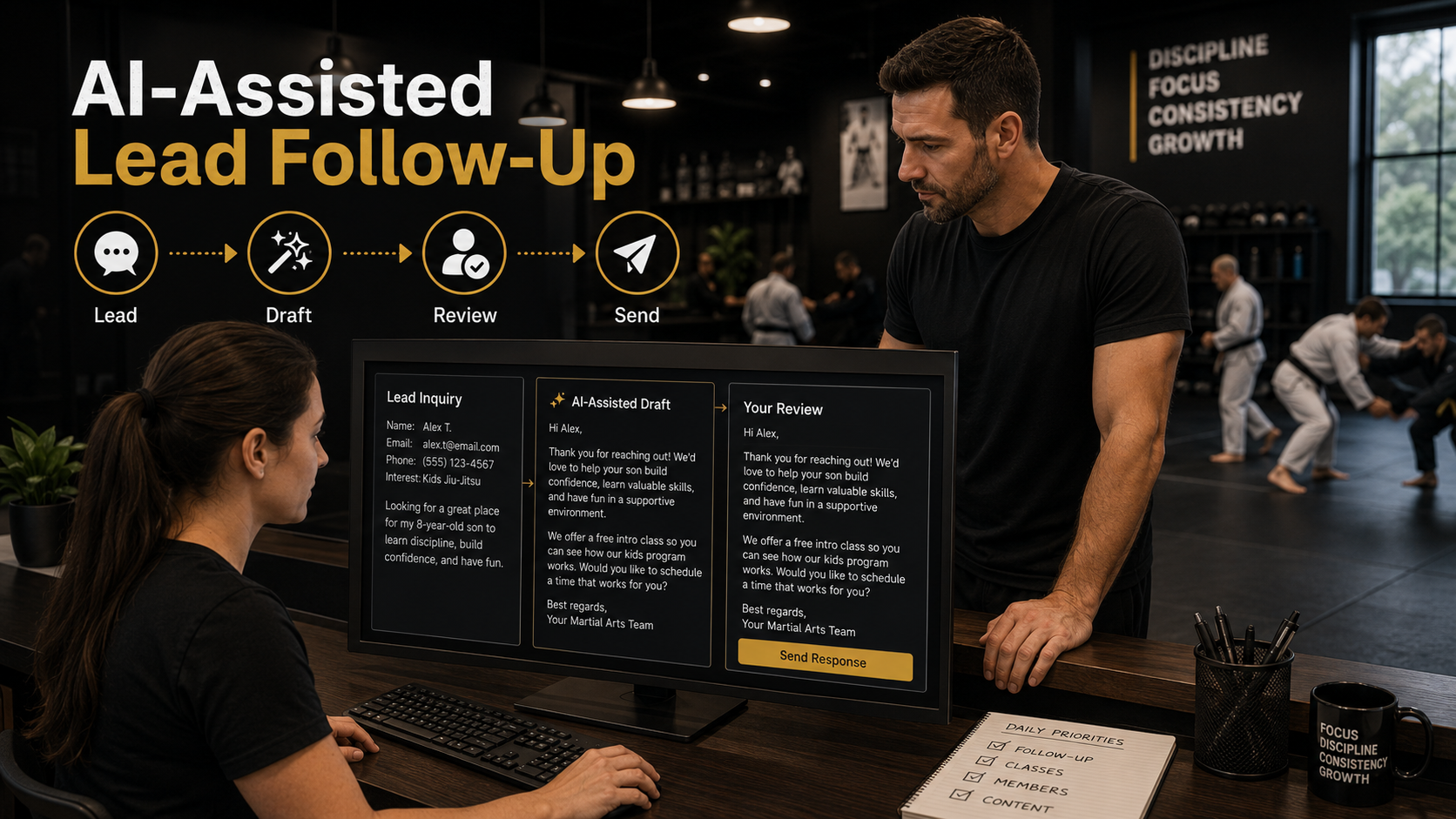
This is where AI can help your staff work faster without turning the sales process into robotic automation.
What AI can help with:
AI can draft responses based on common lead situations, rewrite awkward staff messages, create follow-up variations, summarize a prospect’s conversation history, and help your team answer common objections more clearly.
For example, instead of your employee staring at the screen wondering how to respond to:
“My son is pretty shy. I don’t know if martial arts will be too intimidating for him.”
AI can help produce a starting point that your employee personalizes:
“That’s actually something we hear from a lot of parents. New students aren’t expected to already be confident when they walk in. Helping them build that confidence is part of the process. If you’d like, we can set up a first visit so he can meet the coaches and see what the class feels like.”
The employee still owns the conversation. AI simply reduces the time between knowing what needs to be said and saying it well.
Here’s the play: Start by identifying the ten questions or objections your sales team hears most frequently. Build a library of strong responses. Then use AI to help your team personalize those responses based on the individual prospect rather than reinventing the entire conversation every time.
AI should make your sales process more responsive and consistent, not less personal.
- Turn the Knowledge in Your Head Into SOPs
One of the biggest operational problems in growing martial arts businesses is that the owner knows how everything works.
The team doesn’t.
You know what to do when someone freezes a membership.
You know what happens when an instructor calls out.
You know how to handle an unhappy parent.
You know how a lead gets moved through the CRM.
You know what needs to happen before opening the gym and after closing it.
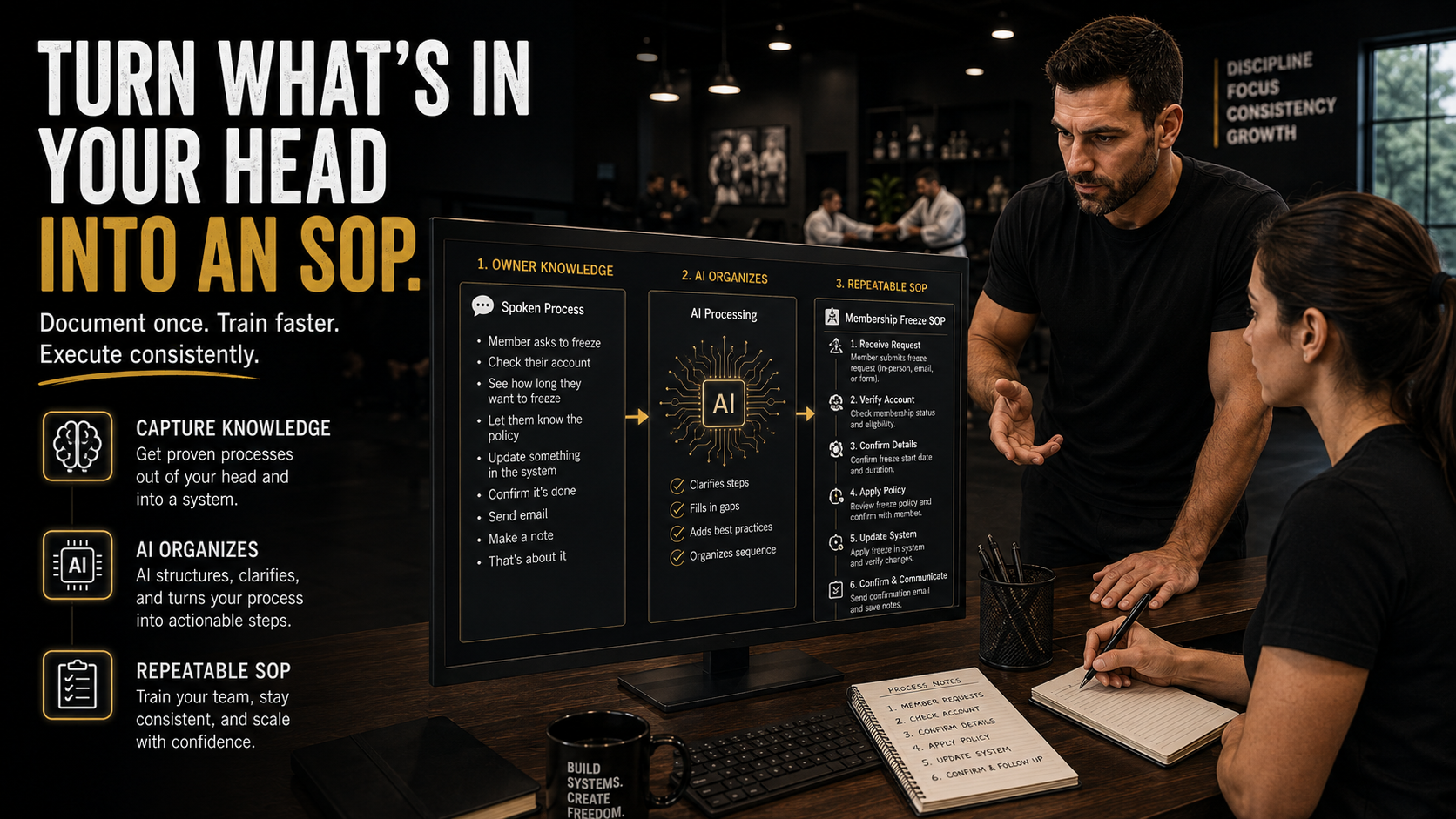
But documenting those processes takes time. So they remain in your head. AI can make that documentation process dramatically easier. Imagine talking through a process for five minutes:
“When someone requests a membership freeze, first we check their account, then we confirm the reason…”
Instead of staring at a blank SOP document afterward, AI can help transform that information into:
- purpose,
- trigger,
- owner,
- required steps,
- decision points,
- exceptions,
- escalation rules,
- and completion criteria.
You still review it. You still decide what the actual policy is.
But you are no longer starting with a blank page.
Here’s the play: Pick one process your team asks you about constantly. Explain it in plain language as if you were training a new employee.
Then use AI to organize that explanation into a first-draft SOP.
Review it against what actually happens in the gym. Test it with an employee. Improve it. Then move to the next process.
One documented system every week gives you more leverage than generating another hundred social media captions.
3. Use AI to Improve Staff Training and Management
Hiring someone is not the same as training them. And handing someone a folder full of SOPs is not the same as teaching them how to think.
Your team needs to understand situations.
What does a good lead conversation sound like?
How should you respond when a parent is upset?
What should a front-desk employee do if a billing issue falls outside the normal process?
How should the team handle a membership cancellation?
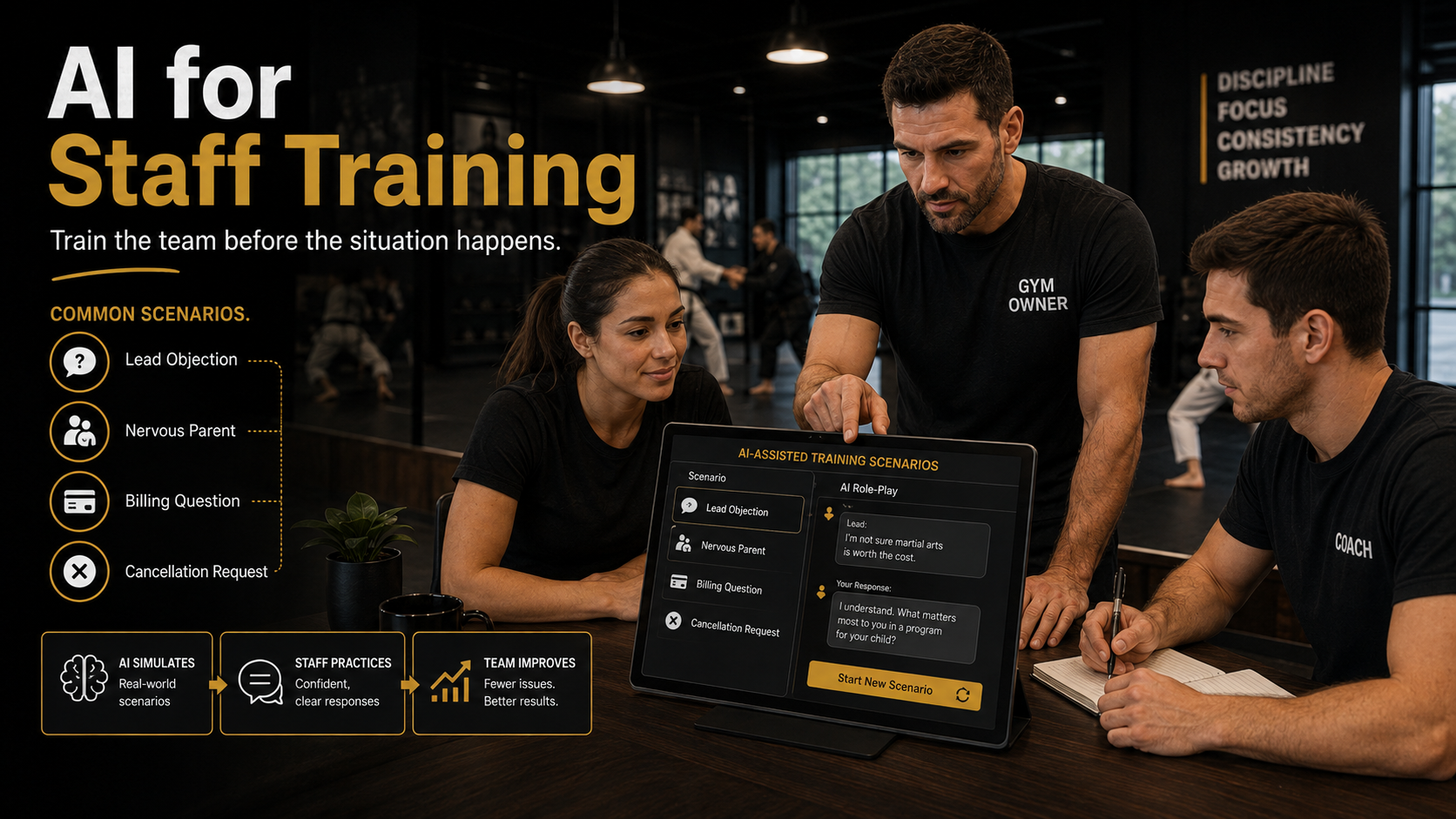
AI can help turn your existing systems into better training.
For example:
Take your sales SOP and ask AI to create five realistic role-play scenarios.
One prospect is price-sensitive.
Another is nervous about starting BJJ.
Another parent has a child who quit two activities already.
Another prospect doesn't respond after booking a trial.
Your employee can practice those situations before they encounter them live.
You can do the same thing with customer service, billing, onboarding, retention, and management situations.
AI can also help managers summarize meeting notes, organize employee feedback, prepare talking points, or identify recurring themes across issues being reported by staff.
Here’s the play: Stop thinking of AI only as something the owner uses. Ask:
Where could AI help my team make better decisions or learn faster?
That is where AI starts becoming an organizational tool rather than another browser tab only the owner knows how to use.
- Use AI to Get More From Your Numbers
Most gym owners have more data than they actually use.
- The CRM has data.
- Your billing system has data.
- Ads have data.
- Website analytics have data.
- Attendance systems have data.
- Sales spreadsheets have data.
The problem is usually not access.
It’s interpretation.
A report says your leads increased.
Great.
But appointments went down.
Why?
Another report says membership is growing.
But cancellations are increasing too.
Is that healthy growth?
Your sales team says leads are bad.
But what do the conversion numbers actually say?
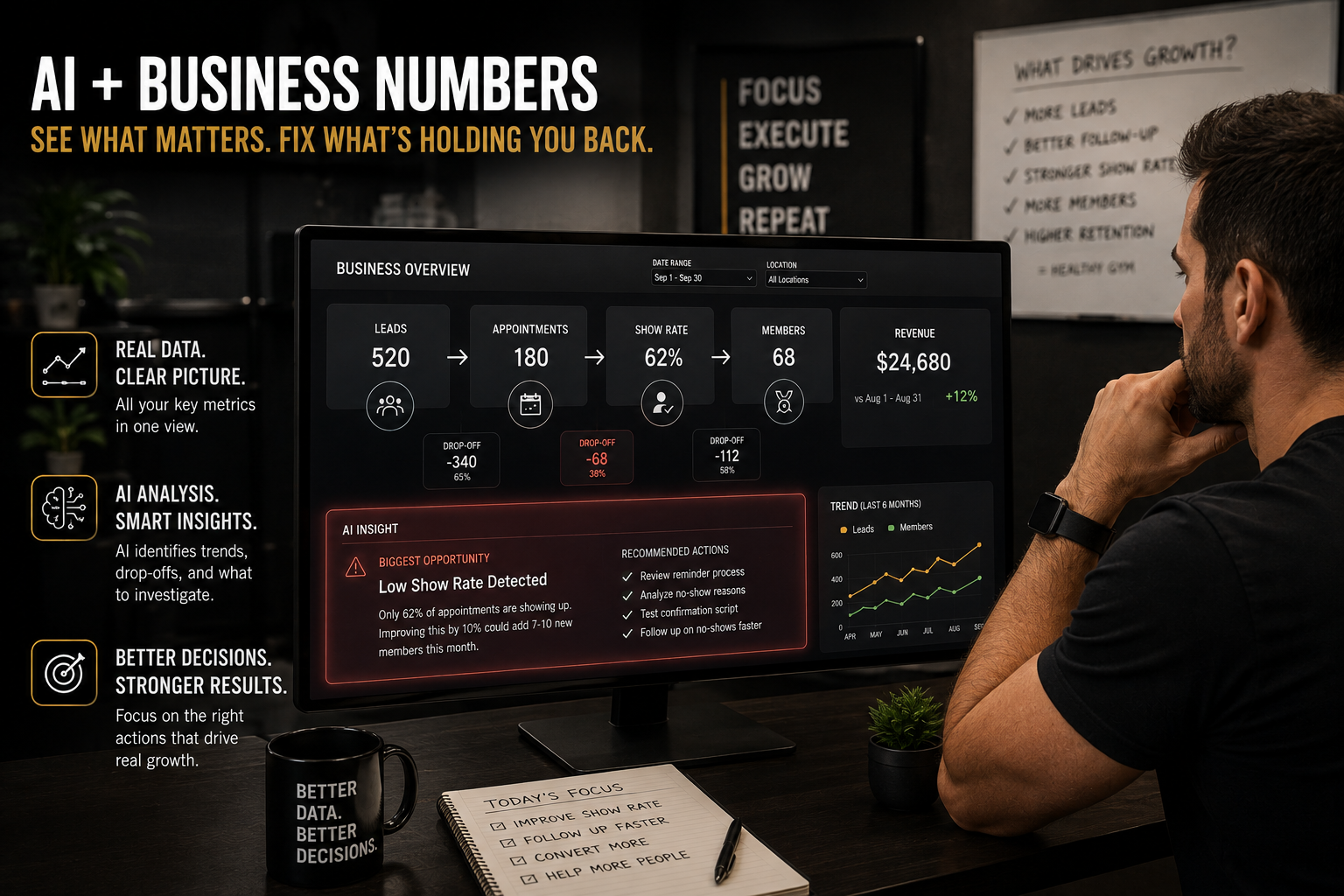
AI can help owners interrogate their data instead of just looking at dashboards.
You might provide a clean set of non-sensitive metrics such as:
- leads generated,
- leads contacted,
- appointments booked,
- appointments attended,
- memberships sold,
- cancellations,
- revenue,
- and marketing spend.
Then ask:
Where is the biggest drop-off?
What changed compared with last month?
Which metric should I investigate first?
What questions should I ask my sales team?
What additional information would help diagnose this?
AI does not magically make the numbers accurate. Bad data is still bad data. But it can make analyzing good data much faster.
Here’s the play: Stop asking AI only to “give me ideas.”
Give it a business problem.
Give it the relevant numbers.
Ask it to challenge your assumptions.
You don’t need AI to make the final decision.
You need it to help you see the decision more clearly.
- Build a Marketing Engine Instead of Asking AI for Random Posts
This is where most businesses started with AI: “Write me a Facebook post.”
There is nothing wrong with that. The problem is that random AI-generated content usually creates exactly what you would expect: Random content.
One day you’re posting about discipline.
The next day it’s weight loss.
Then self-defense.
Then motivation.
Then some generic quote about black belts.
There is no strategy connecting any of it.
AI becomes far more valuable when you give it a marketing system to work inside.
For example, your gym may decide its content should consistently address four audiences:
- Parents - Confidence, discipline, bullying, focus, healthy activity.
- Adult Beginners - Fitness, anxiety about starting, community, self-defense, beginner expectations.
- Existing Members - Retention, milestones, culture, events, achievements.
- Local Prospects - Programs, coaches, reviews, location, first-class experience.
Now AI has boundaries. Instead of: “Give me 30 social media ideas.”
you can ask:
“Build a four-week content calendar using these four audience pillars. Each week needs one educational post, one member story, one objection-handling post, and one conversion-focused post.”
That is dramatically more useful. You can do the same thing with blogs, newsletters, video scripts, landing pages, FAQs, review responses, promotional campaigns, and local SEO content.
Here’s the play: Build the marketing strategy first. Use AI to accelerate execution second. AI without strategy creates more content. AI inside a strategy creates leverage.
Where AI Fits Inside a Martial Arts Gym
AI shouldn't become another disconnected tool. It should sit inside the systems you're already building.
|
Business Area |
Without AI Leverage |
With AI Assistance |
|
Lead Follow-Up |
Staff repeatedly writes similar responses |
AI helps draft and personalize faster |
|
SOPs |
Owner struggles to document what's in their head |
AI helps organize knowledge into processes |
|
Staff Training |
Training depends heavily on the owner |
AI helps create scenarios, quizzes and training materials |
|
Meetings |
Notes get taken but rarely organized |
AI helps summarize decisions and next actions |
|
Reporting |
Owner stares at dashboards and spreadsheets |
AI helps identify patterns and questions |
|
Marketing |
Content starts from scratch every week |
AI accelerates an established content strategy |
|
Customer Communication |
Every message requires manual drafting |
AI creates strong first drafts for team review |
|
Management |
Owner repeatedly solves similar situations |
AI helps managers think through documented policies |
Notice what AI isn't doing.
It isn't running the gym.
It is making the people and systems running the gym more effective.
What You Should NOT Hand Over to AI
There is a dangerous side to AI adoption.
Once something becomes faster, it becomes tempting to use it for everything.
Don't.
There are areas where human judgment should remain firmly in control.
Sensitive Employee Decisions
AI can help organize information or prepare questions. It should not decide who gets hired, fired, promoted, disciplined, or compensated. Those decisions need context and human judgment.
Serious Member Problems
If a customer is angry, injured, threatening legal action, or dealing with a highly sensitive situation, don't outsource the relationship to an AI-generated message.
Use AI as preparation if necessary. Then handle the person like a person.
Financial Decisions
AI can help analyze scenarios. It should not be treated as your accountant, financial advisor, or source of truth.
Verify important numbers.
Legal or Compliance Decisions
AI can help you understand what questions to ask. It should not replace qualified professional advice.
Anything You Haven't Verified
AI can sound extremely confident while being wrong. That makes review essential. The rule should be simple:
AI drafts. Humans own the result.
The AI Opportunity Most Gym Owners Are Missing
The obvious AI question is: What can this tool do?
The more useful question is: Where does my business repeatedly lose time?
Look around your week.
What do you repeatedly write?
What do you repeatedly explain?
What do employees repeatedly ask?
What information do you repeatedly organize?
What reports do you repeatedly review?
What processes do you repeatedly teach?
What decisions require you to gather the same information over and over again?
Those are your AI opportunities. The goal isn't to install fifty AI tools. It's to remove friction from the work your business already needs to do.
Start With These 5 AI Workflows
If you're trying to figure out where to begin, start here.
Workflow #1: Lead Response Assistant
Build approved responses for your most common inquiries and objections. Use AI to personalize them while keeping your team's voice and sales process intact.
Workflow #2: SOP Builder
Record or write how you currently handle one recurring process. Use AI to structure it. Have your team test it.
Workflow #3: Meeting-to-Action System
Take meeting notes or transcripts and turn them into:
decisions → tasks → owners → deadlines
Meetings become dramatically more useful when the discussion turns into execution.
Workflow #4: Weekly Numbers Review
Give AI a clean set of business metrics and ask it to identify unusual changes, bottlenecks, and questions worth investigating. Use it as an analytical assistant, not an oracle.
Workflow #5: Content Repurposing System
Start with one strong piece of content. A blog. A video. A customer story. A webinar.
Then use AI to turn it into multiple formats:
- email,
- social posts,
- short video scripts,
- FAQs,
- website content,
- and sales follow-up material.
One good idea becomes an entire campaign.
Don't Automate Chaos
There is an important warning here. AI makes things faster. That includes bad processes.
If your lead follow-up is poorly designed, AI can help you execute a bad follow-up system faster.
If your SOP is wrong, AI can help distribute the wrong process more efficiently.
If your marketing strategy is unclear, AI can help you publish more unclear marketing.
So before you automate something, ask: Is this actually the process we want to scale?
Because AI does not replace systems.
It amplifies them.
That is why the gyms that get the most value from AI will not necessarily be the ones using the most tools. They'll be the ones with the clearest processes.
AI Should Give the Owner Capacity Back
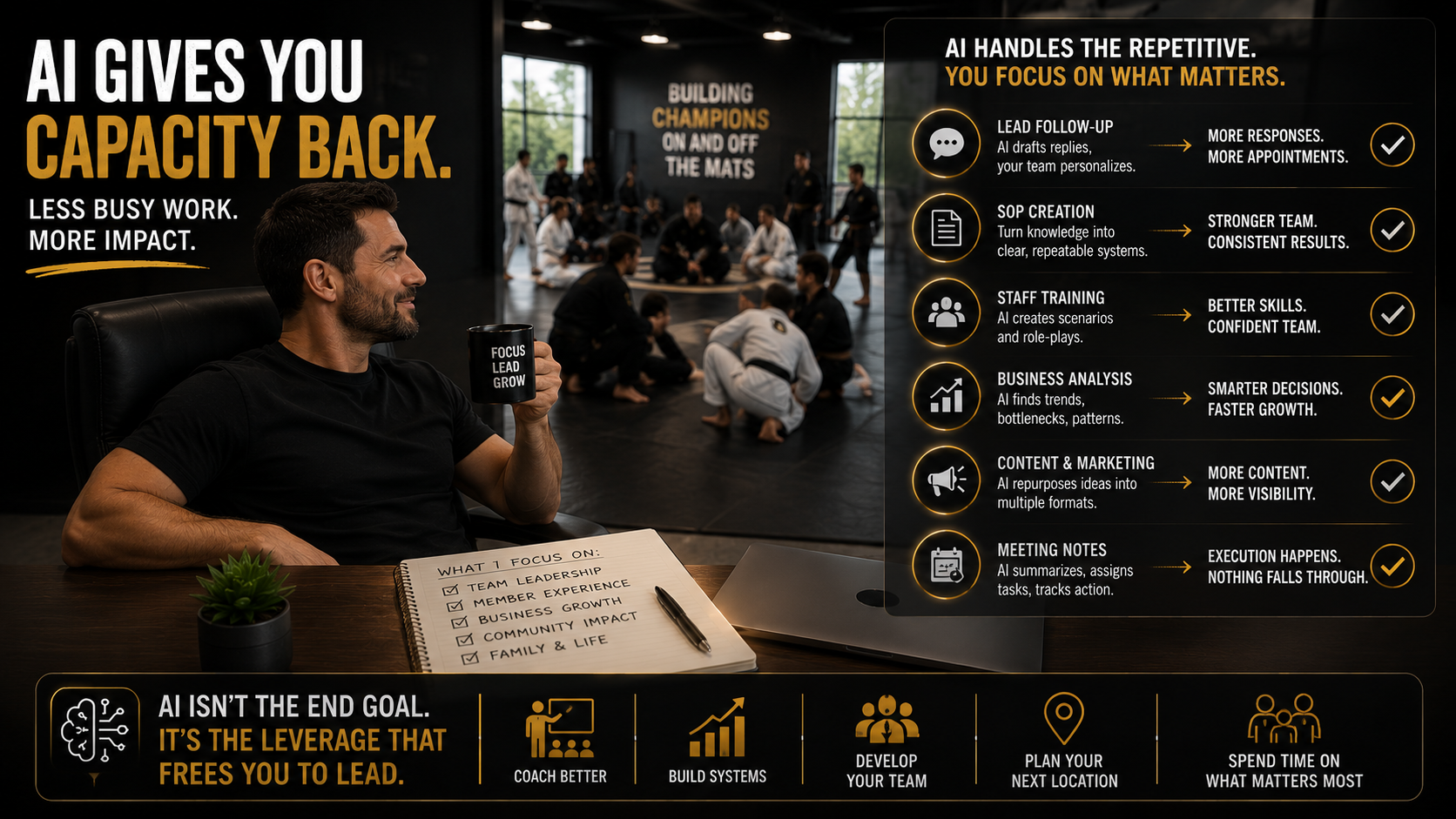
Imagine getting 5 hours back every week. Not because you're working faster.
Because your team no longer needs you to draft every message.
Because turning an idea into an SOP takes 20 minutes instead of two hours.
Because your weekly numbers review tells you where to look instead of forcing you to dig through six reports.
Because one piece of content becomes an entire campaign.
Because managers can find answers without asking you the same questions again.
Then imagine what you could do with those hours.
- Coach your leadership team.
- Improve the sales process.
- Build partnerships.
- Review financials.
- Plan the next location.
- Spend time with your family.
- Or simply stop answering business messages at 10:30 at night.
That's where AI gets interesting. The outcome isn't “we use AI.”
The outcome is:
The business can accomplish more without requiring more of the owner.
FAQ: AI for Martial Arts Gym Owners
How can martial arts gym owners use AI?
Martial arts gym owners can use AI to assist with lead communication, SOP creation, staff training, meeting summaries, business analysis, marketing content, customer communication, and other repetitive administrative work. The strongest use cases usually involve helping people execute an existing business process faster or more consistently.
Can AI help a martial arts gym get more members?
AI can support the systems that influence membership growth, including marketing, lead follow-up, sales training, communication, and performance analysis. However, AI itself does not replace a strong offer, good instruction, a professional sales process, or an excellent member experience.
Can AI automate martial arts gym lead follow-up?
Parts of the process can be automated or AI-assisted, but fully automated communication should be used carefully. Personal context still matters, particularly when prospects have specific questions or objections. A strong approach combines automation for consistency with human interaction when the conversation requires it.
Can AI create SOPs for a martial arts gym?
Yes, AI can help organize an owner's knowledge into structured SOP drafts, checklists, training documents, and workflows. The gym owner or responsible manager should review and test every process before treating it as the official standard.
Should martial arts gym employees use AI?
Potentially, yes. Staff can use approved AI workflows to improve communication, training, documentation, and productivity. Gym owners should establish boundaries around sensitive customer information, employee information, financial data, and decisions that require human judgment.
Is AI going to replace martial arts gym employees?
AI is better viewed as a productivity tool than a replacement for the human relationships at the center of a martial arts business. Coaching, leadership, community, trust, sales conversations, and customer care still depend heavily on people. AI is most valuable when it removes repetitive work so those people can focus on higher-value work.
What is the best AI tool for martial arts gym owners?
There isn't one universal tool that fits every gym. Start with the business problem rather than the software. Identify where your team repeatedly loses time or consistency, then choose the simplest AI tool capable of improving that workflow.
AI Isn't the Strategy. Leverage Is.
The martial arts industry doesn't need another reason to chase shiny objects.
AI can easily become one.
New software.
New tools.
New prompts.
New automations.
But the goal isn't to build the most technologically advanced martial arts school in town.
The goal is to build a better business. One where leads receive better follow-up.
The team has clearer systems.
Managers make better decisions.
Marketing gets executed consistently.
The owner can see what's happening.
And growth doesn't require adding another ten hours to the owner's week.
That's what we'll be working through at the upcoming Combat Business Tribe Event.
Paul and Amy will break down practical ways martial arts gym owners can use AI to grow their businesses, followed by an AI Implementation Workshop on Day 2.
Not another session where you leave with twenty AI tools written in your notebook.
The goal is to identify what AI should actually be doing inside your business — and start building it.
Because knowing what's possible isn't the advantage anymore.
Implementing it is.
Don't just leave inspired. Leave with it built.
→ [See the Tribe Event Details & Reserve Your Seat]
