

More Leads Won’t Fix a Broken Sales System: Where Martial Arts Gyms Lose Prospects
Sep 07, 2026When membership numbers slow down, the first reaction for many martial arts gym owners is predictable:
We need more leads.
So they increase the ad budget, launch another offer, post more often, change the website, or ask the marketing company to generate more inquiries.
Sometimes that helps.
But sometimes the gym already has enough opportunities coming in. The bigger problem is what happens after someone raises their hand.
A prospect clicks an ad but never completes the form. Another submits their information but waits hours for a response. Someone schedules a trial but doesn't show up. Another attends class, says they loved it, and leaves without joining. A lead who wasn't ready today quietly disappears because nobody followed up next week.
At every one of those steps, revenue can leak out of the business.
That means getting more leads into a weak sales system doesn't necessarily create more memberships.
It can simply create more leads to lose.
The better question isn't always:
How do we get more leads?
Sometimes it needs to be:
How many of the opportunities we already have are we actually converting?
Here's where martial arts gyms commonly lose prospects and what to fix before simply spending more money at the top of the funnel.

Leak #1: Your Website Gets Attention but Doesn't Create Action
Your website doesn't need to be the fanciest martial arts website in your market.
It does need to make the next step obvious.
When a prospective student lands on your site, they are usually trying to answer a few basic questions quickly:
- Is this gym for someone like me?
- Do you offer the program I'm looking for?
- Is this beginner-friendly?
- Is this close enough to where I live?
- What should I do next?
The problem begins when the website makes those answers difficult to find.
A parent looking for kids' Brazilian Jiu-Jitsu shouldn't have to click through five pages to understand the program. An adult beginner shouldn't be left wondering whether everyone in the photos is an advanced competitor. A prospect who is finally ready to try a class shouldn't need to hunt for the registration button.
Every extra layer of uncertainty creates another chance for the visitor to leave.
Here's the play: Look at your website from the perspective of someone who has never trained before. Within a few seconds, they should understand:
What you teach. Who it's for. Where you're located. Why should they trust you? What they should do next.
Then make the next action clear.
That may be booking a trial, claiming an introductory offer, scheduling a consultation, or requesting information.
Your website's job isn't just to look professional.
Its job is to move the right prospect forward.
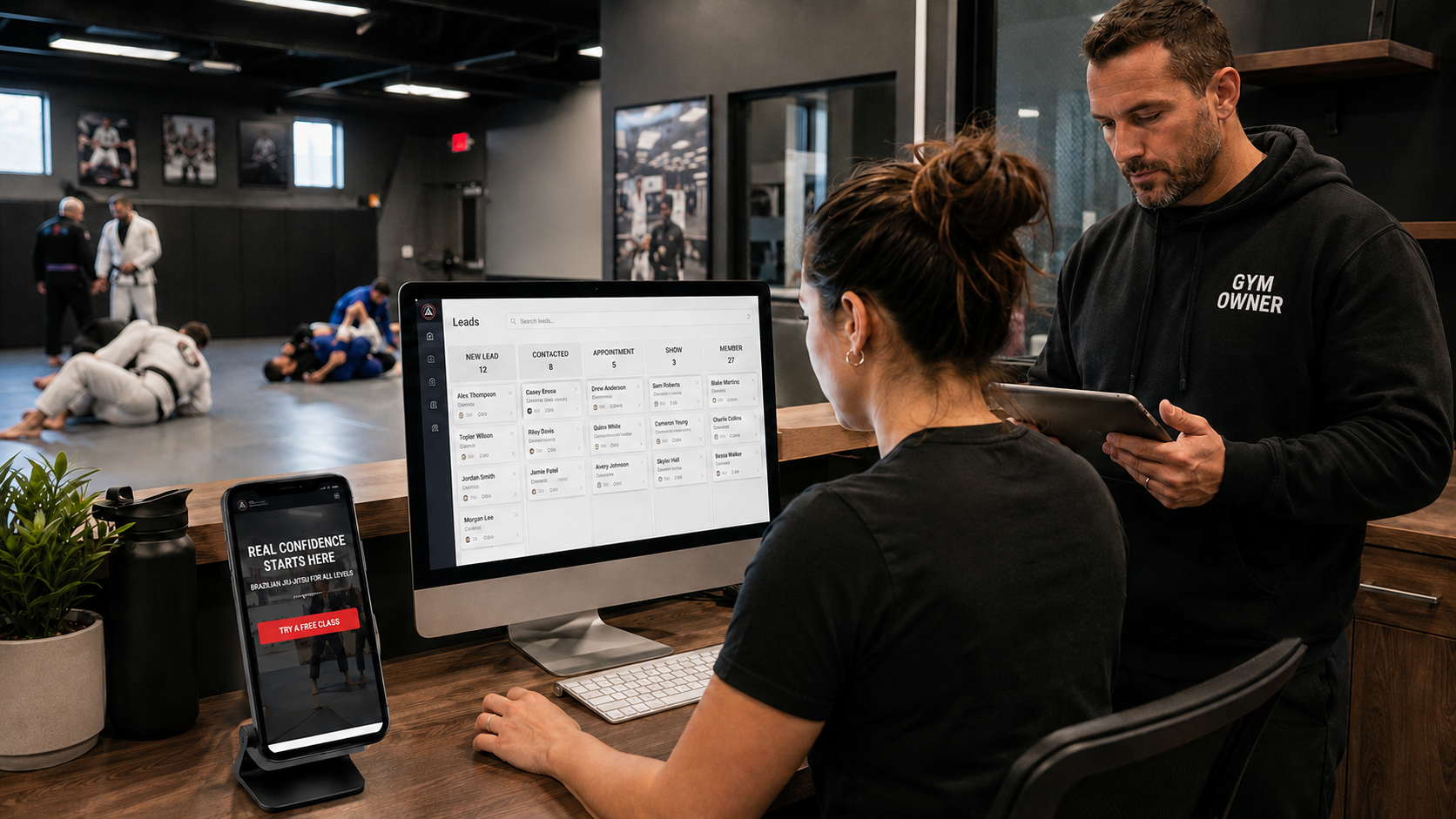
Leak #2: The Lead Enters Your CRM , Then Nothing Happens Fast Enough
Getting someone's contact information is not the win. It's the beginning of the sales process.
The prospect may have submitted information to your gym, but that doesn't mean they stopped looking at other schools. They may still be comparing schedules, pricing, distance, class types, reviews, and how each gym communicates with them.
If your response comes much later, the prospect's interest may already be cooling. This is where a good CRM becomes more than a database. The CRM should help your team know:
- when a new lead arrives,
- who owns the follow-up,
- whether contact has been attempted,
- what the prospect is interested in,
- what stage they're in,
- and what needs to happen next.
Without that structure, leads don't always get intentionally rejected. They simply get forgotten.
Here's the play: Map the first 24 hours after a new inquiry enters your system. Ask:
Who responds first?
What happens if they don't answer?
When is the second attempt?
Is there an automated text or email?
Does a staff member still make a personal contact attempt?
Where is the outcome recorded?
If your answer to any of those questions is, “It depends who sees the lead,” you don't have a repeatable lead-handling system yet.
Leak #3: Your Follow-Up Ends Too Soon
One of the biggest mistakes in martial arts sales is treating a lack of immediate response as a lack of interest.
A parent fills out a form while sitting in the school pickup line.
An adult looks into BJJ after work but gets distracted by dinner, kids, and everything else happening that evening.
Someone considers joining, then payday comes next week.
A prospect might genuinely want what you offer and still fail to respond to the first text or phone call.
If your entire sales process is: “We called once and they didn't answer,” then you're allowing timing to make the buying decision for them. Good follow-up doesn't mean harassing people. It means creating a professional, consistent process that gives interested prospects multiple opportunities to reconnect.
Here's the play: Create a defined follow-up sequence rather than relying on memory. That could include a combination of:
- calls,
- text messages,
- emails,
- appointment reminders,
- educational content,
- testimonials,
- FAQs,
- and personal check-ins.
The important part isn't sending the same “Are you still interested?” message eight times. Each touch should help move the prospect forward by answering a question, removing uncertainty, or making the next step easier.
Leak #4: You're Booking Trials, but Too Many People Never Show Up
A scheduled trial feels like progress. But the business doesn't grow from appointments on the calendar.
It grows when people actually walk through the door.
If your gym books a healthy number of appointments but consistently experiences no-shows, the problem may not be lead generation at all.
It may be what happens between booking and arrival.
A prospect can become less certain after scheduling. They start wondering:
What should I wear?
Will everyone be more experienced than me?
Will I get thrown into sparring?
Where do I park?
Will I embarrass myself?
Can I bring my child inside?
How long does the class last?
Those may sound like minor questions to an experienced gym owner. For someone who has never stepped onto a martial arts mat, they can feel like real barriers.
Here's the play: Treat the period between appointment booking and the first visit as part of the sales process.
Confirm the appointment.
Tell them exactly what to expect.
Give them simple arrival instructions.
Introduce the coach if appropriate.
Send a reminder.
Make the experience feel familiar before they arrive.
The easier you make that first visit mentally, the more likely the prospect is to actually show up.
Leak #5: Your Trial Class Is Great, but Nobody Owns the Sale
This one happens more than gym owners realize.
The prospect comes in.
They enjoy the class.
The coach does a great job.
Everyone is welcoming.
Then the class ends and somebody says: “Let us know if you want to sign up.”
That's not a sales process.
That's hoping. There needs to be a clear transition between experiencing the gym and becoming a member. Someone should know exactly who is responsible for speaking with the prospect after the class, understanding what they want, answering questions, presenting the appropriate membership option, and asking them to enroll.
Without clear ownership, everyone assumes someone else is handling it. And a warm prospect walks out the door.
Here's the play: Define the post-trial process.
Who talks to them?
When?
Where?
What questions should be asked?
How are membership options presented?
What happens if they aren't ready today?
Your instructors don't need to become aggressive salespeople. But your business does need a professional way of helping an interested person make a decision.
Leak #3: Your Follow-Up Ends Too Soon
One of the biggest mistakes in martial arts sales is treating a lack of immediate response as a lack of interest.
A parent fills out a form while sitting in the school pickup line.
An adult looks into BJJ after work but gets distracted by dinner, kids, and everything else happening that evening.
Someone considers joining, then payday comes next week.
A prospect might genuinely want what you offer and still fail to respond to the first text or phone call.
If your entire sales process is: “We called once and they didn't answer,” then you're allowing timing to make the buying decision for them. Good follow-up doesn't mean harassing people. It means creating a professional, consistent process that gives interested prospects multiple opportunities to reconnect.
Here's the play: Create a defined follow-up sequence rather than relying on memory. That could include a combination of:
- calls,
- text messages,
- emails,
- appointment reminders,
- educational content,
- testimonials,
- FAQs,
- and personal check-ins.
The important part isn't sending the same “Are you still interested?” message eight times. Each touch should help move the prospect forward by answering a question, removing uncertainty, or making the next step easier.
Leak #4: You're Booking Trials, but Too Many People Never Show Up
A scheduled trial feels like progress. But the business doesn't grow from appointments on the calendar.
It grows when people actually walk through the door.
If your gym books a healthy number of appointments but consistently experiences no-shows, the problem may not be lead generation at all.
It may be what happens between booking and arrival.
A prospect can become less certain after scheduling. They start wondering:
What should I wear?
Will everyone be more experienced than me?
Will I get thrown into sparring?
Where do I park?
Will I embarrass myself?
Can I bring my child inside?
How long does the class last?
Those may sound like minor questions to an experienced gym owner. For someone who has never stepped onto a martial arts mat, they can feel like real barriers.
Here's the play: Treat the period between appointment booking and the first visit as part of the sales process.
Confirm the appointment.
Tell them exactly what to expect.
Give them simple arrival instructions.
Introduce the coach if appropriate.
Send a reminder.
Make the experience feel familiar before they arrive.
The easier you make that first visit mentally, the more likely the prospect is to actually show up.
Leak #5: Your Trial Class Is Great, but Nobody Owns the Sale
This one happens more than gym owners realize.
The prospect comes in.
They enjoy the class.
The coach does a great job.
Everyone is welcoming.
Then the class ends and somebody says: “Let us know if you want to sign up.”
That's not a sales process.
That's hoping. There needs to be a clear transition between experiencing the gym and becoming a member. Someone should know exactly who is responsible for speaking with the prospect after the class, understanding what they want, answering questions, presenting the appropriate membership option, and asking them to enroll.
Without clear ownership, everyone assumes someone else is handling it. And a warm prospect walks out the door.
Here's the play: Define the post-trial process.
Who talks to them?
When?
Where?
What questions should be asked?
How are membership options presented?
What happens if they aren't ready today?
Your instructors don't need to become aggressive salespeople. But your business does need a professional way of helping an interested person make a decision.

Leak #6: Your Team Talks About Price Before They Understand the Prospect
Pricing matters.
But if the conversation becomes primarily about dollars before the prospect understands the value of the program, you're making the decision unnecessarily difficult.
A parent may be looking for confidence, discipline, structure, physical activity, or help getting their child away from a screen.
An adult might want fitness, community, stress relief, competition, or the confidence that comes from learning self-defense.
Two prospects asking: “How much is it?” may actually be trying to solve completely different problems. If the sales conversation never gets beyond price and schedule, your team never discovers what the membership is actually worth to that person.
Here's the play: Teach your team to diagnose before they prescribe. Ask questions.
Why are they looking now?
What do they want to change?
Have they tried martial arts before?
What's important to them?
What would make this a successful experience?
Then connect your program to what they actually told you. That isn't manipulation.
It's a better sales conversation.
Leak #7: You Don't Know Where Your Sales Process Is Actually Breaking
This is the most dangerous leak because it makes every other problem harder to diagnose. Imagine your gym generated 100 leads.
How many did you contact?
How many responded?
How many booked?
How many showed up?
How many joined?
How many didn't join but remained in follow-up?
If you don't know those numbers, it's easy to blame marketing every time membership slows down.
But consider two gyms.
Gym A
100 leads
50 contacted
20 appointments
10 showed
5 joined
Gym B
100 leads
85 contacted
50 appointments
40 showed
20 joined
They received the exact same number of leads.
They created dramatically different results.
The difference isn't lead volume.
It's what happened between the lead and the membership.
Here's the play: Track the stages that matter. At minimum, your gym should be able to see:
Lead → Contact → Appointment → Show → Sale
Once you can see those numbers, the conversation changes.
Instead of saying: “Our leads aren't good”, you can say: “We're contacting 80% of our leads, but only 25% are booking appointments.”
That's a problem you can actually work on.
More Leads vs. a Better Sales System
Here's the distinction.
|
❌ Lead-Dependent Growth |
✅ System-Driven Growth |
|
Increase advertising whenever sales slow down |
Diagnose where the funnel is leaking first |
|
Website mostly serves as an online brochure |
Website intentionally drives a next action |
|
Leads live in inboxes and spreadsheets |
CRM shows ownership and pipeline stage |
|
Follow-up depends on staff memory |
Defined follow-up process |
|
One call equals “we followed up” |
Multiple professional contact attempts |
|
Trial is considered the finish line |
Trial is one stage of the sales process |
|
Nobody clearly owns the close |
Sales responsibility is defined |
|
Marketing gets blamed when membership drops |
Conversion metrics identify the real problem |
|
More leads create more opportunities to lose |
Better systems create more memberships from existing demand |

Before You Spend Another Dollar on Leads, Audit These 5 Numbers
You don't need a complicated dashboard to start.
Pull the last 30 to 60 days of lead activity and find these numbers.
1. Lead Contact Rate
What percentage of new leads actually received a meaningful contact attempt?
If the CRM contains dozens of untouched or poorly followed-up prospects, increasing lead volume isn't the first priority.
Fix the response process.
2. Appointment Rate
Of the prospects you reached, how many scheduled a visit?
A low appointment rate can point to problems with messaging, sales conversations, offer positioning, staff training, or simply failing to confidently ask for the appointment.
3. Show Rate
How many scheduled prospects actually walked through the door?
If appointment numbers look healthy but attendance is weak, work on confirmation, reminders, expectation-setting and the pre-visit experience.
4. Close Rate
Of the prospects who showed up, how many became members?
This is where you evaluate the in-gym experience, sales presentation, membership options, staff confidence and follow-up after the trial.
5. Follow-Up Pipeline
How many prospects didn't join immediately but are still being actively followed?
Not every prospect will buy today. A healthy sales system doesn't throw away everyone who says: “I need to think about it.”
Those leads should move into a defined follow-up process rather than disappearing into CRM history.

The Goal Isn't More Leads. It's More Members.
Marketing matters.
You absolutely need a reliable way to create opportunities. But the job isn't finished when somebody fills out a form.
That's where the next system begins.
- Your website needs to turn attention into action.
- Your CRM needs to keep opportunities organized.
- Your team needs to respond consistently.
- Your follow-up needs to keep conversations alive.
- Your appointment process needs to get people through the door.
- Your sales process needs to help the right people become members.
When those pieces work together, marketing becomes much more valuable because you're no longer paying to pour prospects into a funnel full of holes.
And when they don't?
Buying more leads can become an expensive way of avoiding the real problem.
FAQ: Martial Arts Gym Leads, CRM and Sales Conversion
How can a martial arts gym convert more leads into members?
Start by measuring the entire path from inquiry to membership. Track how many leads are contacted, how many book appointments, how many show up, and how many join. Once you know where the biggest drop occurs, improve that specific stage rather than assuming you simply need more leads.
How quickly should a martial arts gym follow up with a new lead?
The best approach is to respond while the prospect's interest is still active and to have a system that prevents new inquiries from sitting unnoticed. More important than chasing a perfect number of minutes is creating clear ownership, notifications and a repeatable process so every lead receives timely attention.
Why aren't my martial arts leads responding?
There can be several reasons. The prospect may be busy, comparing schools, unsure about the program, worried about cost, nervous about starting martial arts, or simply not ready at that moment. One unanswered call doesn't tell you which reason applies. That's why a structured follow-up process matters.
What should a martial arts gym CRM track?
At minimum, your CRM should tell you where each prospect is in the sales process, who owns the next action, the history of communication, scheduled appointments, attendance status, and whether the prospect joined or needs continued follow-up.
How do I reduce trial-class no-shows at my martial arts gym?
Improve the experience between booking and arrival. Confirm the appointment, explain what to expect, answer common first-class questions, send reminders and make arrival instructions simple. A prospect who feels prepared is generally easier to get through the door than one who is still uncertain about what will happen.
Should I generate more leads if my gym isn't growing?
Not automatically. First review your current lead flow and conversion numbers. If you have very little demand entering the business, lead generation may genuinely be the constraint. But if leads are coming in and being lost during contact, booking, show-up or closing, improving the sales system may produce better results before increasing advertising.
What's a good martial arts gym sales process?
A good sales process is simple enough for the team to follow consistently and clear enough to measure. It normally includes lead capture, timely contact, needs discovery, appointment setting, appointment confirmation, a strong first experience, a membership conversation, enrollment and continued follow-up for prospects who don't join immediately.
Stop Treating Marketing and Sales Like Separate Problems
Your ads don't operate in one business and your sales team in another.
They're part of the same growth engine.
The website creates the first impression.
The CRM catches the opportunity.
The follow-up creates the conversation.
The trial builds trust.
The sales process turns the right prospect into a member.
And the numbers tell you which part needs attention next.
That's one of the reasons we're bringing these conversations together at the upcoming Combat Business Tribe Event.
Brian will break down how gym owners can improve their website and CRM, while Day 2 includes a hands-on Sales Implementation Workshop designed to help owners turn the ideas into an actual process they can use inside their gym.
Because the goal isn't to leave with another page of notes saying: “We need to improve follow-up.”
The goal is to leave knowing what happens next, who owns it and how you'll measure whether it's working.
Don't just leave inspired. Leave with it built.
