

What Happens to Your Gym's Revenue When You Take a Week Off
Aug 03, 2026You Already Know the Answer. You Just Haven't Liked It Yet.
Think about the last time you took a real week off.
Not a long weekend. Not a conference where you were still checking messages between sessions. A full week. Phone down. Genuinely away.
Did you take one? Or did you tell yourself you would — and then not quite manage it because something always needed you?
And for the owners who did take one: what did you come back to?
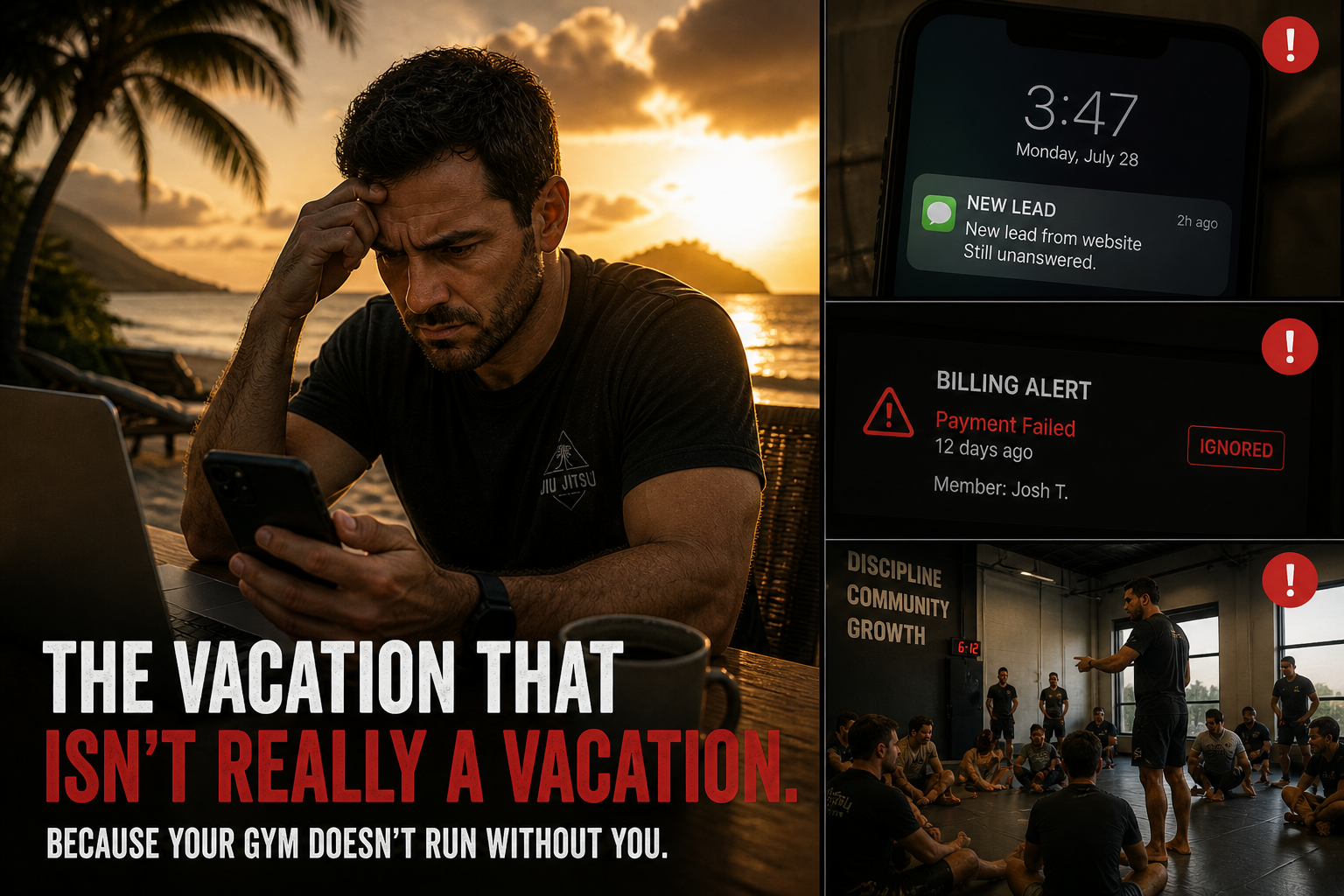
A lead or two that fell through. A renewal that didn't get followed up. A member who texted while you were gone and got a delayed response that felt off. A billing failure nobody caught. An inquiry that went cold while you were on the beach telling yourself to relax.
Nothing catastrophic. Just a slow leak of the things that normally only work because you're there to make them work.
That feeling — the low hum of anxiety that follows you on vacation, the slight dread when you pick your phone up on day four — is not stress. It's information.
It's telling you that your gym runs on you. And that's the problem.
What Actually Happens When You Step Away
Let's be specific. Because "things get a bit messy" undersells it.
Here is the real sequence of events when a gym owner who runs everything personally takes a week off.
Day 1–2: The illusion of control You've briefed the staff. You've front-loaded your energy into the days before you left. Things seem fine. You check in once or twice and nothing is on fire. You start to relax.
Day 3: The first thing slips A lead comes in overnight. Nobody is set up to respond. By morning it's been eight hours. By the time someone notices — or you notice, because you checked even though you said you wouldn't — the lead has gone cold. You draft a message from your phone. It helps. Slightly.
Day 4: The accumulation starts A renewal was due. The member hasn't heard anything. They've been meaning to ask about changing their membership tier anyway, and with nobody proactively reaching out, they've decided to just... let it lapse and see what happens. A billing failure from two days ago is sitting in a report nobody ran. A member who missed their second week in a row hasn't received a check-in because you're the person who normally sends those.
Day 5–7: The quiet drift You're back on your phone more than you planned. You're not present on the vacation. You're not fully present at the gym either. You're somewhere in between — managing by half-measures, not fixing anything properly, not resting properly. And when you get back, the first two days are damage control.
That's not a vacation. That's remote work with worse WiFi.
And the members who drifted? Most of them came back. But some didn't. And you'll never quite know which decisions happened in that window that cost you money.
Why This Is a Systems Problem, Not a Staffing Problem
The instinct when this happens is to blame the team.
"If my staff were more proactive..." "If I had a better manager..." "If people just took more initiative..."
That instinct is understandable. It is also wrong.
The problem is not the people. The problem is that there are no systems for the people to follow.
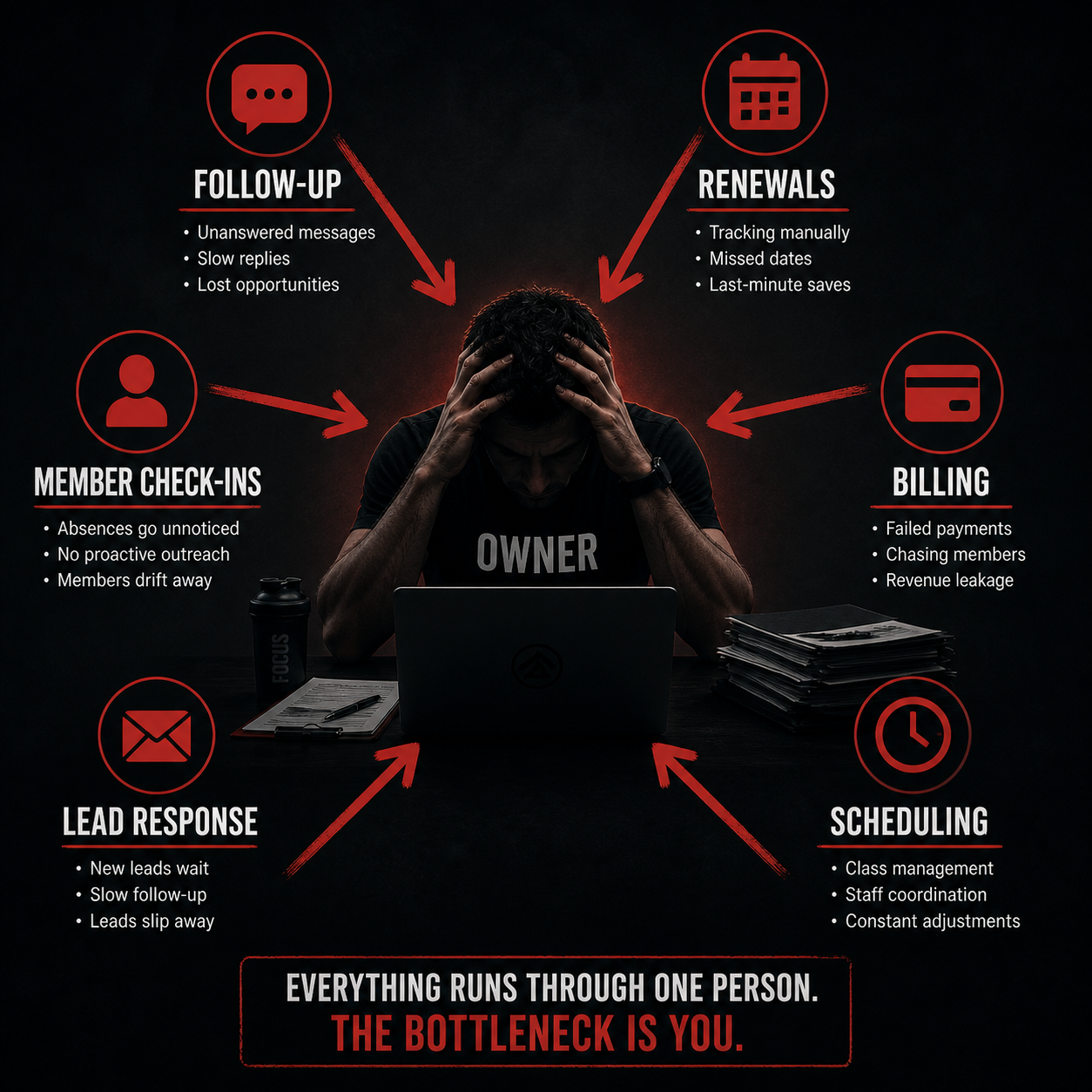
When the owner is present, they are the system. They notice the lead and respond. They remember the renewal and follow up. They sense the at-risk member and reach out. They catch the billing failure and fix it. All of it runs through them — through their attention, their memory, their energy, their presence.
When they leave, none of that has been transferred to a process. So the team — however capable — has no infrastructure to operate inside. They're not underperforming. They're improvising. And improvisation breaks under the complexity and volume of running a real gym.
The fix is not a better hire. The fix is a documented, automated, repeatable system that runs regardless of who is in the building.
A system that fires the follow-up. That triggers the renewal sequence. That catches the billing failure and escalates it correctly. That flags the at-risk member and sends the check-in. That does all the things the owner was personally doing — so the owner can actually step away without the business stepping down.
Here's the play: Before your next week off, ask yourself: for every critical retention and revenue task that normally happens — can you point to the system that runs it? Not the person. The system. If the answer is "that's me," you have identified exactly what needs to be built.
The Revenue Cost of Owner Dependency
This is not abstract. Let's put numbers on it.
A typical gym in the 40–100 member range, at an average membership of $150/month, carries $6,000 to $15,000 in monthly recurring revenue.
Here is what owner-dependent operations cost that gym per week away:
Leads lost to slow response: 2–4 leads that went cold cost approximately $300–$600 in first-month revenue. Compounded over a year, if the owner takes three weeks off and this pattern holds, that is $900–$1,800 in lost acquisition revenue. Conservatively.
Renewals not proactively handled: 1–2 renewals that lapsed or converted to a lower tier cost $150–$300 per month in recurring revenue. Permanently, unless recovered.
At-risk members who drifted and didn't come back: Even one lost member represents $150/month in MRR — $1,800 per year — plus the cost to reacquire someone at that lifetime value.
Billing failures unresolved: A payment failure sitting for 10 days instead of being caught in 24 hours has a measurably higher cancellation conversion rate. Every billing failure that turns into a cancellation costs $150/month minimum, likely more.
Total conservative weekly cost of owner-dependent operations: $600–$2,700 in identified revenue exposure per week away.
Not counting the invisible costs: the leads who got a slow response and didn't come back, the members who sensed the communication drop and quietly started looking elsewhere, the owner's mental state returning from a vacation that wasn't actually restful.
The boring stuff prints money. And when the owner leaves, the boring stuff stops running.
What a System-Run Gym Looks Like When the Owner Steps Away
Here is the same week — owner away — but this time the systems are in place.
Day 1: Owner leaves. Automated first-touch response fires for every new lead within 90 seconds. Renewal sequence for this month's upcoming renewals is already running. Absence triggers are live.
Day 3: A lead came in on day 2. They got an immediate text, a follow-up email with a booking link, and a calendar that let them schedule their intro trial without anyone manually intervening. The trial is booked for next Tuesday. Nobody had to do anything.
Day 4: A billing failure triggered at 11pm. An automated text went out within the hour. The member updated their card at 7am the next morning. The payment processed. Total time the billing issue was unresolved: 8 hours. Nobody noticed. Nobody needed to.
Day 5: A member hit 14 days of unexpected absence. The re-engagement sequence fired. A check-in text went out. The member replied — life got busy, they'll be back next week. A human on the team saw the reply, responded briefly, flagged it as resolved. Done. No owner involvement required.
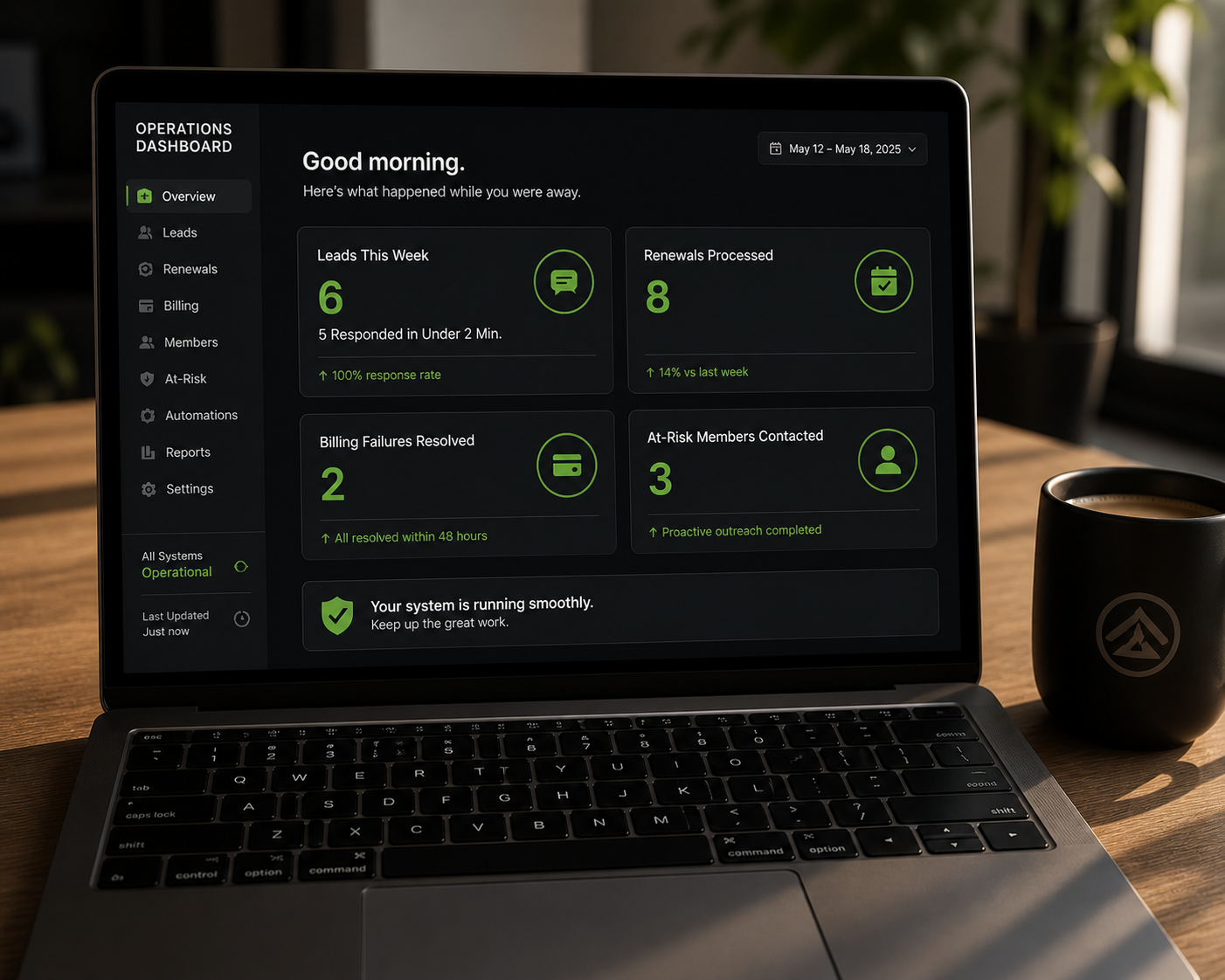
Day 7: Owner comes home. Opens the dashboard. Reviews the week. Sees the bookings, the renewals processed, the billing recovery, the re-engagement responses. Has one or two things to personally follow up on. No damage control. No catching up. Just a normal Monday.
That is not a fantasy. That is what a system-run gym looks like in practice.
And the difference between that gym and the first one is not staff quality, budget, or market. It is infrastructure.
System vs. Chaos: Owner Away, One Week
|
❌ Owner-Dependent Gym |
✅ System-Run Gym |
|
Lead response depends on owner checking in |
Automated first-touch fires within 90 seconds, always |
|
Renewals get missed or delayed |
30-day sequence running, no manual triggers required |
|
Billing failures sit until owner notices |
Auto-text within 1 hour, resolved within 24–48 |
|
At-risk members drift with no check-in |
Absence trigger fires at day 10, re-engagement at 14 |
|
Owner checks phone constantly on vacation |
Owner reviews a summary dashboard when they return |
|
Staff improvise without clear process |
Staff operate inside defined systems with clear escalation |
|
Revenue wobbles every time owner steps back |
Revenue is protected by process, not presence |
|
Owner returns to damage control |
Owner returns to a normal Monday |
The 4 Systems That Make a Gym Owner-Independent
You do not need to automate everything. You need to automate the four functions that currently run only because you're there.
System 1: Lead Response Every inbound lead — form, DM, missed call — triggers an immediate automated response with a booking link. No human required for first contact. Human involvement begins at the conversation stage, not the response stage.
System 2: Renewal Management 30-day sequence — heads up, value reminder, booking link, confirmation, personal follow-up for exceptions. Set once. Runs every renewal cycle. Owner touches only the genuine exceptions.
System 3: Billing Recovery Failed payment auto-text within one hour. Day 2 follow-up. Day 4 personal escalation. Friendly tone, direct link, fast resolution. Nobody needs to run a report to find it.
System 4: Retention Monitoring Absence trigger at day 10. Re-engagement sequence at day 14, 21, 30. High-risk member flags for priority outreach. System catches the drift. Human handles the conversation.
Build these four. Hand them to a team or a service to run. Take the week off.
That is what Tribe Revenue Team installs — so you stop being the system and start being the owner.
FAQ: Martial Arts Gym Owner Systems, Burnout, and Building a Gym That Runs Without You
Why do martial arts gym owners struggle to take time off?
Because most gym owners have built a business that runs on their personal presence rather than on documented systems. Follow-up, renewals, billing, member communication — all of it passes through the owner's attention and memory. When they step away, the system steps away with them. This is not a character flaw or a management failure. It's a structural problem that gets more expensive the longer it goes unaddressed. The fix is not being more disciplined about disconnecting. It is building systems that run consistently without requiring the owner to be the trigger.
What is the revenue impact of a martial arts gym owner taking a week off without systems?
For a gym with 40–100 members and average membership value of $150/month, a week without operational systems typically results in 2–4 leads going cold, 1–2 renewals handled late or missed, at least one billing failure sitting unresolved past the recovery window, and 1–3 at-risk members receiving no retention outreach. Conservative revenue exposure from one week off is $600–$2,700 in identified losses. The unidentified losses — members who quietly drifted, leads who went elsewhere — are harder to count and typically higher.
How do I make my BJJ or MMA gym less dependent on me as the owner?
Start by identifying every critical revenue and retention function that currently happens because you make it happen. Then ask: can I document this as a process? Can I automate the trigger? Can I hand the execution to a system or a team member with clear instructions? The four highest-priority functions to systematise are lead response, renewal management, billing recovery, and absence monitoring. Build those four systems first. The gym will not become owner-independent overnight, but it will become measurably less fragile within 30 to 60 days.
Is martial arts gym owner burnout common?
Yes, and it's underreported. Most gym owners at the 2–5 year mark are carrying more operational weight than is sustainable — running classes, managing staff, handling marketing, chasing payments, and personally managing member relationships simultaneously. The initial hustle that built the gym becomes the structural problem that limits it. Burnout in this context usually doesn't look like a dramatic breakdown. It looks like a persistent low energy, an inability to fully switch off, declining enthusiasm for parts of the business that used to be energizing, and a creeping awareness that the gym is running them rather than the other way around.
What is the difference between a gym that scales and one that stays stuck?
Systems. A gym that scales has documented, repeatable processes for its core functions — lead handling, member retention, billing, communication — that run independently of the owner's daily involvement. A gym that stays stuck has the owner as the process. The revenue ceiling for an owner-dependent gym is almost always the owner's personal capacity. The moment they get sick, take a vacation, or have a difficult month, the ceiling drops. Gyms that grow past 100, 150, 200 members consistently have built operational infrastructure that doesn't require the owner to be present for normal functions to run.
Can a small martial arts gym afford to build these systems?
The more relevant question is whether a small gym can afford not to. Most of the systems described — absence triggers, renewal sequences, billing recovery flows — can be built inside existing gym management platforms and basic CRM tools at low or no additional cost. The investment is time upfront: writing the messages, setting the triggers, documenting the processes. The return is measurable within the first month — in leads not lost, renewals not missed, billing failures resolved faster, and owner time not spent on tasks that should be automated.
What does Tribe Revenue Team do for a gym owner who is the bottleneck?
TRT installs and runs the operational systems that currently exist only inside the owner's head and calendar. Absence tracking, renewal sequences, billing recovery, re-engagement campaigns, and member communication all move from owner-dependent to system-dependent. The owner stops being the trigger for every retention and revenue function and starts being the closer — present for conversations that need a human, absent from tasks that should be automated. Most owners who go through TRT describe the first month as the first time their gym has felt like a business rather than a job.

The Gym That Runs Without You Is Not a Fantasy. It's a Build.
You built the gym. You built the culture. You are probably the best coach in the room and the hardest worker in the building.
And that is exactly the problem.
Because a gym that runs on your presence, your energy, and your memory is a gym with a single point of failure. And that single point of failure is you.
Every week you can't fully step back is a week the business owns you instead of the other way around. Every vacation that isn't really a vacation is a signal. Every return from time off that starts with damage control is data.
The gym you want — the one that runs clean when you're away, that doesn't drop leads when you're sick, that doesn't wobble when life happens — that gym is a build, not a hire.
It is four systems. Installed. Running. Maintained.
That is what Tribe Revenue Team does for established gym owners who are done being the bottleneck.
Take the week off. The gym should be fine. If it's not — that's the problem TRT fixes.
→ Stop Being the Bottleneck → Tribe Revenue Team
Want to see how retention systems hold revenue through summer specifically? Read the summer retention playbook — same operator-first approach, built for the same problem.
