
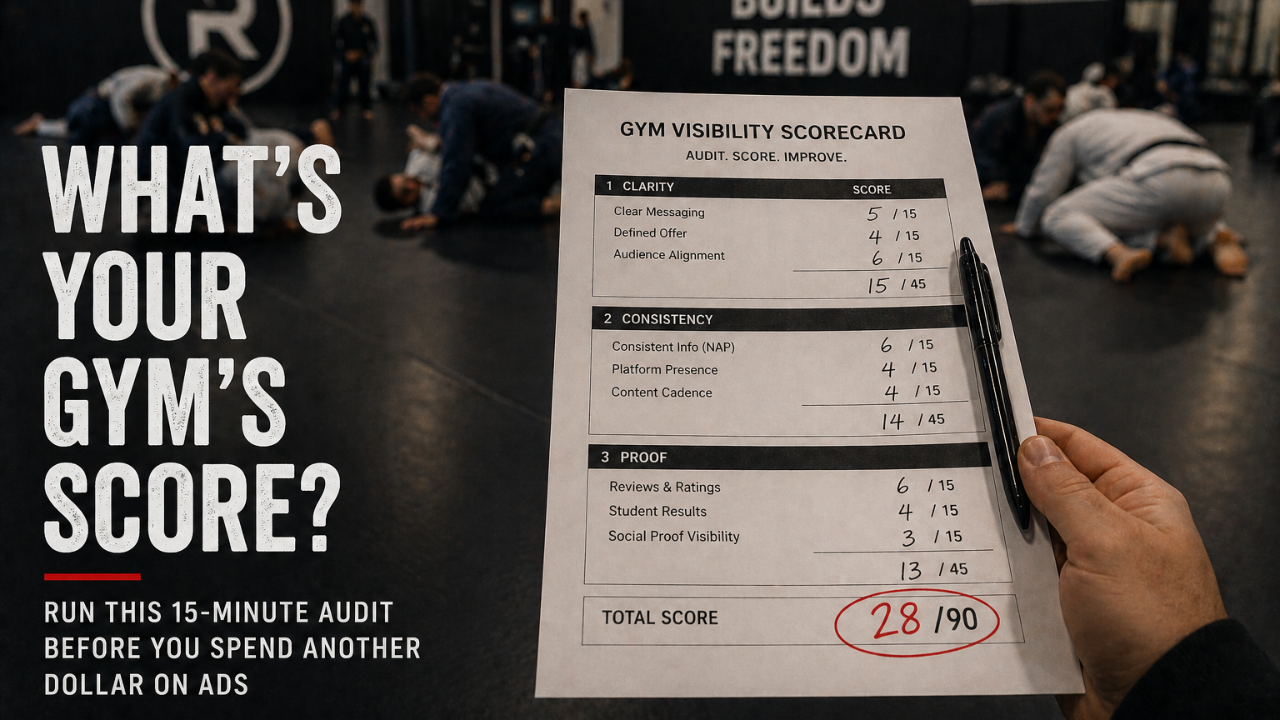
How to Run a 15-Minute Gym Growth Audit (And What the Score Means)
Jun 15, 2026Most Gym Owners Have No Idea What Their Score Is
Not a rough idea. No idea.
They know things are inconsistent. They know the leads aren't converting the way they should. They know the mat isn't as full as the ad spend would suggest it ought to be.
But they couldn't tell you their AI visibility score. They couldn't tell you how many of their local directory listings are wrong. They couldn't tell you what a new lead sees when they Google the gym, look at the reviews, and try to figure out whether to book.
This is not a criticism. It's a system gap.
You can't fix what you haven't scored. And most gym owners have been running on instinct and optimism instead of a real baseline.
This blog fixes that. In 15 minutes, you'll have a score. You'll know what it means. And you'll know exactly what to do first.
The boring stuff prints money. But first you have to know what the boring stuff is.

Before You Start: What This Audit Actually Measures
This is not a feelings audit. It is not "how do you think your marketing is going?"
It is a structured score across three dimensions that directly affects whether your gym gets found, trusted, and chosen by people who are actively looking for what you offer.
Dimension 1: Clarity Can a new visitor (human or AI) immediately understand what your gym is, who it's for, and where it's located? Clarity determines whether you make the shortlist when someone searches "best BJJ gym near me" or asks an AI tool for a recommendation.
Dimension 2: Consistency Do all your local listings (Google, Apple Maps, Facebook, Yelp, and the directories that feed them) agree on your name, address, and phone number? Inconsistency suppresses local rankings and confuses AI search tools that are trying to verify your business is real and reliable.
Dimension 3: Proof Does your digital presence show enough social evidence (reviews, photos, testimonials, real results) that a skeptical stranger would feel confident booking? Proof is what converts a curious click into an actual intro class.
Each dimension scores 0–33. Total score is 0–100.
- 0–39: Invisible. AI tools and local search are not recommending you.
- 40–59: Inconsistent. You show up sometimes, but the signals are mixed.
- 60–79: Competitive. You're in the conversation, but there are clear gaps.
- 80–100: Recommendation-ready. AI and local search treat you as a trusted source.
Got it? Good. Start the clock.
Section 1: Clarity Check (5 Minutes)
Open your gym's homepage. Open your Google Business Profile. Do these checks.
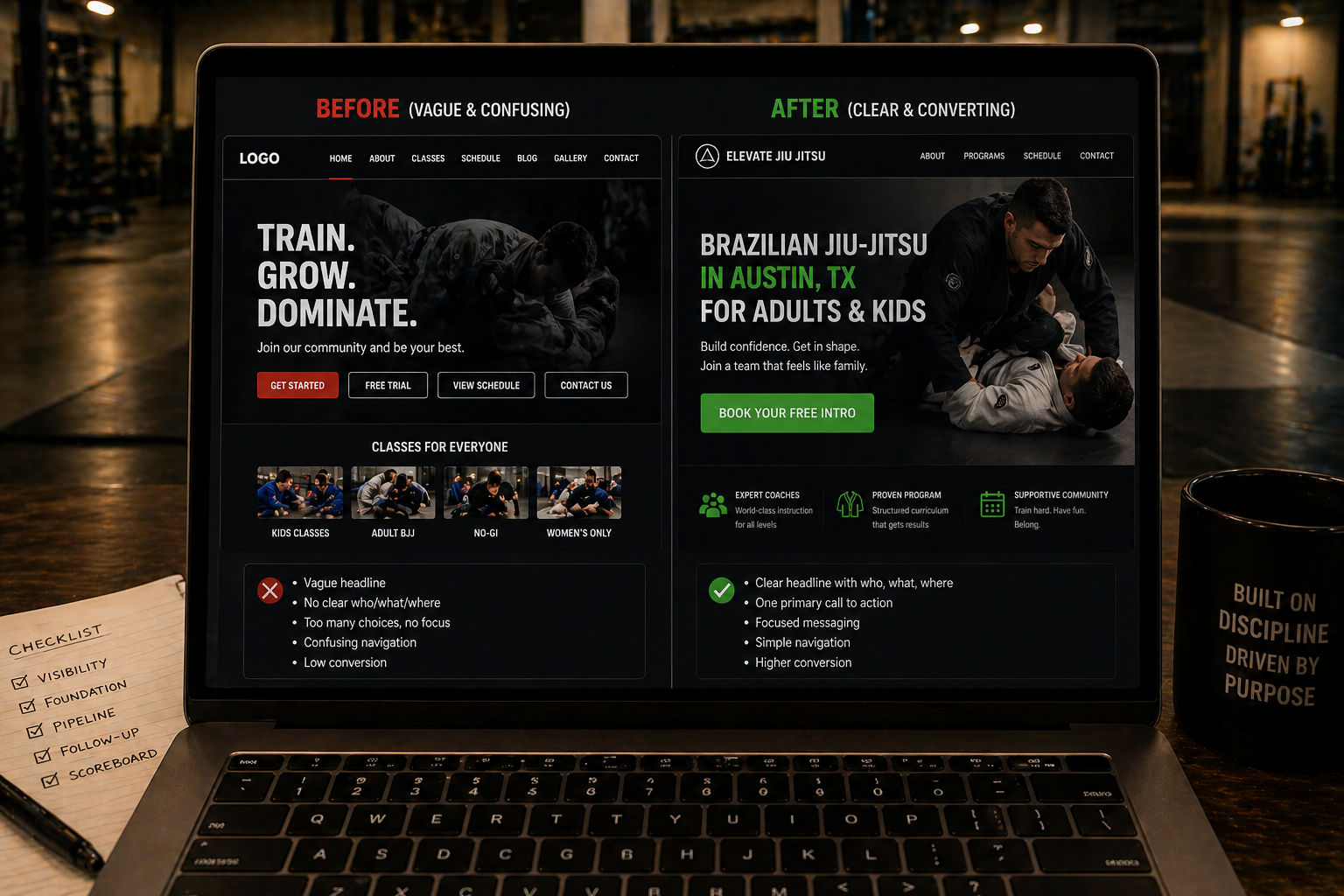
Check 1: The 5-Second Test Read your homepage headline. Without reading anything else on the page, can a total stranger answer these three questions?
- What kind of gym is this? (BJJ? MMA? Karate?)
- Who is it for? (Adults? Beginners? Competitors? Kids?)
- Where is it? (City? Neighborhood?)
If the answer to any of those is "not immediately”, that's a Clarity failure. Headlines like "Train. Grow. Dominate." say nothing that an AI system or a new lead can act on.
Score yourself:
- All three answered clearly above the fold → 10 points
- Two of three answered → 6 points
- One or none → 2 points
Check 2: Program Offers — Are They Specific? Look at your classes or programs page. For each program listed, ask: does this page tell a beginner who the class is for and what to expect in their first session?
"Gi BJJ – Monday/Wednesday/Friday 6pm" is not a program description. It's a schedule entry.
A beginner landing on that page has no idea if they belong in that class, what level it's for, or whether they'll survive it.
Score yourself:
- All major programs have a description of who they're for and what to expect → 10 points
- Some do, some don't → 5 points
- Programs are listed but not described → 1 point
Check 3: Is There One Clear CTA? Look at your homepage. Count how many different calls to action exist (buttons, links, pop-ups). "Book a Trial," "Contact Us," "See Schedule," "Follow on Instagram," "Learn More" all count.
More than two primary CTAs = confusion = lower conversion.
Score yourself:
- One dominant CTA, clear and specific ("Book Your Free First Class") → 10 points
- Two CTAs, both relevant → 6 points
- Three or more, or vague language → 2 points
Clarity Section Total: ___ / 30
Section 2: Consistency Check (5 Minutes)
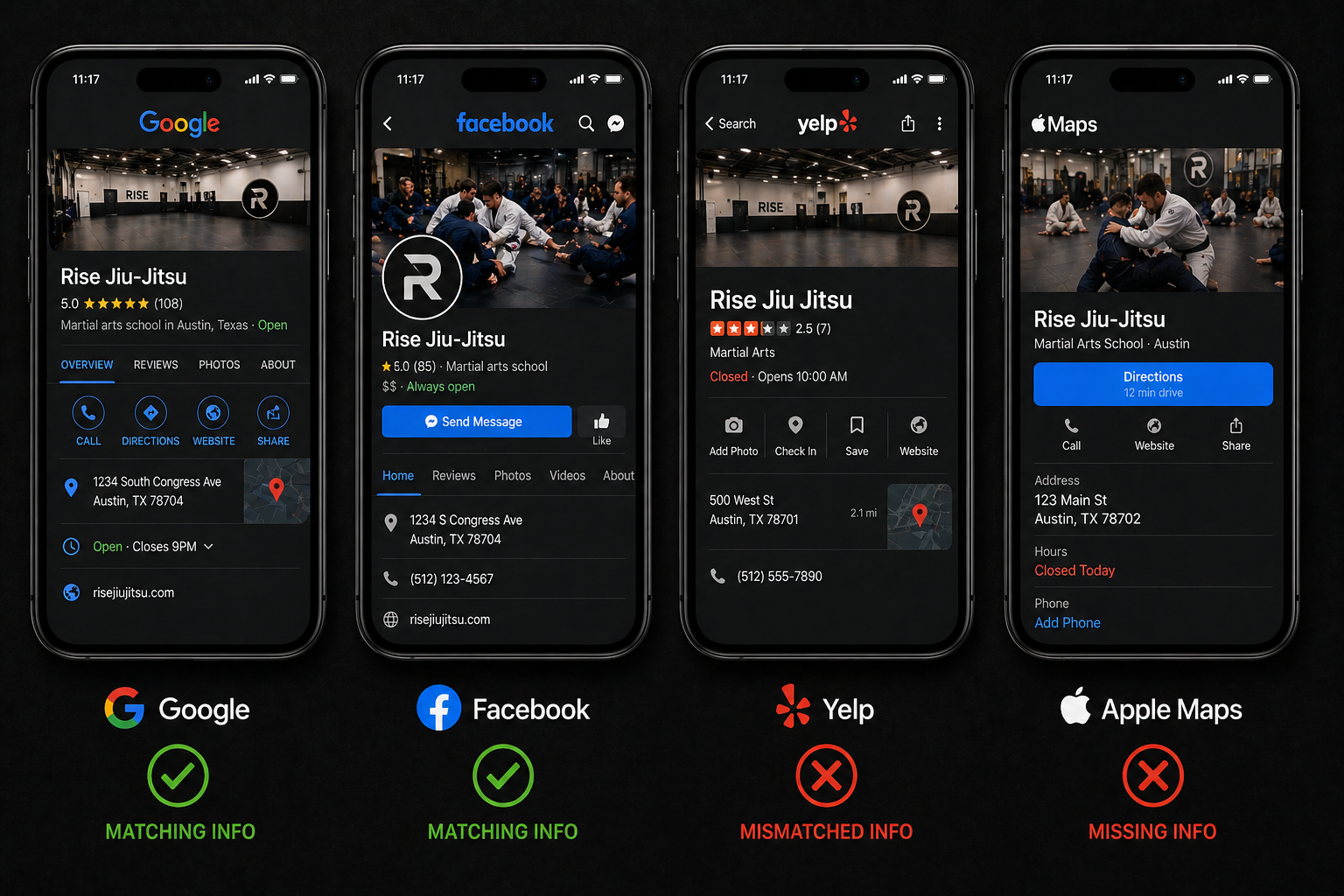
Open four tabs: Google Business Profile, Facebook page, Yelp listing, Apple Maps. You're looking for one thing — do they all say the same thing?
Check 4: NAP Consistency NAP = Name, Address, Phone. Check each platform.
Common issues:
- Old address still showing on one listing after a move
- Phone number missing from two out of four platforms
- Gym name listed differently ("Combat BJJ" on Google, "Combat Brazilian Jiu-Jitsu" on Yelp, "Combat Gym" on Facebook)
- Hours wrong or missing on two platforms
AI search tools cross-reference these signals to verify your business. Mismatches get flagged as unreliable. Unreliable sources don't get recommended.
Score yourself:
- All four platforms match exactly on name, address, phone → 10 points
- Two to three match, one has an error or is missing data → 5 points
- Multiple mismatches or missing listings → 1 point
Check 5: Google Business Profile — Is It Complete?
A thin GBP is a suppressed GBP. Check yours against this list:
- [ ] Business category set correctly (Martial Arts School, BJJ Gym, etc.)
- [ ] Description includes what you teach, who it's for, and your location
- [ ] Hours are accurate and up to date
- [ ] At least 10 photos of real training (not stock)
- [ ] Q&A section has at least one answered question
- [ ] Posts section has been updated in the last 30 days
Score yourself:
- All six items complete → 10 points
- Four to five complete → 6 points
- Three or fewer → 2 points
Check 6: Are You in the Local AI Conversation?
Here's the real test. Open ChatGPT or Google and type:
"What's the best BJJ gym in [your city]?"
or
"Best MMA gym for beginners near [your neighborhood]"
Does your gym appear? If yes — where? If no — that's your answer.
Steal this test: Run it on three different queries. Note what information the AI uses to describe the gyms it does recommend. That is exactly what your profile needs to say about you.
Score yourself:
- Appears in AI and local results on at least two queries → 10 points
- Appears on one → 5 points
- Does not appear → 0 points
Consistency Section Total: ___ / 30
Section 3: Proof Check (5 Minutes)
This is the section most gym owners underestimate. Proof is what converts a cautious lead into a booked intro. Without it, even a visible and consistent gym leaves leads on the fence.
Check 7: Google Reviews — Volume and Recency
How many Google reviews does your gym have? When was the last one posted?
Here's the truth: 12 reviews from three years ago is not proof. It's a dormant profile. A skeptical lead doing research wants to see recent activity — reviews from the last 30 to 90 days that confirm the gym is alive, active, and worth trying.
Score yourself:
- 40+ reviews, at least 5 posted in the last 90 days → 10 points
- 20–39 reviews with some recent → 6 points
- Under 20 reviews or nothing recent → 2 points
Check 8: Website Social Proof
Open your gym's homepage and about page. Score what you see:
- [ ] At least two member testimonials with real names (not "- John D.")
- [ ] At least one before/after result or transformation story
- [ ] Real photos of your actual members training (not stock photography)
- [ ] At least one coach bio with credentials and a real photo
Score yourself:
- All four present → 10 points
- Two to three present → 5 points
- One or none → 1 point
Check 9: Does Your Proof Answer the Beginner's Fear?
This is the most overlooked check of all.
Most people who are considering a martial arts gym are afraid of one or more of these things:
- Being the only beginner in a room of experienced people
- Getting hurt
- Looking stupid
- Not being in good enough shape
- Not fitting in with the culture
Does your website or Google profile address any of those fears directly?
Here's the play: Find one review, one testimonial, or one piece of content on your site that says something like "I was completely new and had no idea what I was doing — and the coaches made it easy from day one." If you can't find it, you don't have it — and that silence is costing you beginner leads.
Score yourself:
- Clear beginner-friendly messaging on homepage and backed by reviews → 10 points
- Some beginner messaging but no review evidence → 5 points
- Nothing addressing beginner concerns → 1 point
Proof Section Total: ___ / 30
Add Up Your Score
|
Section |
Your Score |
Maximum |
|
Clarity |
___ |
30 |
|
Consistency |
___ |
30 |
|
Proof |
___ |
30 |
|
Total |
___ |
90 |
(The total is 90 because we've given you 9 checks at 10 points each — the full 100-point version includes additional technical checks done in the full audit.)
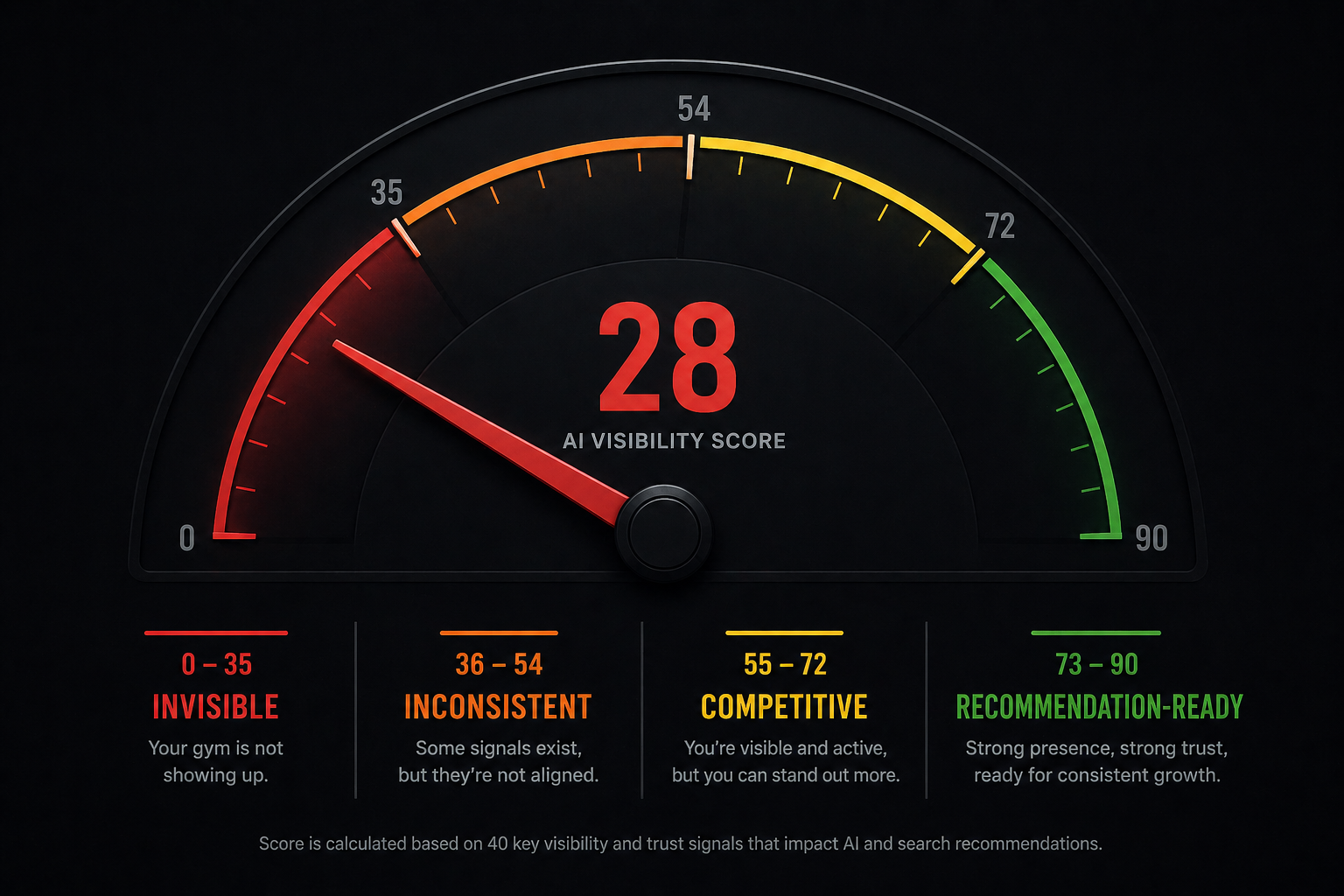
What Your Score Means
0–35: Invisible Your gym is not being found, recommended, or trusted by people actively looking for what you offer. The gaps are foundational — clarity, listings, proof. These need to be fixed before more ad spend makes sense. Every dollar you spend on ads right now is landing on a broken foundation.
36–54: Inconsistent You show up sometimes. But the experience is patchy. Some listings are accurate, some aren't. Some proof exists, but it's thin. You're in the conversation occasionally — but you're not winning it reliably. The fixes here are specific and fast-moving once identified.
55–72: Competitive You have a real presence. There are visible gaps, but you're in the running. The work at this stage shifts from foundation repairs to conversion optimization — tightening follow-up, improving offer clarity, building the proof layer more intentionally.
73–90: Recommendation-Ready Your gym's digital foundation is strong. AI tools can find you, understand you, and recommend you. The focus at this stage is pipeline — making sure the leads your visibility generates are being handled, followed up with, and converted efficiently.
System vs. Chaos: What Each Score Zone Looks Like in Real Life
|
Score Zone |
What the Owner Experiences |
|
0–35 (Invisible) |
Runs ads, gets some clicks, almost no bookings. Thinks the ad is the problem. It's not. |
|
36–54 (Inconsistent) |
Gets occasional leads but can't predict them. Some months are fine, others aren't. No clear reason why. |
|
55–72 (Competitive) |
Has a decent presence but leaves leads on the table. Follow-up is inconsistent. Proof is thin. |
|
73–90 (Recommendation-Ready) |
Showing up in AI and local search. Leads coming in. The next problem is pipeline — handling them well. |
Most gyms that come to Combat Business Success for the first time score between 22 and 45. Not because they're doing a bad job. Because nobody told them what the score was.
What to Do With Your Score
If you scored 0–35: Stop running ads until the foundation is fixed. You're paying for traffic that lands on a gym that can't be understood, trusted, or found. Fix the homepage headline. Correct your local listings. Get your review count above 30. Then revisit your ad strategy.
If you scored 36–54: Pick the one check you scored lowest on and fix it this week. Probably either NAP consistency or proof. Both are fast fixes with meaningful impact on local ranking and AI visibility.
If you scored 55–72: Your visibility is workable. The next leverage point is almost certainly your lead pipeline — what happens after someone finds you and expresses interest. That's where the booking gap lives for gyms in this range.
If you scored 73–90: The foundation is there. The question is whether your lead handling matches your visibility. If your response time is slow, your follow-up is inconsistent, or your intro show rate is under 60%, you're leaving money on the table.
Here's the play regardless of your score: The full audit goes deeper than this 15-minute version. It includes technical checks — schema markup, page load speed, structured data, AI crawlability — that this self-audit doesn't cover. And it comes with a prioritized fix list, not just a number.
→ Get the full gym growth audit through LeadMax and find out exactly what's costing you the most right now.
FAQ: Gym Growth Audits and AI Visibility for Martial Arts Gyms
What is the difference between a gym growth audit and an SEO audit?
A traditional SEO audit focuses on technical website factors like page speed, backlinks, keyword rankings. A gym growth audit covers those elements but adds two layers that matter more for local martial arts gyms: AI visibility (whether your gym is being recommended by tools like ChatGPT and Google SGE) and lead conversion health (whether your pipeline, follow-up, and proof layer are converting the leads your visibility generates). An SEO audit tells you how the site performs. A gym growth audit tells you why the mat isn't full.
How often should a martial arts gym run a growth audit?
A full audit should be run at least quarterly. Local listing data can drift; meaning old information resurfaces, listings get edited by third parties, new directories pull stale data. Review volume and recency decay over time without an active strategy. AI visibility can shift with algorithm changes. A quarterly scorecard keeps the gym's digital foundation accurate and competitive without requiring constant attention.
Can I fix my gym's AI visibility without hiring an agency?
Some of it, yes. Rewriting your homepage headline, correcting local listings, and running a review campaign are all things a gym owner can do without outside help. The harder fixes — schema markup, structured data, AI crawlability signals — require more technical knowledge. The fastest path is a structured audit that separates what you can fix today from what needs a system behind it.
What is NAP consistency and why does it affect my gym's ranking?
NAP stands for Name, Address, and Phone number. When these details appear differently across Google, Facebook, Yelp, Apple Maps, and local directories, search engines and AI tools receive conflicting signals about your business. That conflict reduces trust in your listing and suppresses your ranking in local search results and AI recommendations. It's one of the fastest fixes with one of the highest impacts on local visibility and most gyms have at least one mismatch.
Why isn't my BJJ gym showing up when people search for it on AI tools like ChatGPT?
AI tools pull from publicly available information: your website, Google Business Profile, reviews, and third-party mentions. If your homepage doesn't clearly describe what your gym is and who it serves, if your local listings are incomplete or inconsistent, or if your review volume is low, AI tools don't have enough reliable signal to recommend you confidently. The fix starts with Clarity and Consistency, making your gym easy for AI systems to understand and verify.
How many Google reviews does a martial arts gym need to be competitive?
For most local markets, 40 or more reviews with an average of 4.7 or higher puts a gym in a competitive position in local search. More important than the total number is recency. A gym with 80 reviews that stopped getting new ones 18 months ago loses ground to a gym with 40 reviews that gets two or three new ones each month. An active review strategy matters as much as the starting volume.
What is the first thing a gym owner should fix after running this audit?
Fix your lowest-scoring section first: Clarity, Consistency, or Proof. If your Clarity score is low, rewrite your homepage headline this week. If Consistency is the gap, do an NAP audit across your four main platforms and correct the errors. If Proof is the issue, send a personal text to your 10 most loyal members asking for a Google review. Each of those fixes takes less than an hour and produces a visible impact on ranking and conversion within 30 days.
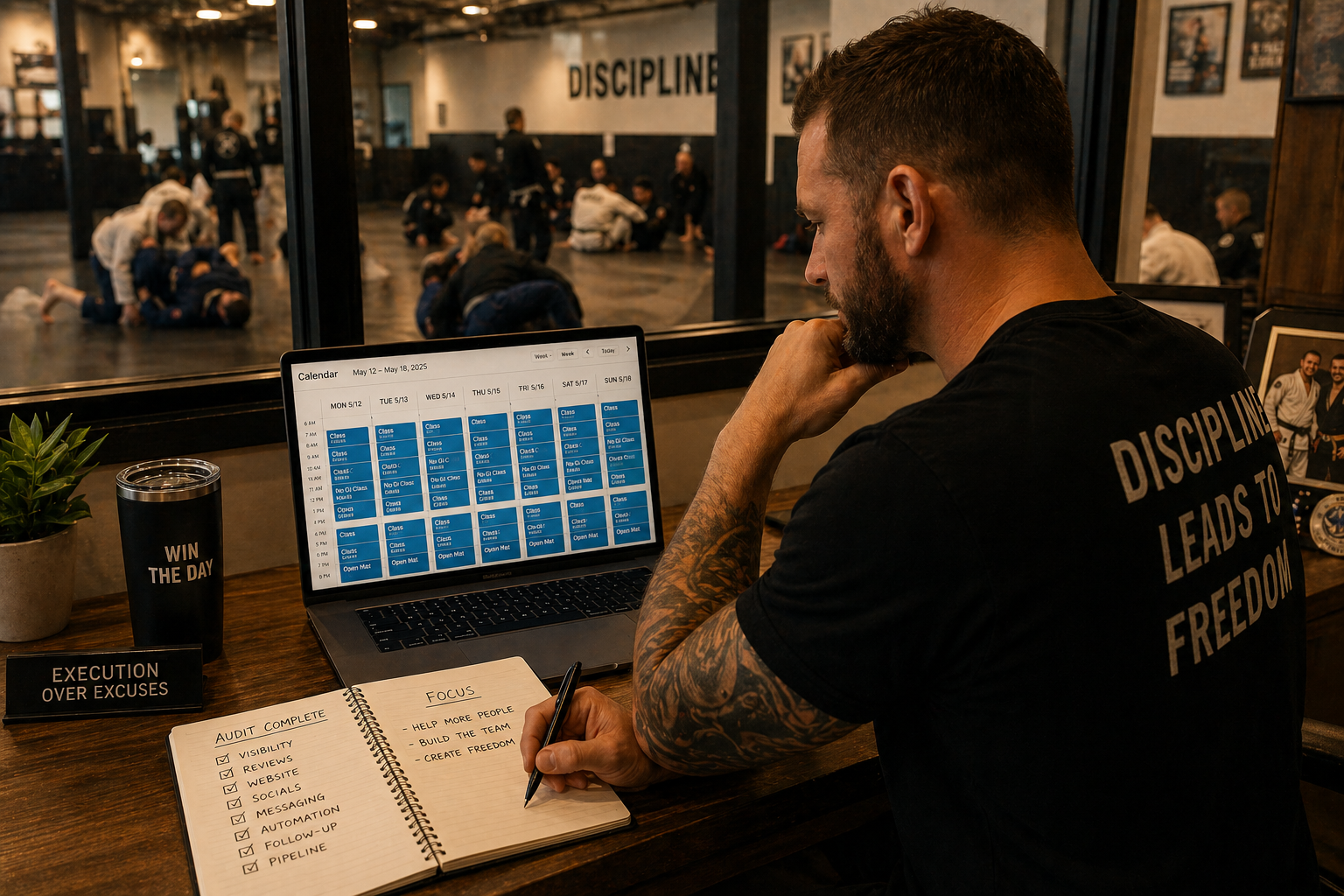
You Have the Score. Now Do Something With It.
A 15-minute audit is a starting point, not a finish line.
The score tells you where you are. The system is what moves it.
Most gym owners who run this audit for the first time land below 50. Not because they've been negligent, but because nobody handed them a scorecard. They've been guessing. Running ads. Hoping the follow-up was good enough. Wondering why the mat isn't fuller.
Now you're not guessing. You have a number. You know which dimension is costing you the most.
The next step is the full audit. The one that goes deeper than this 15-minute version, includes technical visibility checks, and comes with a prioritized action list specific to your gym.
Then LeadMax handles the pipeline. The follow-up. The lead capture. The system that runs while you're on the mat.
You don't need another agency. You need a score and a system.
→ Get Your Full Gym Growth Audit → LeadMax
Want to see what the audit looks like in action? Read the Combat Business Success case study on what actually moved the numbers.
