
Summer Retention Playbook for BJJ and MMA Schools (Stop the Summer Slide Before It Starts)
Jun 29, 2026Summer Is Coming. And so is the Dip.
Every gym owner who's been in the game more than a year knows what July looks like.
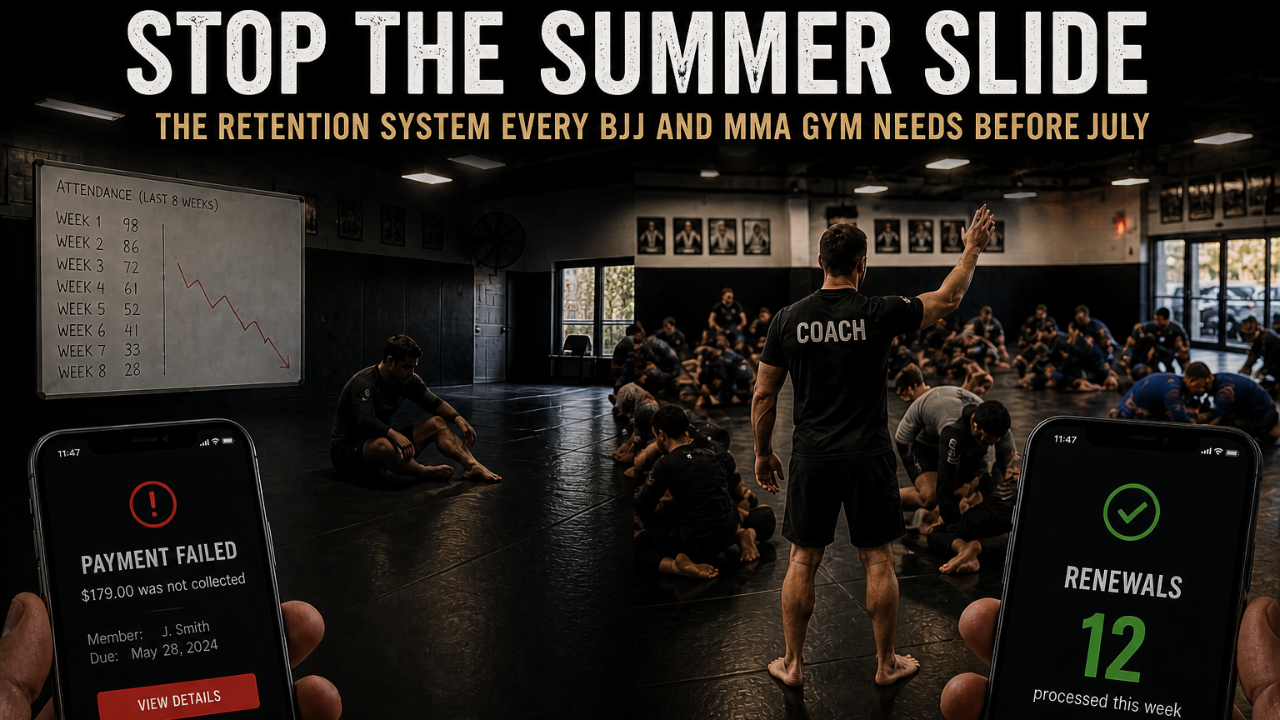
Attendance wobbles. A few long-term members take a break. Renewals that should be automatic get missed. A couple of billing failures go unnoticed for two weeks. Someone you haven't seen in six weeks quietly cancels via text.
And the owner, you, ends up carrying it. Chasing payments. Sending the "hey, haven't seen you" messages. Trying to remember who's up for renewal this month. Plugging holes manually while also running classes, coaching, and keeping the whole operation moving.
This is not a motivation problem. This is a system problem.
The gym that survives summer without a revenue dip is not the one with the most enthusiastic owner. It's the one with a retention system that runs whether the owner is on the mat, on vacation, or just out of bandwidth.
This is that system.
Why Summer Hits Gyms Hard (And Why Motivation Isn't the Fix)
Here's what actually happens between June and August.
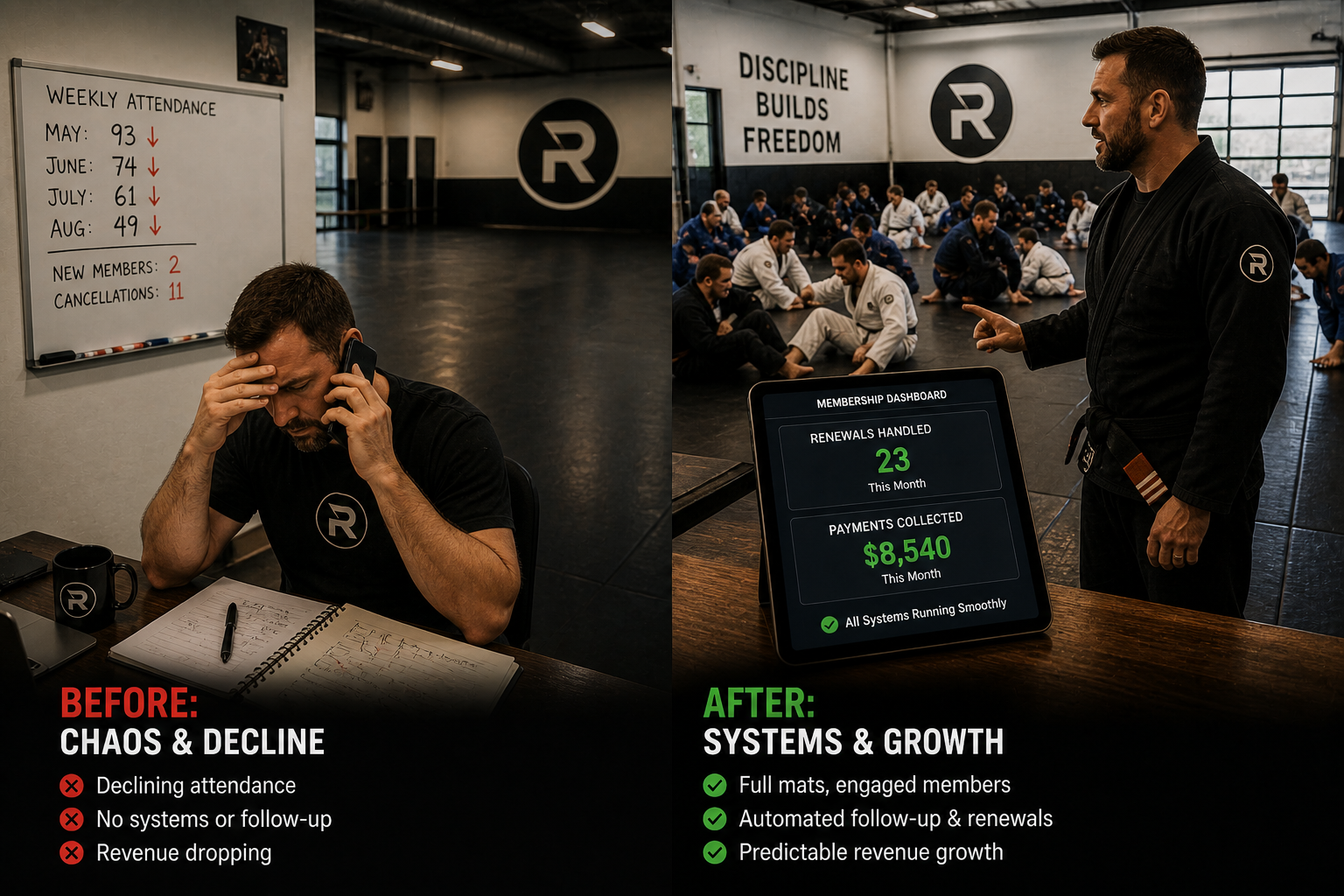
School gets out, and schedules change. Families go on vacation. Adults take time off work and lose their routine. The members who trained because they were already in the habit of showing up start missing sessions and for a lot of them, one missed week turns into two, two turns into a month, and a month turns into a quiet cancellation.
None of that is unusual. It's seasonal. It's predictable. It should be planned for.
But most gyms don't plan for it. They feel it, react to it, and then spend September trying to rebuild what July and August quietly took.
The instinct is to run a new promotion. Offer a discount. Post more on social media. "Get your summer body on the mats" content.
That's lead generation energy applied to a retention problem. It doesn't fix the underlying issue, and it pulls your attention away from the members who are already quietly at risk.
The boring stuff prints money. In summer, the boring stuff is retention. And retention is a system, not a pep talk.
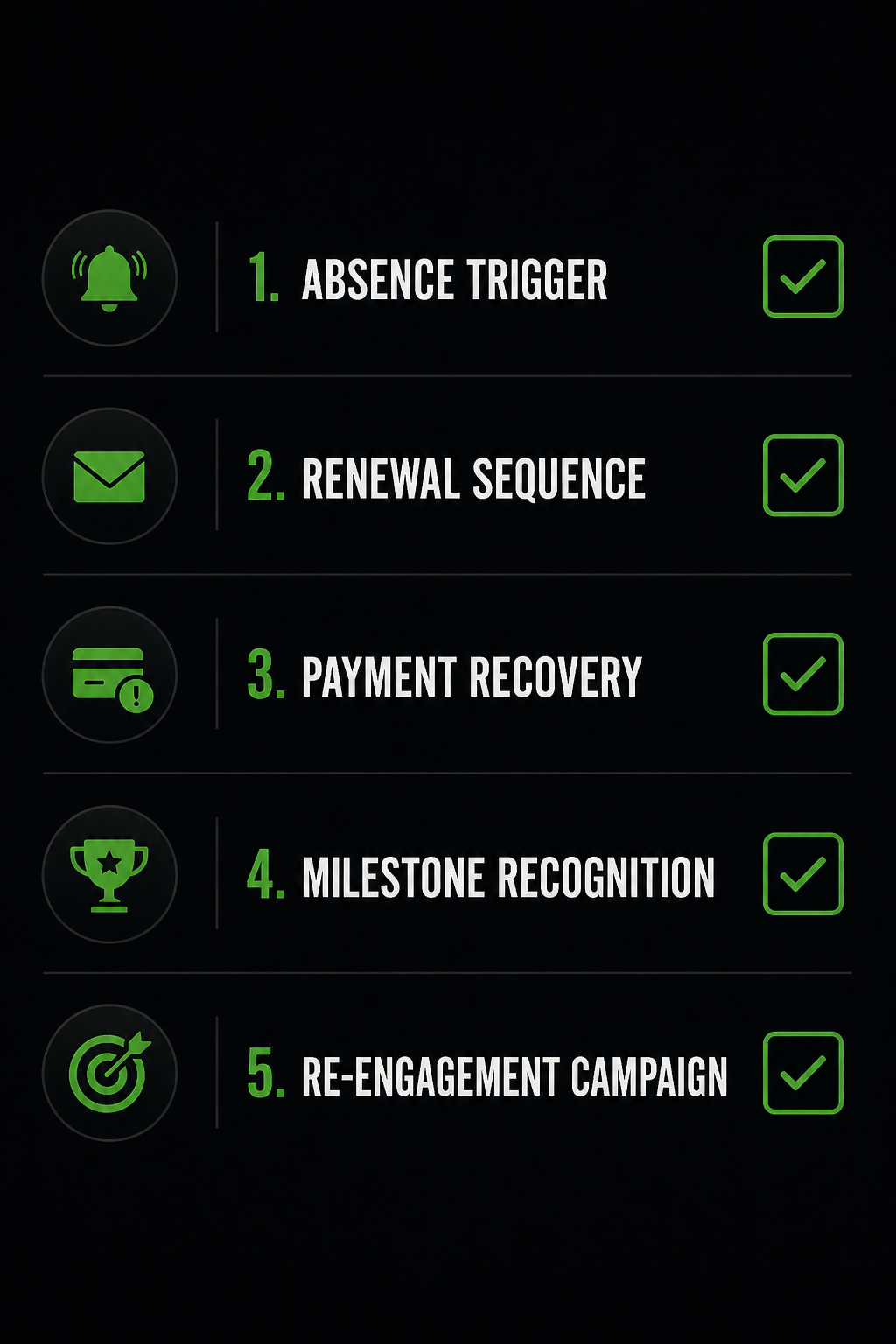
The 5-Part Summer Retention System
Part 1: The Attendance Early Warning System
This is the part everyone skips.
Most owners find out a member is at risk when they cancel, not three weeks before when there was still time to do something about it.
An attendance early warning system flags members before they disappear. The trigger is simple: if a member who normally trains three times a week hasn't been in for 10 days, something is sent to them. Not a mass blast. A personal-feeling check-in.
"Hey [name], haven't seen you on the mat in a bit. Is everything good? If life gets busy or you hit a wall, it's totally normal. Let us know if we can do anything. Your spot's here when you're ready."
That message, sent at day 10, not day 40, saves members that a reactive gym would have lost.
Here's the play: Set a 10-day absence trigger in your system. Every member who hits that threshold gets a check-in. Every member who hits 21 days gets a direct outreach from a coach. Automate the trigger. Keep the message human.
This is not hounding people. It's showing up before it's too late.
Part 2: The Renewal System That Doesn't Depend on You
If you are manually tracking renewals, you are going to miss some. Especially in summer.
This is not a character flaw. It's a capacity problem. You have 80 members, two coaches, three classes a day, and a phone that doesn't stop. Manually monitoring who renews when is not a system, it's a gamble.
A structured renewal system does three things:
- Flags upcoming renewals 30 days in advance. Not the day before. Thirty days. That gives enough time to have a real conversation with the member about continuing, upgrading, or addressing anything that might make them hesitant to renew.
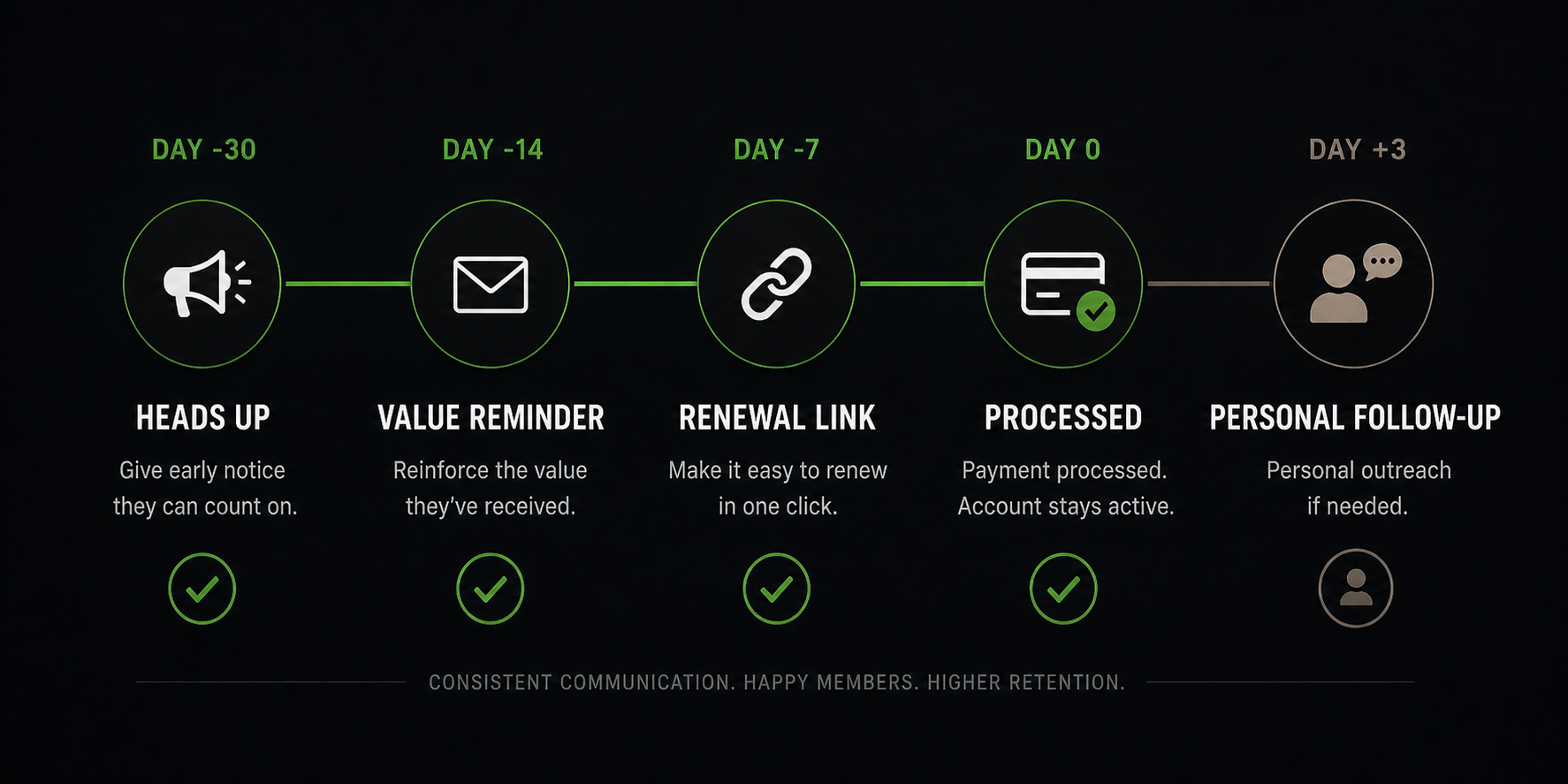
- Sends a renewal communication sequence. Day -30: Heads up, renewal is coming. Day -14: Here's what's included. Here's what's new. Day -7: Reminder with a frictionless "confirm your renewal" link. Day 0: Renewal processes. Day +3 (if not renewed): Direct personal outreach. Not automated. A human.
- Removes the owner from the process. The owner is not sending these messages. The system is. The owner shows up for the conversation, not the logistics.
Steal this sequence: Write those five messages once. Load them into your CRM or communication platform. Set the trigger. Every renewal that comes up in the next 90 days is now handled.
Part 3: Failed Payment Recovery Before It Becomes a Cancellation
A failed payment is not a cancellation. Treat it like one and you'll lose the member.
Billing failures happen. Cards expire. Banks flag auto-charges. Payment methods change after a vacation. Most of the time it has nothing to do with the member's intent to keep training.
But here's what happens in most gyms: the payment fails, nobody notices for a week or two, and by the time the owner reaches out it's awkward — and the member, embarrassed or checked out, uses it as the exit they were halfway considering anyway.
A failed payment recovery system catches it in 24 hours and handles it without drama.
The sequence:
- Hour 1 after failure: Automated text: "Hey [name], looks like your payment didn't go through — probably just a card issue. Here's a quick link to update your info: [link]. No rush, just wanted to flag it."
- Day 2 (if not resolved): Follow-up text, slightly more direct.
- Day 4 (if still unresolved): Personal call or message from staff, not automated.
- Day 7: Final notice before access is flagged.
Frictionless. No shame. No drama. Most members update their card the same day the first message goes out.
Here's the play: The message tone matters. This is not a collection notice. It's a helpful heads-up. Keep the language human, keep the link easy to find, and most billing failures resolve themselves within 48 hours.
Part 4: The Summer Milestone and Recognition System
Retention is emotional before it's logical.
A member who feels seen, recognized, and connected to the gym does not quietly cancel in July. A member who trains for six months and nobody ever acknowledges it — who shows up, puts in the work, and gets nothing but a class schedule is already halfway out the door before summer even starts.
Summer is the highest-risk time for emotional drift. Routines break. Motivation dips. The external reasons to keep showing up — the commute, the schedule, the habit — get disrupted.
The internal reason to stay: this gym knows my name, cares about my progress, and I belong here, has to be stronger than the disruption.
A milestone recognition system keeps that feeling alive without the owner personally managing every touchpoint.
Steal this:
- 30-day milestone: Text from the system, personal-feeling. "[Name], 30 days in. You're already a different athlete. We see it."
- Belt promotion or rank progression: Acknowledged publicly in class and followed up with a direct message.
- 6-month anniversary: A short personal note from the head coach. Not automated. Takes 90 seconds. Stays with the member.
- 1-year anniversary: Recognition in class. Documented. Posted (with permission).
None of this is expensive. All of it is intentional. And the members who receive it renew at significantly higher rates than the ones who don't.

Part 5: The Summer Re-Engagement Campaign for At-Risk Members
Some members are going to go quiet. The question is whether you have a plan when they do.
Every gym has members who drift in summer. They miss two weeks, then three, and then they're officially MIA. Most gyms wait too long and by the time they reach out, the member has mentally moved on.
A re-engagement campaign is a scheduled, structured outreach to members who have gone quiet before they cancel, not after.
The 3-message re-engagement sequence:
Message 1: The check-in (Day 14 of absence): "Hey [name], summer schedules get crazy, totally get it. We've got a few flexible class times this week if you want to come get a session in. Miss having you on the mat."
Message 2: The value reminder (Day 21): "[Name], quick one. We've got [something new or upcoming: a seminar, a new class time, a new program] coming up that I think you'd actually love. Thought of you specifically."
Message 3: The honest close (Day 30): "Hey, I want to make sure your membership is still working for you. If summer has made things tough and you want to talk about options, I'm here. No pressure, just want to make sure we're doing right by you."
That third message is the most important. It opens the door to a real conversation and real conversations save memberships that a form email would lose.
Here's the play: Load these three messages as a triggered sequence in your communication platform. Anyone who hits 14 days of absence enters the flow automatically. A human reviews responses. The system does the reaching out.
The 5-Step Summer Retention Setup
If you only do one thing this month, set up the attendance trigger. But here's the full stack.
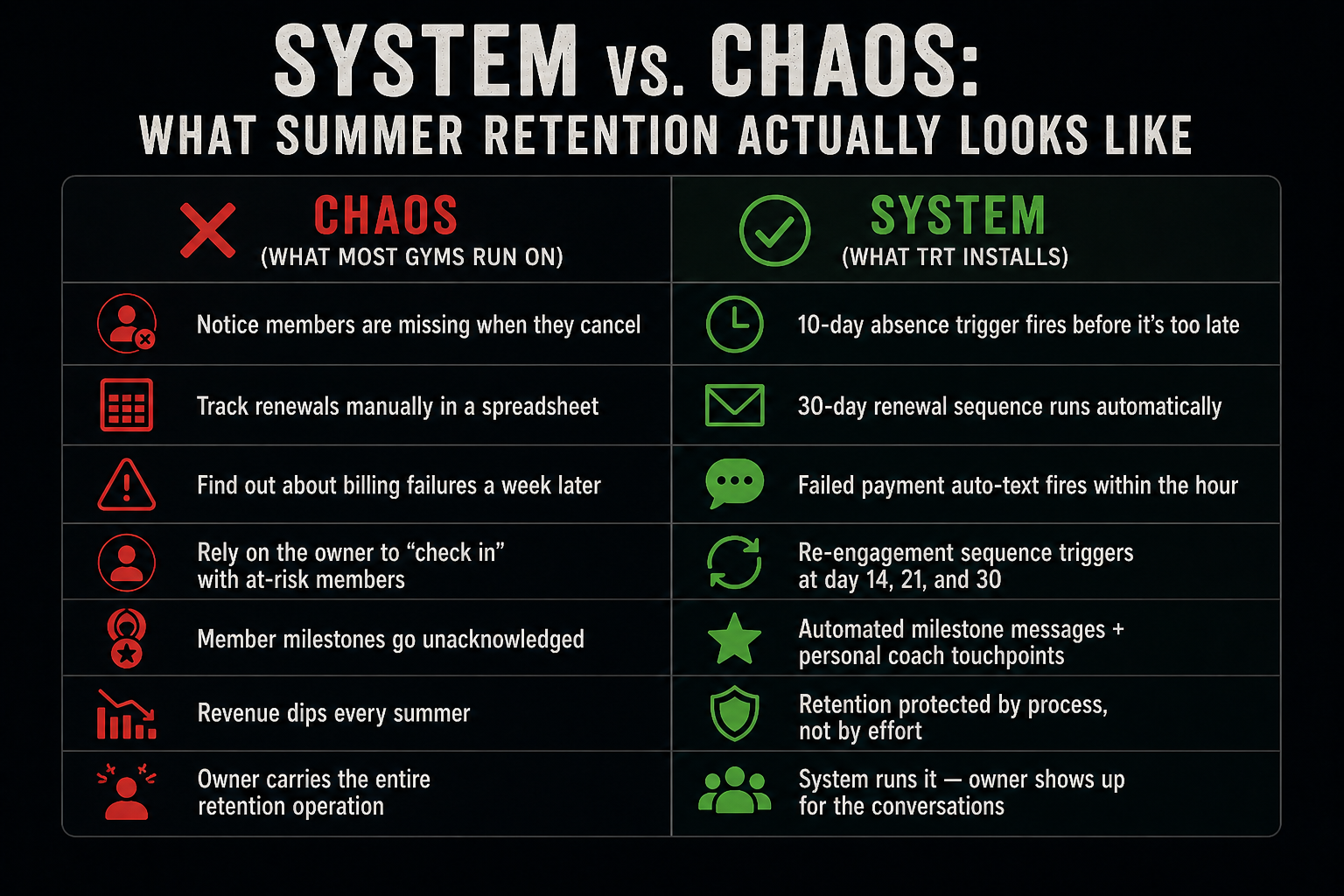
Step 1: Set your absence trigger Pick a threshold. 10 days for regular members, 7 for higher-risk ones. Anyone who hits it gets a check-in message. Set it once. Let it run.
Step 2: Build your renewal sequence Five messages, written once, triggered automatically at -30, -14, -7, day of, and +3 if unresolved. The owner only gets involved at day +3 — for the personal call.
Step 3: Set up failed payment recovery Three messages: hour 1, day 2, day 4. Keep the tone helpful, not threatening. Include a direct link to update payment info every time.
Step 4: Schedule your milestone messages 30-day, 6-month, 1-year. Write the messages. Set the triggers. Add a manual flag for coach-to-member moments (belt promotions, anniversaries) that the system reminds you to do personally.
Step 5: Load the re-engagement sequence Three messages, days 14, 21, 30 of absence. Triggered automatically. Reviewed by a human. Saves memberships that would otherwise quietly cancel.
Run this for one summer. The revenue stabilization alone pays for the setup ten times over.
FAQ: Martial Arts Retention Systems and Summer Member Management
Why do martial arts gyms lose members in summer?
Summer disrupts the routines that keep members training consistently. School schedules change, families travel, work hours shift, and the habit that brought someone to the gym three times a week breaks down. Without a system that catches drift early through absence tracking, re-engagement sequences, and proactive communication. Gyms lose members they could have saved with a single well-timed message. Summer retention failures are almost never about the member's interest. They're about the gym's response time.
What is the most effective way to prevent BJJ gym cancellations?
Early detection. Most cancellations don't happen suddenly. They follow a pattern of increasing absence. A member who trains regularly and then misses 10 days is at risk. A member at 21 days of absence is likely already decided. The most effective cancellation prevention strategy is an automated absence trigger that fires a personal-feeling check-in at day 10, before the member has mentally moved on. Combining this with milestone recognition and proactive renewal communication reduces cancellation rates significantly.
How do I set up a membership renewal system for my martial arts gym?
Start with a 30-day lead time. Identify every member whose renewal falls in the next 30 days and build a communication sequence: a heads-up at day -30, a value reminder at -14, a frictionless renewal link at -7, and a personal follow-up if the renewal hasn't been processed by day +3. The goal is to make renewal feel like a natural continuation, not an invoice. Once the sequence is written, it can be loaded into any gym management or CRM platform and triggered automatically.
How much revenue does poor summer retention actually cost a gym?
It depends on the gym's size and average membership value, but the pattern is consistent. A gym with 80 members, average membership of $150/month, and a summer churn rate of 10–15% is losing $1,200 to $1,800 per month in July and August alone — before factoring in the cost to reacquire those members in September. For most gyms, improving summer retention by even 5% more than covers the cost of any system built to support it.
What should a gym do when a member's payment fails?
Act immediately and keep the tone helpful. The first message should go out within an hour of the failed payment — a short, friendly text that frames the issue as a likely card problem (not a judgment about the member) and includes a direct link to update payment info. Most billing failures are accidental and resolve within 24–48 hours when the outreach is prompt and friction-free. Waiting more than 48 hours to act significantly increases the chance the member uses the billing issue as a reason to cancel.
Should a martial arts gym owner personally manage member retention?
Not the logistics of it. The owner should be involved in meaningful moments — the direct call when a renewal hasn't been processed after day +3, the personal note for a one-year anniversary, the conversation when a long-term member signals they're struggling. But the triggers, sequences, check-ins, and communication flows should all be handled by a system. An owner who is manually tracking attendance, chasing payments, and sending individual renewal reminders is a bottleneck and that bottleneck breaks under the extra pressure of summer.
What is the Tribe Revenue Team (TRT) and how does it help with retention?
TRT is Combat Business Success's done-for-you retention, follow-up, and revenue consistency system. It installs the absence triggers, renewal sequences, billing recovery flows, and re-engagement campaigns described in this playbook and runs them on behalf of the gym. The owner stops being the person who catches everything before it falls through the cracks. TRT becomes that layer. It's built specifically for martial arts gym owners who have solid acquisition but are losing ground on retention because the systems aren't there yet.

Stop Relying on Motivation. Build the System.
You already know what summer without a retention system feels like.
The attendance wobble. The renewals you almost missed. The member you didn't reach out to in time. The billing failure you found out about two weeks late. The quiet cancellation that stung because you liked that member and thought they were solid.
None of that is inevitable. It's what happens when retention depends on you having the bandwidth to catch everything manually.
TRT installs the system that catches it for you.
Absence triggers. Renewal sequences. Payment recovery. Milestone recognition. Re-engagement campaigns. All of it running in the background — so your revenue stops wobbling when the season changes and your attention is pulled in six directions.
This is the part everyone skips. Don't skip it this year.
→ Build Your Retention System with Tribe Revenue Team
Want to see how the lead side connects to retention? Read more on the Combat Business Success blog — same operator-first approach, start to finish.
