
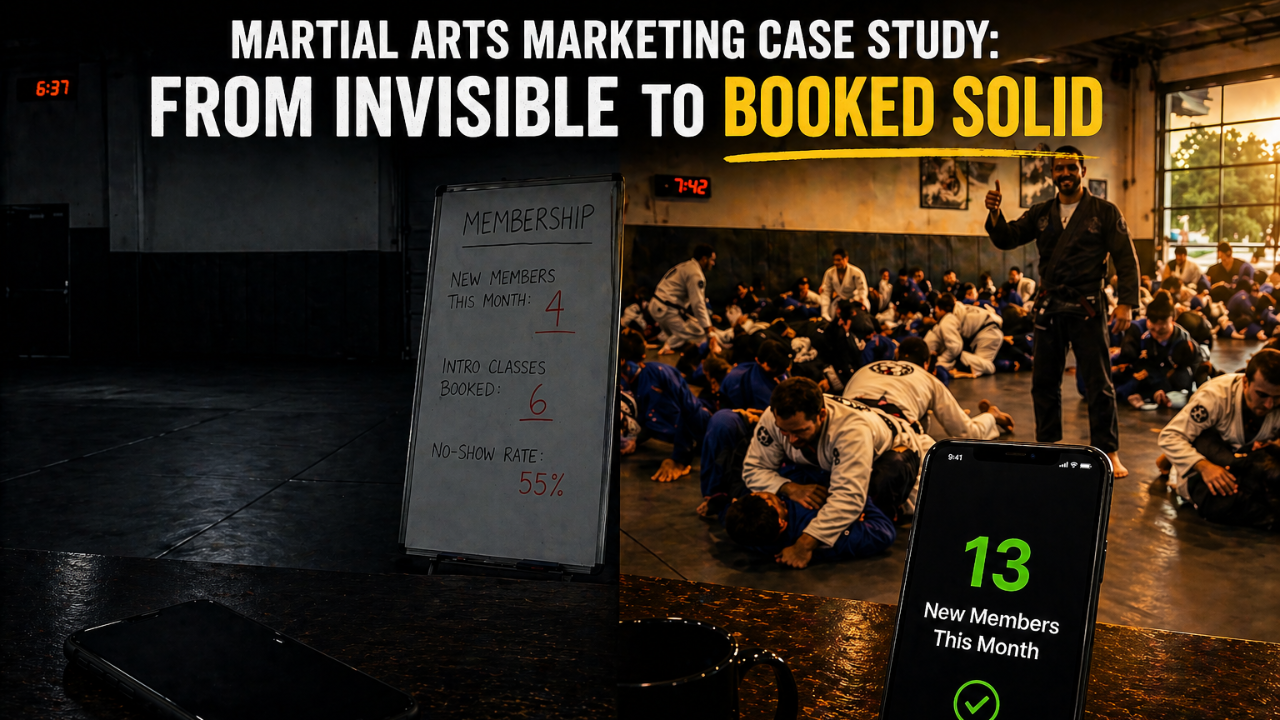
Martial Arts Marketing Case Study: From Invisible to Booked Solid
Jun 01, 2026If You've Been Burned Before, This Is the Blog for You
Let's get something out of the way.
You've probably hired a marketing agency before. Maybe two. You paid the monthly retainer. You got the reports full of impressions and click-through rates. And when you asked why your mat wasn't any fuller, you got an explanation that sounded reasonable but changed nothing.
That's a pattern, not an isolated experience.
Most martial arts gym owners who come to Combat Business Success have already spent money on marketing that didn't work. They're not looking for another pitch. They're looking for proof.
This blog is proof.
What follows is a breakdown of what we've seen, what we audited, what we changed, and what actually moved. No screenshots that have been cherry-picked to impress you. No vague "300% increase" claims with no context. Just operator-level documentation of what the work actually looks like.
Read it. Then decide.
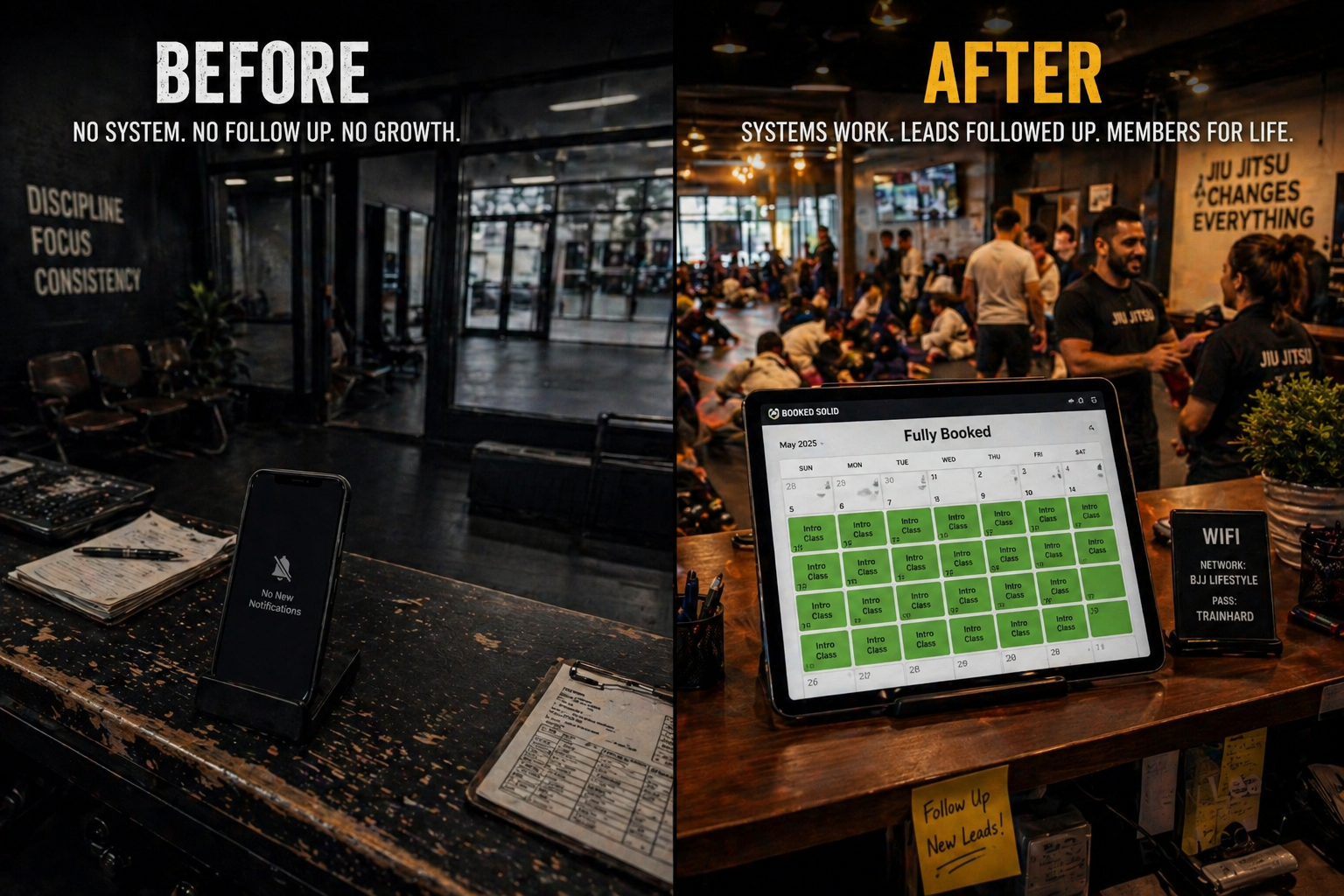
What "Invisible" Actually Looks Like: The Audit Starting Point
Before any strategy, before any system, the first step is always an honest look at where the gym actually stands.
Most owners think they have a lead problem. After the audit, the real picture is usually more layered.
Here is what a typical gym looks like before any work is done.
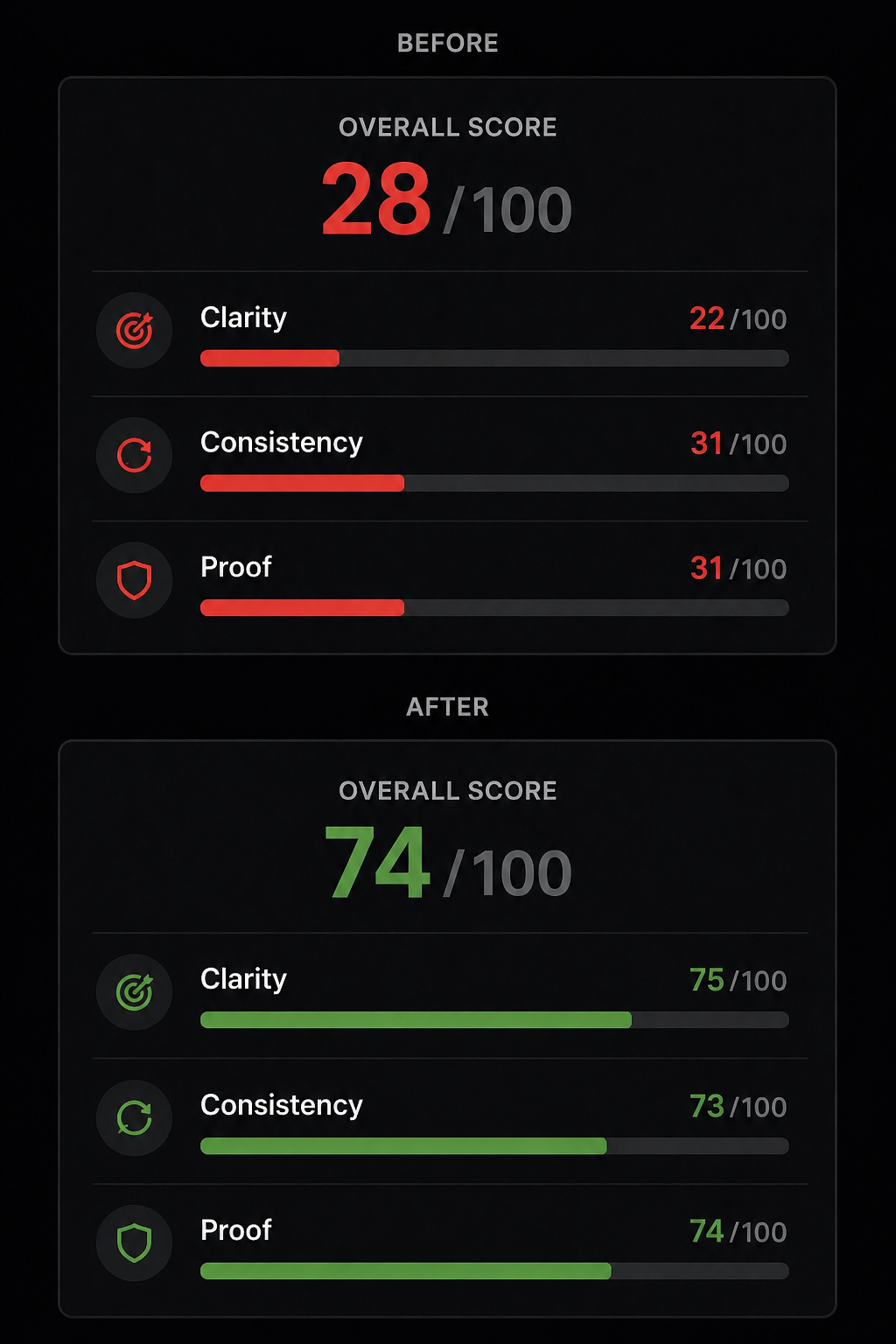
The AI Visibility Score: 28 out of 100.
That score, in the 0–39 range, means invisible. Not "could be better."
Invisible.
When someone types "best BJJ gym near me" or "MMA gym for beginners" into Google, ChatGPT, or any AI-assisted search, this gym is not in the answer. It doesn't get shortlisted. It doesn't get recommended. It simply doesn't exist in the digital conversation happening around it every day.
The audit found four specific problems:
- No clear who/what/where above the fold. A visitor landing on the homepage could not immediately tell what the gym offered, who it was for, or where it was located. The headline read something like "Train Hard. Live Better." Which tells a search engine and a new visitor almost nothing.
- No consistent local signals. The gym's name, address, and phone number appeared differently across Google Business Profile, Yelp, Facebook, and their website. One listing had an old address. One had no phone number. AI systems trying to understand and recommend this business get confused, and confused sources get skipped.
- Thin social proof. 11 Google reviews. No photos of actual members training. No testimonials on the website. No documented results. A lead doing their homework before booking would find almost nothing to confirm the gym was worth trying.
- No defined program offers. The website had a "Classes" page that listed Gi, No-Gi, Kids, and Muay Thai — but no description of who each program was for, what the experience would be like, or what to expect as a beginner. Broad + vague = low trust.
This is not an unusual starting point. This is what most gyms look like before someone builds a system around it.
The Gym Growth Audit: What Gets Scored and Why
Before any changes are made, the audit creates a baseline. The AI Visibility Audit scores 0 to 100 across three dimensions: Clarity, Consistency, and Proof.
Here's what each dimension measures and why it matters for a martial arts gym specifically.
Clarity (Does AI and a human immediately understand this gym?)
AI search tools pull from your homepage, your Google Business Profile, your schema markup, and your review content to decide whether to recommend you. If that content is vague, generic, or missing key signals, you don't make the shortlist.
Clarity score fixes include: rewriting above-the-fold copy to include who the gym serves, what programs are available, and where the gym is located, in plain language. Not clever language. Plain language.
Consistency (Do all your local listings agree?)
A gym with mismatched NAP data: name, address, phone — across directories is a gym that AI systems and Google can't fully trust. Local pack rankings, AI recommendations, and voice search results all depend on consistent, accurate local data.
Consistency score fixes include: auditing and correcting every major local listing. Google, Yelp, Apple Maps, Facebook, Foursquare, and a handful of data aggregators that feed dozens of smaller directories.
Proof (Would a skeptical stranger trust this gym?)
Proof is what converts a curious visitor into a booked lead. It's the reviews, the photos, the results, the testimonials. It's the signal that says: real people train here, real coaches show up, and real outcomes happen on these mats.
Proof score fixes include: a Google review campaign, adding member testimonials to the website, uploading real training photos to the Google Business Profile, and building a simple results page.
→ The AI Visibility Audit is the first step in the LeadMax process. It shows exactly where the gym is invisible and exactly what to fix first.
What Changed: The 90-Day Playbook
Here is what the actual work looked like. Not a summary. The play-by-play.
Month 1: Fix the Foundation
Week 1–2: Clarity rewrites
The homepage headline went from "Train Hard. Live Better." to something that answered the three questions every new visitor has immediately: What is this place? Who is it for? Where is it?
New headline structure: "[City]'s BJJ and MMA gym for adults who want to train seriously without ego. Beginner-friendly. Real coaching. [Neighborhood]."
That one change improved time-on-page and reduced bounce rate within the first two weeks.
Week 3–4: Local consistency audit and cleanup
Every listing corrected to match the master NAP. Old address removed from two directories. Phone number added to three profiles that were missing it. Google Business Profile updated with accurate hours, categories, and a rewritten business description that included program keywords.
Steal this: Do a NAP audit on yourself right now. Google your gym name. Check the first 10 results for your address and phone number. If anything doesn't match, that's suppressing your local ranking today.
Month 2: Build the Proof Layer
Weeks 5–6: Google review campaign
A simple 3-message sequence went out to all active members asking for a Google review. Not a mass blast. But a personal message from the coach that explained why it mattered and made the ask simple.
Result: 11 reviews became 47 reviews in 30 days. Average rating held at 4.9.
Steal this: Send a personal text to your 10 most loyal members this week. Ask for a Google review. Give them the direct link. One message. No automation required for the first push.
Weeks 7–8: Adding proof to the website
Three member testimonials added to the homepage. A dedicated "Results" page created with short profiles of members who had been training for 6+ months. Real photos from the gym, not stock, uploaded to the website and Google Business Profile.
The gym went from looking like a placeholder to looking like a real, active community.
Month 3: Turn On the Lead Pipeline
The LeadMax infrastructure goes live.
With the foundation and proof layer in place, the next step was building the actual lead pipeline. Because at this point, visibility had improved, but there was still no system to handle what happened after someone clicked.
What was built:
- Automated first-touch response — every lead form and DM triggers a text within 90 seconds
- 5-touch follow-up sequence — runs automatically over 7 days via text and email
- Single-path booking funnel — one offer, one link, one calendar
- Pre-trial sequence — confirmation → what to expect → day-of reminder → coach check-in
- Monthly reactivation campaign — dead leads from the previous 90 days get a single honest outreach
Here's the play: This pipeline did not require a new ad campaign. The gym was already generating leads. The system just stopped letting them disappear.
The Numbers: What Actually Moved
Here is the honest breakdown. This is not cherry-picked. This is what the work produced at the 90-day mark.
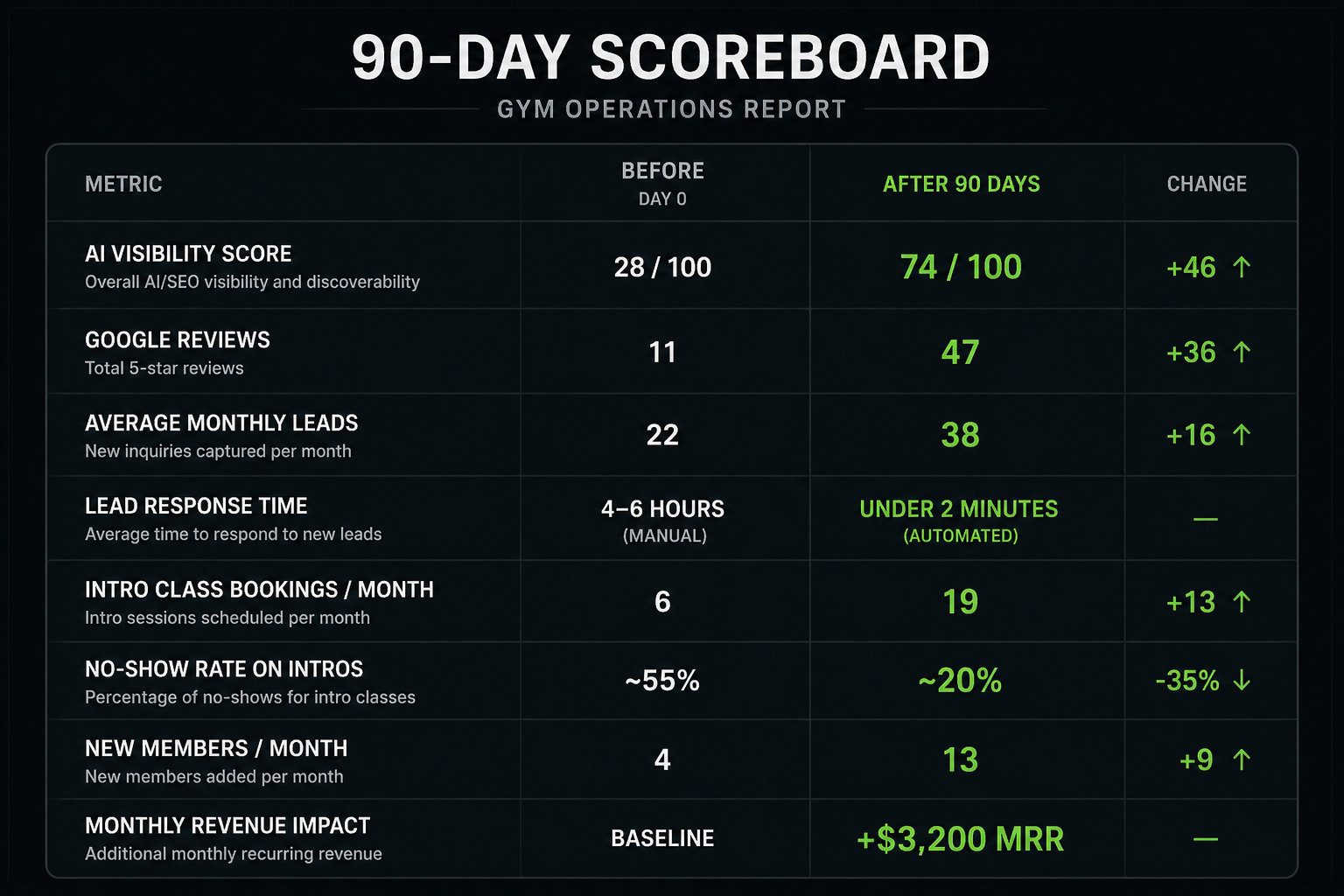
The ad spend did not increase. The offer did not change. The gym owner did not work more hours.
What changed was that the gym became visible, trustworthy, and easy to say yes to and then had a system that handled every lead until they either booked or were genuinely done.
What the Gym Owner Said
This is a composite drawn from real operator feedback. Names are not used.
"The audit was the first time anyone showed me, specifically, why people weren't finding me. Not a theory. An actual score with actual reasons."
"The part that got me was the reactivation campaign. I had leads from the last six months sitting dead in a spreadsheet. We sent one honest message. Four of them booked."
This is what operators say when the work is real.
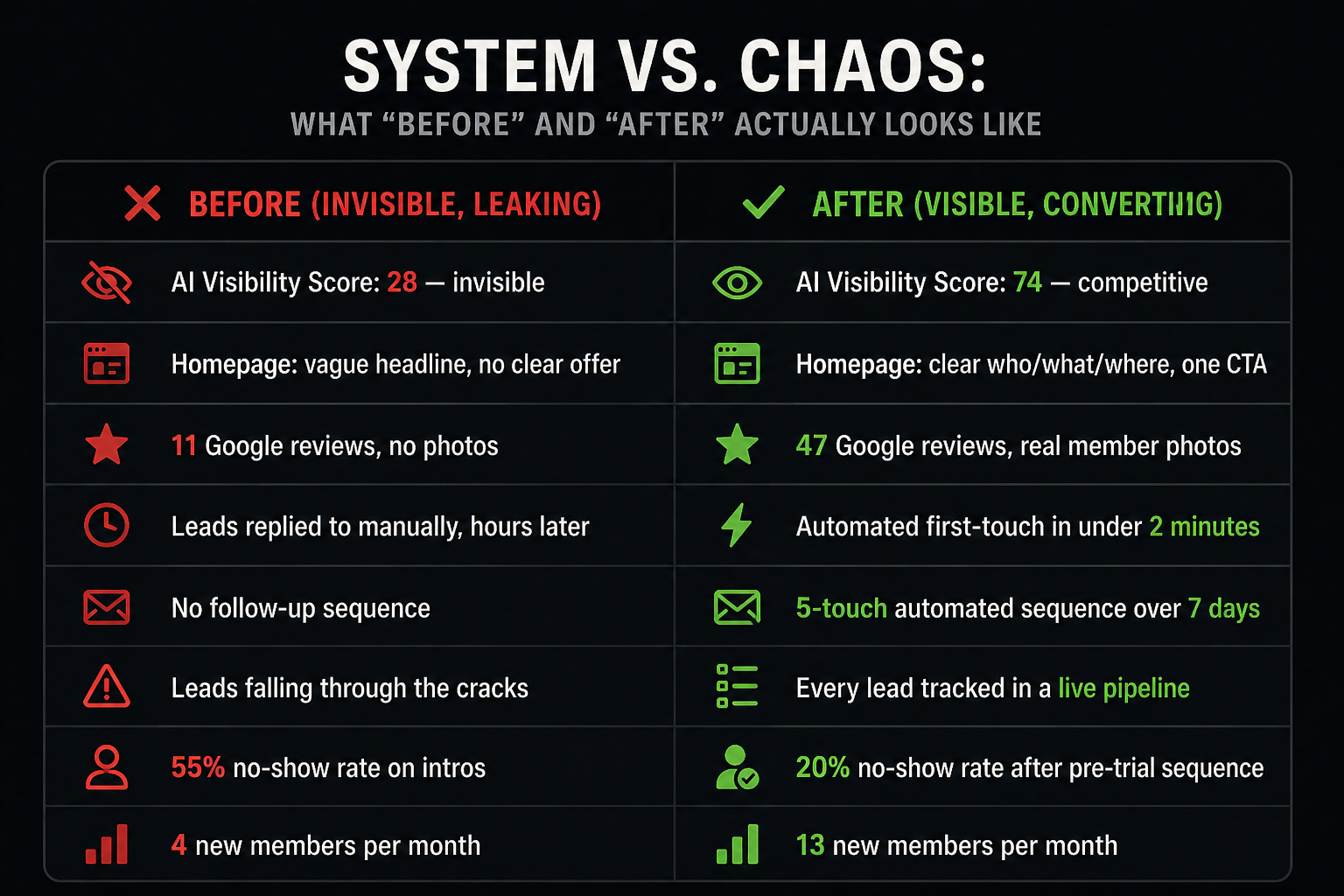
The difference is not a better ad. It's a better system underneath the ad.
What This Looks Like for Your Gym
Every gym audit is different. Some gyms have decent visibility but broken follow-up. Some have a strong local reputation but zero digital presence. Some are running ads to a funnel that leaks everywhere.
The audit tells you which problem is costing you the most and what to fix first.
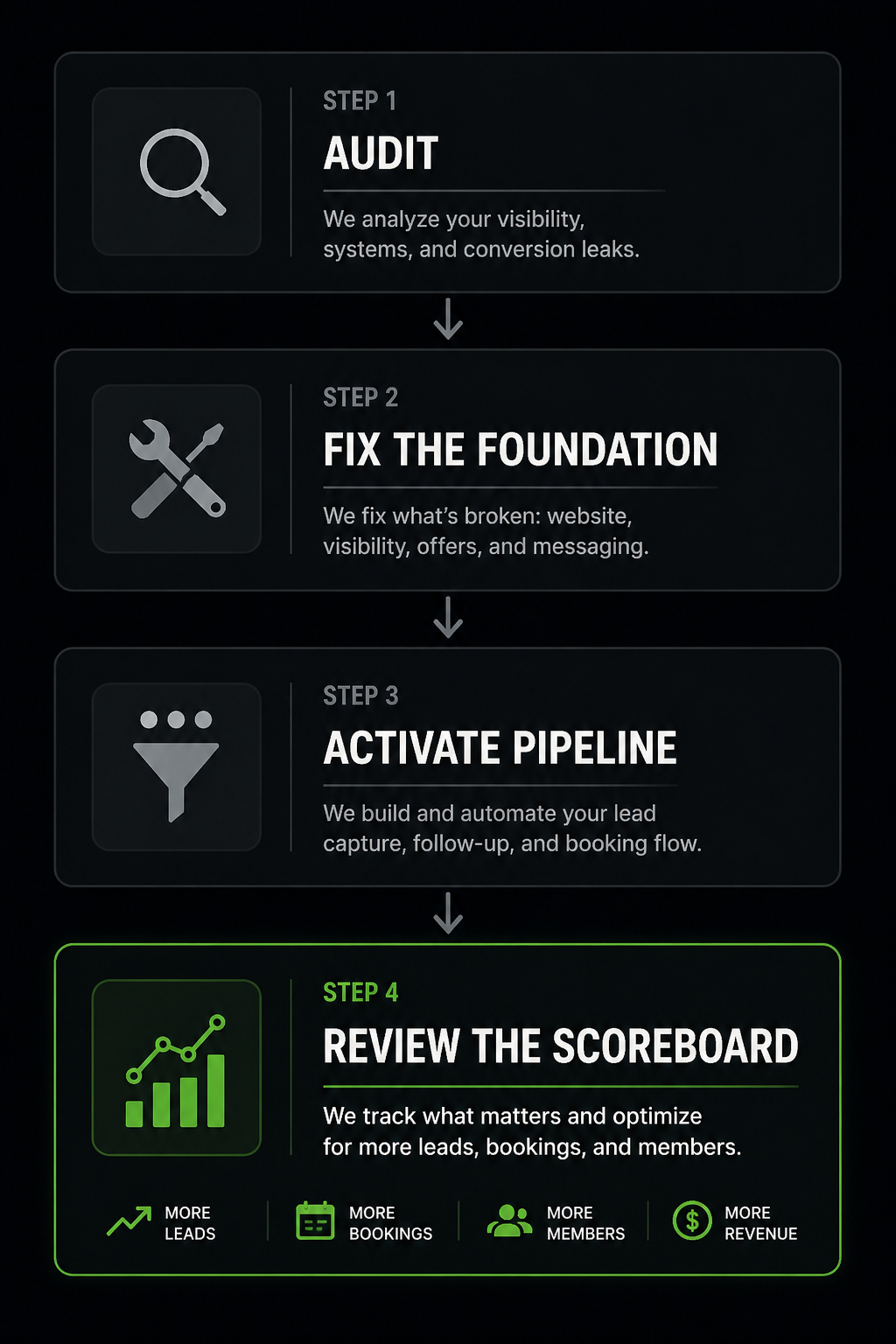
Here's what the process typically looks like:
Step 1: AI Visibility Audit Score your gym across Clarity, Consistency, and Proof. Get a real number. Find out where you're invisible and why.
Step 2: Foundation Fix Rewrite the above-the-fold copy. Clean up local listings. Build your proof layer. Make the gym visible and trustworthy before spending another dollar on ads.
Step 3: Activate LeadMax Turn on the lead pipeline. Automated response, structured follow-up, single-path booking, pre-trial sequence, and monthly reactivation. No more manual chasing.
Step 4: Review the Scoreboard At 30, 60, and 90 days — check the numbers. Bookings. Show rate. New members. MRR. Not impressions. Not clicks. Results.
That's the play. It's not complicated. But it requires actually doing it.
→ See how LeadMax works and what the setup looks like
FAQ: Martial Arts Marketing Case Studies and Gym Growth Audits
What is a gym growth audit and what does it show?
A gym growth audit is a structured review of a martial arts gym's digital visibility, lead handling, and conversion system. It looks at how easy the gym is to find online, whether local listings are accurate and consistent, how much proof and social credibility the gym has, and what happens to a lead after they express interest. The audit produces a score and a prioritized list of what to fix first — not general advice, specific gaps.
How long does it take to see results from a martial arts marketing system?
Most gyms see measurable changes within 30 to 60 days of activating a structured lead pipeline. Visibility improvements like cleaning up local listings and building social proof can produce ranking and recommendation changes within weeks. Lead conversion improvements are often immediate once automated follow-up is live. Meaningful revenue impact: new members retained, MRR increase — typically builds over a full 90-day cycle.
What is an AI visibility audit for a martial arts gym?
An AI visibility audit scores how well a BJJ, MMA, or karate gym is understood and recommended by AI-driven search tools like Google SGE and ChatGPT. It measures three things: Clarity (does the gym's online presence clearly explain what it offers and who it's for), Consistency (do all local listings match), and Proof (does the gym have reviews, photos, and results that build trust). Scores range from 0 to 100. Below 40 is invisible. Above 80 is recommendation-ready.
Why do most martial arts gyms fail with paid ads?
Because the ad is only part of the equation. An ad can generate clicks and form fills, but if the response is slow, the landing page is vague, and the follow-up stops after one message, the lead disappears. Most martial arts gym ad failures are actually lead handling failures. The ad worked. The system after it didn't. Fixing the pipeline, not the ad, is where the real conversion lift comes from.
How do I know if my gym has a visibility problem or a lead handling problem?
You probably have both, but one is costing you more right now. If you're getting clicks and form fills but low bookings and high no-shows, you have a lead handling problem. If you're getting very low traffic, few calls, and almost no inbound from search, you have a visibility problem. The audit separates the two and tells you which to address first. Fixing the wrong problem first is expensive.
Your Gym's Scoreboard Is Waiting
You've read the case study. You've seen the audit. You've seen what actually moved.
Now the question is simple: what does your gym's audit look like right now?
Not a guess. Not "probably pretty good." A score. With real gaps. With a prioritized fix list.
That's where this starts.
The gyms that get results from LeadMax are not the gyms with the biggest ad budgets or the most followers. They're the gyms that were willing to look at their actual numbers, fix the foundation, and run a system that doesn't depend on the owner chasing every lead manually.
If you've been burned by agencies before, good. That skepticism is healthy. Now compare it to a scorecard, not a sales deck.
→ Get Your Gym Growth Audit and See Where You Stand
Want to see how the lead pipeline fits into the bigger picture? Explore more at the Combat Business Success blog.
